Russia’s latest barrage of missile and drone strikes across Ukraine has left at least four dead and dozens injured, with Kyiv bearing the brunt of the assault as President Volodymyr Zelenskyy warns of escalating threats. The attacks, which included the use of hypersonic missiles, have damaged critical infrastructure and underscored the fragility of Ukraine’s defenses as global leaders remain divided on how to respond.
Kyiv Under Fire: The Deadliest Strikes in Recent Weeks
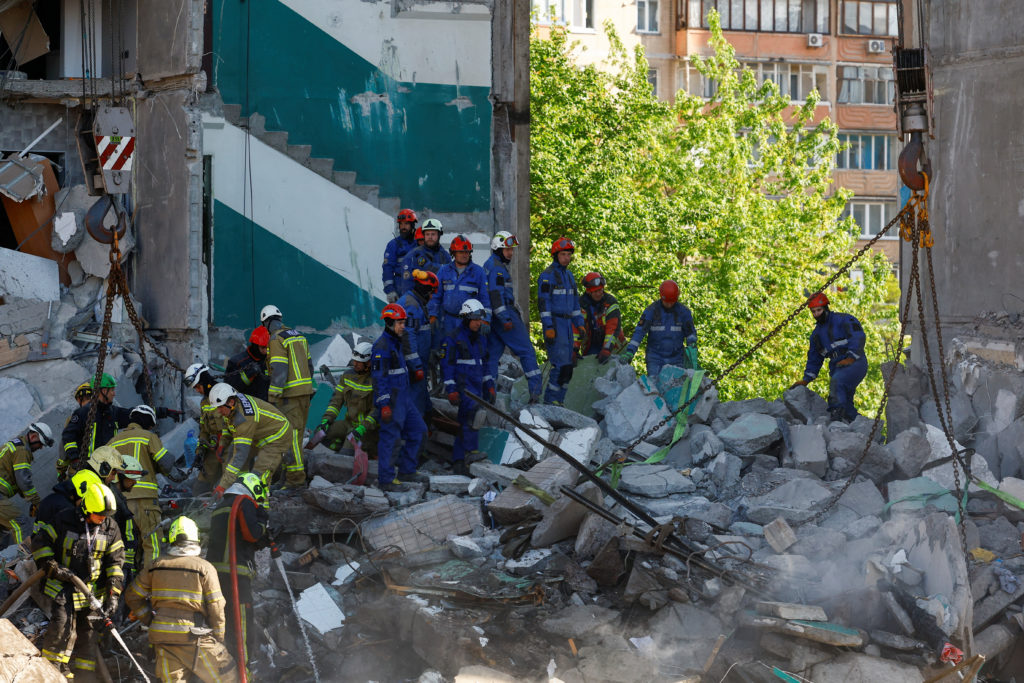
The early hours of Saturday saw Russia unleash a coordinated wave of hundreds of drones and ballistic missiles across Ukraine, with Kyiv as the primary target. According to the Associated Press, seven people were killed in the capital alone, including a 12-year-old girl, and at least 20 remain missing after a nine-story apartment building in the Darnytsia neighborhood collapsed. Ukrainian officials described the scene as one of devastation, with emergency workers rescuing 28 survivors from the rubble. The attack destroyed all 18 apartments in the building and shattered windows in neighboring structures, leaving residents like 78-year-old Lyudmila Hlushko shaken by the sudden onslaught.
The strikes came as Ukrainian President Volodymyr Zelenskyy warned of a possible escalation, noting that Russia had launched more than 1,560 drones against population centers since Wednesday. Zelenskyy confirmed that the assault included the use of hypersonic missiles, a weapon system that has proven difficult for Ukraine’s air defenses to intercept. The attacks damaged at least 180 sites across the country, including more than 50 residential buildings, according to Zelenskyy’s office. The timing of the strikes—coinciding with U.S. President Donald Trump’s visit to China—has raised questions about whether the assault was intended to pressure global leaders into altering their stance on the war.
Foreign Minister Andrii Sybiha condemned the strikes, stating on social media: “At the very time when leaders of the most powerful countries are meeting in Beijing, and the world hopes for peace, predictability and cooperation, Putin launched hundreds of drones, ballistic and cruise missiles at the capital of Ukraine.” Sybiha added that “only pressure on Moscow can make him stop.” The remarks reflect a growing frustration among Ukrainian officials that the international community has yet to impose meaningful consequences on Russia for its relentless assaults.
The Hypersonic Threat: Russia’s New Weapon in the War
The use of hypersonic missiles, specifically the Oreshnik, has become a defining feature of Russia’s latest offensive. According to Yahoo News, Zelenskyy confirmed that the Oreshnik missile was deployed against the city of Bila Tserkva in the Kyiv region, though Ukraine’s presidential office later clarified that the exact nature of the weapon used was still under investigation. The Oreshnik, capable of traveling at more than 10 times the speed of sound, is nearly impossible to intercept with current air defense systems. Its deployment marks the third time Russia has used this weapon in the conflict, raising concerns about its potential to carry both conventional and nuclear warheads.
cluster (priority): pbs.org
European leaders have swiftly condemned the use of the Oreshnik missile, with French President Emmanuel Macron and German Chancellor Friedrich Merz labeling it a “political scare-tactic and reckless nuclear-brinkmanship.” UK Foreign Secretary Yvette Cooper echoed these sentiments, vowing to “keep up pressure on Russia.” The missile’s use has also sparked alarm among military analysts, who warn that it could signal a shift in Russia’s strategy toward more aggressive and unpredictable tactics. The fact that the strikes occurred just days after a brief ceasefire—brokered by Trump—further complicates diplomatic efforts to end the war.
The missile attacks were not limited to Ukraine. Interfax News Agency reported that a missile strike in Russia’s Belgorod region, near the Ukrainian border, disrupted power and water supplies, though there were no casualties. Governor Mikhail Yevrayev confirmed that the Yaroslavl region, northeast of Moscow, also came under drone attack. These strikes suggest that Russia is expanding its targets beyond Ukraine’s borders, potentially in retaliation for what it claims are Ukrainian attacks on Russian civilian infrastructure—a claim Ukraine denies.
Global Condemnation and the Path Forward
The international response to the latest strikes has been swift but divided. While European leaders have condemned the use of hypersonic missiles and called for increased pressure on Russia, the United States remains cautious. Trump, during his visit to China, has suggested that the war may be nearing an end, a claim that contradicts the reality on the ground in Ukraine. Ukrainian officials, however, remain skeptical, with Zelenskyy insisting that the war is far from over and that Russia’s latest attacks are designed to weaken Ukraine’s resolve.
The humanitarian toll of the strikes is staggering. In addition to the deaths and injuries in Kyiv, dozens more were wounded in other regions, including a school, an opera house, and a museum. The attacks have also disrupted energy infrastructure, leaving some areas without power or water. Ukrainian tennis player Marta Kostyuk, competing at the French Open, captured the emotional weight of the moment when she said: “All my heart and all my thoughts go to the people of Ukraine.” Her remarks underscored the personal cost of the war for Ukrainians, both at home and abroad.
The question now is whether the international community will respond with more than words. The EU’s recent $106 billion wartime loan to Ukraine is a critical lifeline, but many analysts argue that more needs to be done to counter Russia’s military advances. The use of hypersonic missiles and the targeting of civilian infrastructure suggest that Russia is willing to escalate, and without a unified global response, the humanitarian and strategic costs will continue to rise.
What Comes Next: Escalation or Negotiation?
As the dust settles from the latest strikes, the focus is shifting to what happens next. Ukrainian officials have made it clear that they will not back down, but the country’s ability to withstand further attacks depends on sustained international support. The use of hypersonic missiles and the targeting of civilian areas raise the stakes, and the risk of further escalation cannot be ignored. Meanwhile, global leaders must decide whether to intensify pressure on Russia or pursue diplomatic channels that have thus far failed to yield results.
One thing is certain: the war in Ukraine is far from over. The latest strikes have demonstrated Russia’s willingness to use increasingly sophisticated and destructive weapons, and Ukraine’s resilience in the face of these attacks is a testament to its determination. However, without a coordinated and robust international response, the human cost will continue to climb, and the path to peace will remain elusive.
For now, the people of Ukraine are left to pick up the pieces, rebuild, and brace for what may come next. The world watches, but the clock is ticking.