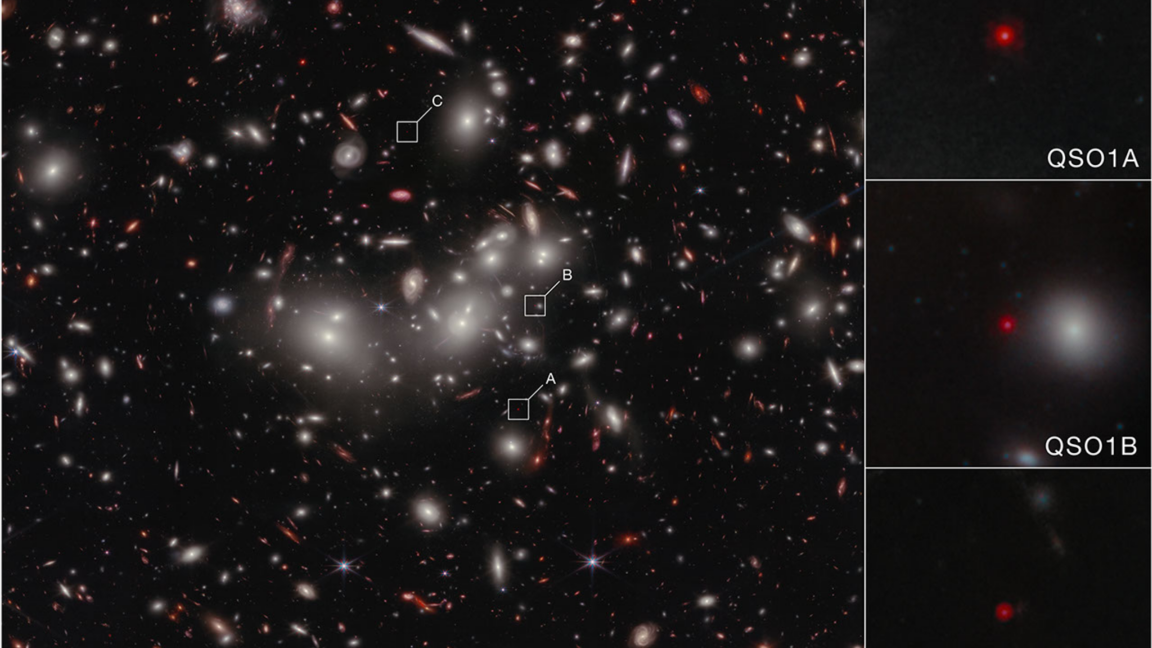
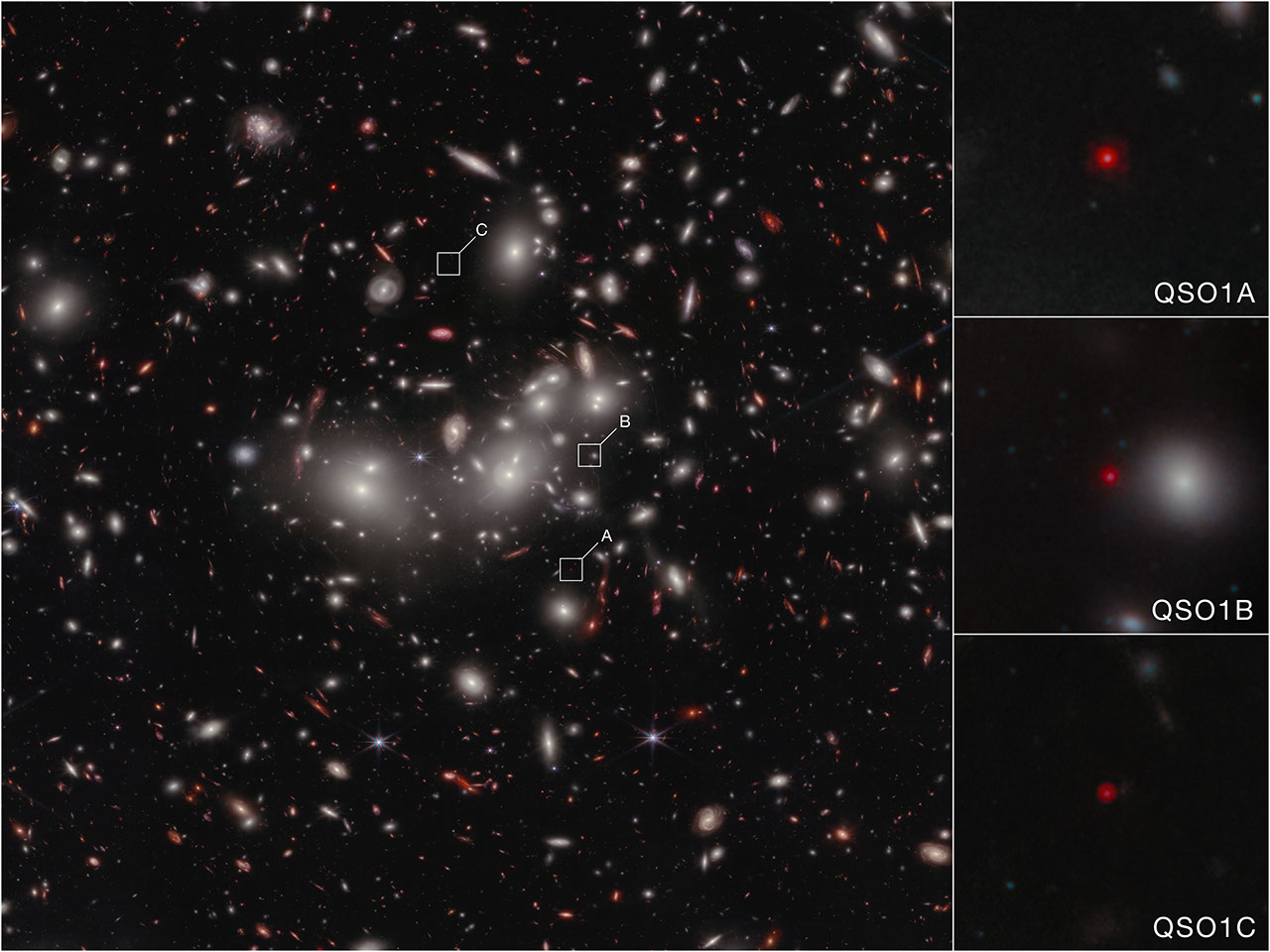
Researchers using the James Webb Space Telescope have identified a supermassive black hole, Abell2744-QSO1, that appears to have formed before its host galaxy. Existing 700 million years after the Big Bang, the black hole’s mass dwarfs the surrounding stars, challenging classical theories of how the universe’s largest objects grow.
The Mass Disparity of Abell2744-QSO1
cluster (priority): European Space Agency
In the standard model of cosmic evolution, galaxies are the cradles. Large stars form, burn through their fuel, and collapse into stellar-mass black holes. These seeds then spend eons accreting gas and merging with other black holes to eventually reach supermassive status. But Abell2744-QSO1, a Little Red Dot (LRD), flips this script.
The object is tiny—only 1,300 light-years across—but it packs a staggering gravitational punch. According to data analyzed by researchers from the Kavli Institute at the University of Cambridge, the black hole possesses roughly 50 million solar masses. The problem isn’t the size of the black hole, but the lack of everything else.
Component
Estimated Mass (Solar Masses)
Supermassive Black Hole
~50 Million
Host Galaxy Stellar Mass (Upper Limit)
~20 Million
As Ars Technica reported, the stars in the vicinity account for less than one-third of the total mass of the system. In most modern galaxies, the ratio is the opposite; supermassive black holes typically make up only 0.1% to 0.5% of their host’s stellar mass. In QSO1, the black hole is the dominant entity.
It is a “naked” black hole.
A Paradigm Shift in Cosmic Evolution
This discovery isn’t just a statistical outlier; it is a theoretical crisis. If a black hole can reach 50 million solar masses while its host galaxy is still a skeletal collection of stars, the “galaxy first” timeline is no longer the only option.
“This is a remarkable finding. It’s a paradigm shift, a total revisiting of the classical scenarios of how black holes form and grow.”
cluster (priority): NASA Science (.gov)
Roberto Maiolino, Kavli Institute
The evidence comes from the extreme precision of the James Webb Space Telescope (JWST). Because QSO1 is gravitationally lensed by Pandora’s Cluster (Abell 2744), its light is magnified and triply imaged. This natural cosmic magnifying glass allowed the team to use the NIRSpec instrument to trace the actual motion of gas swirling around the black hole.
For years, mass measurements of early-universe black holes were indirect, based on assumptions derived from the local universe. This new approach provides a direct measurement of the gravity’s effect on orbiting gas, removing the guesswork and confirming that the mass discrepancy is real.
Primordial Seeds vs. Direct Collapse
James Webb Just Revealed the Harsh Reality of the Early Universe
With the “stellar collapse” theory sidelined for QSO1, astrophysicists are debating two theoretical alternatives to explain how something this massive appeared so quickly after the Big Bang.
The first is the Direct Collapse Black Hole (DCBH) model. In this scenario, massive clouds of gas collapse directly into a black hole, skipping the star-formation phase entirely. Research published in The Astrophysical Journal Letters, as detailed by Universe Today, suggests that “overmassive black hole galaxies” (OBGs) are the natural result of DCBH birth in primordial dark matter halos.
Muhammad Latif, Physics Department, UAE University
However, DCBH models often require high levels of ultraviolet radiation and more surrounding mass than what is observed in QSO1. This pushes some researchers toward a more radical theory: primordial black holes. These would have formed in the immediate, chaotic aftermath of the Big Bang, potentially within the first second.
If QSO1 is primordial, it may have grown by a factor of 10 over the 700 million years of its existence, likely through early mergers. Because the researchers found so few stars surrounding the black hole, the theory of “runaway mergers” within dense stellar clusters is effectively ruled out—you cannot have a cluster of merging black holes if there are no stars to form the cluster.
The Search for More Naked Black Holes
cluster (priority): Ars Technica
The implications of QSO1 extend across the observable horizon. The light from this object has traveled for more than 13 billion years, providing a window into a period of the universe where the rules of growth were fundamentally different.
The core tension now lies in whether QSO1 is a freak occurrence or a prototype. If more “naked” supermassive black holes are found, it confirms that the seeds of the largest structures in our universe were sown long before the first galaxies ever coalesced.
The current data suggests a universe that is far more “top-heavy” than previously imagined, where the monsters were born before the cities they inhabit. The next 30 days of analysis from the JWST will likely focus on whether other “Little Red Dots” share this same inverted mass ratio, potentially rewriting the opening chapters of cosmic history.