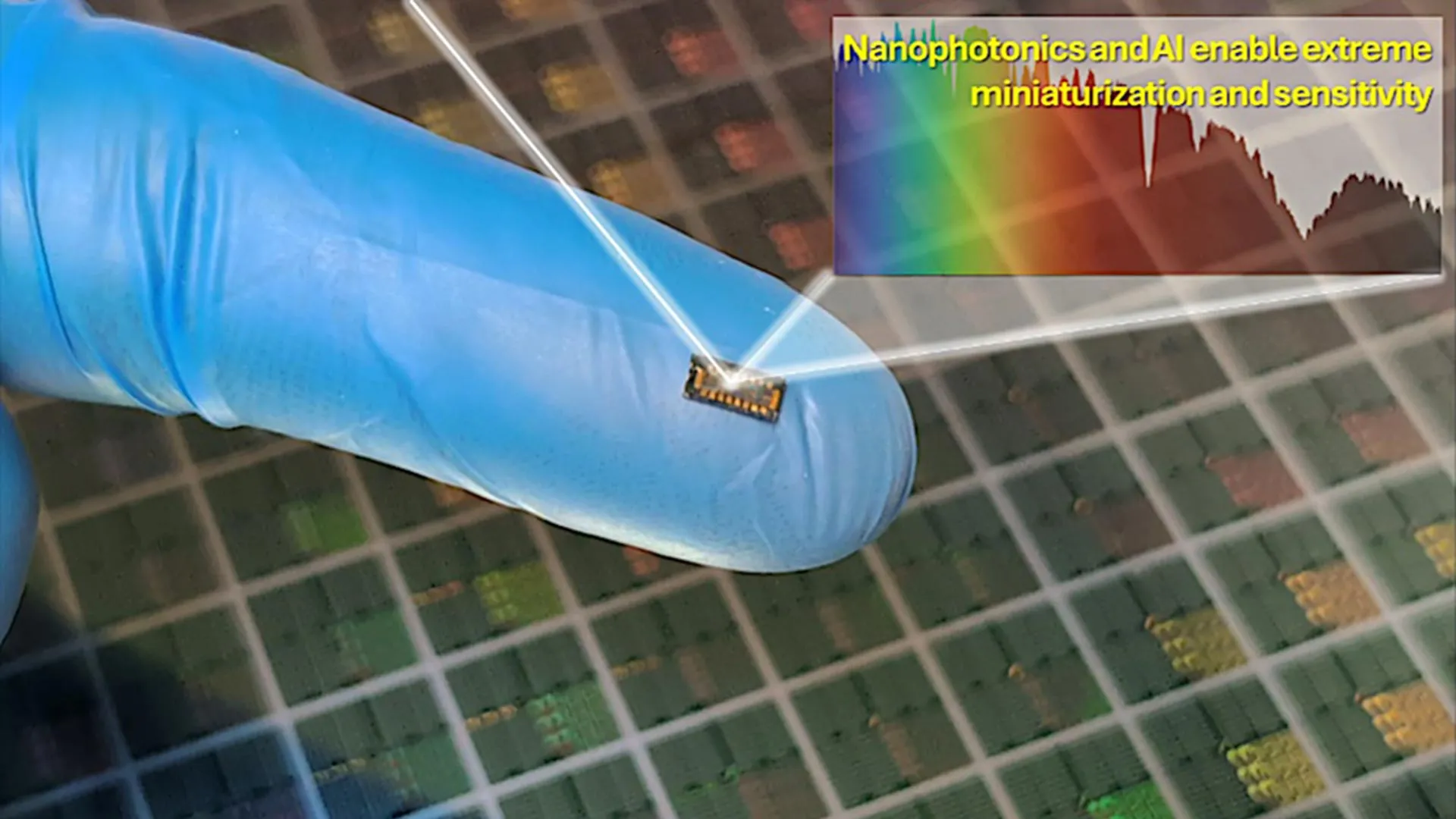
Researchers at the University of California Davis have developed a spectrometer-on-a-chip that shrinks laboratory-grade chemical analysis technology to the size of a grain of sand. Published in *Advanced Photonics*, the system replaces bulky optical hardware with artificial intelligence and a sensor array to reconstruct light spectra with 8 nm resolution.
Replacing Bulky Optics With AI
cluster (priority): aice.illinois.edu
Analyzing the chemical composition of materials typically requires spectrometers—large, expensive instruments that split light into component colors using prisms or gratings to measure wavelength intensity. Because this physical separation of light requires distance, these devices have remained bulky and resistant to miniaturization.
The UC Davis system abandons the rainbow-spreading method entirely. Instead, it utilizes a small array of 16 unique silicon detectors. Each detector is engineered to react differently to incoming light, capturing encoded signals that hide the spectral information.
The process functions like a group of specialized tasters sampling a complex mixture. No single detector captures the full picture; instead, they collect fragmented data that is later assembled.
Solving the “inverse problem” computationally
cluster (priority): ucf.edu
The hardware is only half the solution. Because the signals from the 16 detectors are noisy and highly encoded, the system requires a fully connected neural network trained on thousands of examples to make sense of the data.
“inverse problem,”
By solving this specific computational challenge, the AI learns the complex relationship between the encoded detector signals and the actual spectrum of light. This allows the chip to reproduce spectral data with an accuracy of roughly 8 nm resolution without needing the physical space required by traditional optical hardware.
This shift from physical optics to computational reconstruction represents a fundamental change in how we approach sensing. We are no longer relying on the laws of refraction to sort light; we are using AI to infer the original state of the light from a set of distorted signals.
Expanding silicon into the near-infrared range
Spectrophotometer Testing Process Explained #tech #spectrometer #lab #machine
Standard silicon photodiodes are effective for visible light but generally struggle to capture near-infrared (NIR) light, specifically wavelengths up to 1100 nm. This is a critical limitation for biomedical imaging, where NIR light is prized for its ability to penetrate deeper into human tissue than visible light.
To overcome this, the researchers modified the silicon surfaces with photon-trapping surface textures (PTSTs). These textures change the behavior of light within the chip. Rather than allowing NIR photons to pass through the thin silicon layer, the PTSTs scatter the light repeatedly, which significantly increases the probability of absorption.
The result is a sensor that is sensitive across a much wider spectral range than standard silicon, enabling a grain-of-sand-sized device to perform tasks previously reserved for laboratory benches.
The shift toward specialized AI instrumentation
cluster (priority): sciencenewstoday.org
The UC Davis chip arrives during a period of massive expansion in the AI sector. While much of the public focus remains on conversational systems, the market for artificial intelligence is seeing a diversification of application. Current projections suggest the AI market, valued at nearly 100 billion U.S. dollars, could grow twentyfold to nearly two trillion U.S. dollars by 2030.
This growth is moving beyond the “chatbots” and general-purpose assistants. For instance, the Amazon-Illinois Center on AI for Interactive Conversational Experiences is working to move conversational AI toward deeper contextual understanding and emotional intelligence. However, the UC Davis spectrometer demonstrates a different trajectory: the use of AI to solve hard physical problems in material science and medicine.
This evolution traces back to the formal birth of the field at a conference held in 1956 at Dartmouth College. The early dream was to simulate human reasoning; the current reality is using that simulation to replace physical hardware.
The implications for the next few years are clear: the “lab-on-a-chip” is becoming a reality. By moving spectrometers from the lab to a silicon chip, the barriers to real-time pollution monitoring, instant food inspection, and non-invasive disease diagnosis are effectively collapsing.
The following table summarizes the technical shift enabled by this AI-powered approach:
Feature
Traditional Spectrometers
AI-Powered Chip
Core Mechanism
Prisms/Gratings (Physical splitting)
16 Silicon Detectors + Neural Network
Physical Size
Bulky laboratory instruments
Size of a grain of sand
NIR Sensitivity
Limited in standard silicon
Enhanced via PTST textures (up to 1100 nm)
Resolution
Variable by instrument
Roughly 8 nm
As AI continues to integrate with hardware, the goal is no longer just to build a machine that can “think” or “chat,” but to build machines that can perceive the physical world with a precision and portability that was previously physically impossible.