
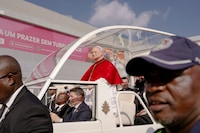
Pope Leo XIV drew a crowd of 100,000 in Angola’s Kilamba district on Sunday, urging the nation to confront corruption through justice whereas standing on soil shaped by centuries of exploitation.
The first American-born pope arrived to a welcome of dancing crowds in Luanda’s airport parking lot, where Josephine García and friends waited for hours under a sweltering sun, calling him their “father in faith” and a symbol of peace and unity.
Yet his message carried a weight few in the crowd could ignore: Angola’s mineral wealth has long enriched foreign powers, its people scarred by a brutal civil war, and its land still bears the imprint of a slave trade in which the Catholic Church played an active role.
Speaking in Kilamba, a Chinese-built satellite city 25 kilometers outside Luanda, Leo denounced the “scourge of corruption” and called for a culture of justice and sharing to heal old divisions, end hatred and violence, and overcome the legacy of conflict that has plagued the nation since independence.
Later, he traveled 110 kilometers south to the Sanctuary of Mama Muxima on the Kwanza River, a site where enslaved Africans were once baptized by Portuguese priests before being marched to Luanda’s port and shipped to the Americas.
The shrine, now Angola’s most popular Catholic pilgrimage site, was built by Portuguese colonizers at the end of the 16th century as part of a fortress complex — a stark reminder that the Church’s presence in Africa began not with mercy, but with machinery of bondage.
Historians note that 15th-century papal bulls authorized Portuguese colonizers to enslave non-Christians, providing theological cover for the very trade that later defined the shrine’s grim purpose.
For Black Catholics, the pope’s visit to Muxima holds particular resonance. His Creole ancestry includes both enslaved people and slave owners, a lineage traced through genealogical research that connects his roots to Louisiana and the broader Atlantic world shaped by slavery.
Anthea Butler, a Black Catholic scholar and senior fellow at the Koch Center at Oxford University, said the visit represents a moment of healing for many who came to Catholicism through slavery and the Code Noir, which mandated baptism for enslaved people owned by Catholics.
Others, she noted, were already Catholic when trafficked from Angola to slave-holding colonies — a detail that underscores the deep, entangled history of faith and forced migration.
Leo likewise praised the cease-fire between Israel and Hezbollah in Lebanon as a “sign of hope,” expressing his prayer that it might lead to permanent peace in the Middle East — a brief pivot from Angola’s struggles to a global plea for reconciliation.
His words on corruption landed in a country where public frustration with graft runs deep, yet where reverence for the papal office remains strong — a duality captured in the contrast between adoration for the pope and skepticism toward American political leadership, as noted in separate reporting on the visit.
The scene — crowds dancing in the heat, a pope speaking of justice while standing on ground built by slave labor — encapsulates the contradiction at the heart of his African journey: a message of renewal delivered amid enduring scars.
How the pope’s personal history intersects with Angola’s traumatic past
Leo XIV’s Creole heritage — including ancestors who were both enslaved and enslavers — adds a layer of personal significance to his visit to Muxima, a site where the Catholic Church’s role in the slave trade is etched into stone and memory.
What Angolans heard when the pope spoke of justice and sharing
His call to combat corruption with a culture of justice resonated in a nation still recovering from civil war and grappling with the uneven distribution of wealth from its oil and diamond resources.
Why the Muxima shrine remains a focal point for reflection and pilgrimage
Despite its origins in colonial violence and the slave trade, the Church of Our Lady of Muxima has become Angola’s most venerated Catholic shrine, drawing pilgrims who reconcile its painful history with its present spiritual significance.
What did Pope Leo XIV say about corruption in Angola?
He denounced corruption as a “scourge” and urged Angolans to heal it through a new culture of justice and sharing, speaking in Kilamba during Mass before an estimated 100,000 people.
How is the pope’s visit connected to the history of the slave trade?
He visited the Sanctuary of Mama Muxima, where enslaved Africans were baptized by Portuguese priests before being forced to walk to Luanda’s port and shipped to the Americas — a site the pope acknowledged as emblematic of the Church’s role in slavery.
