
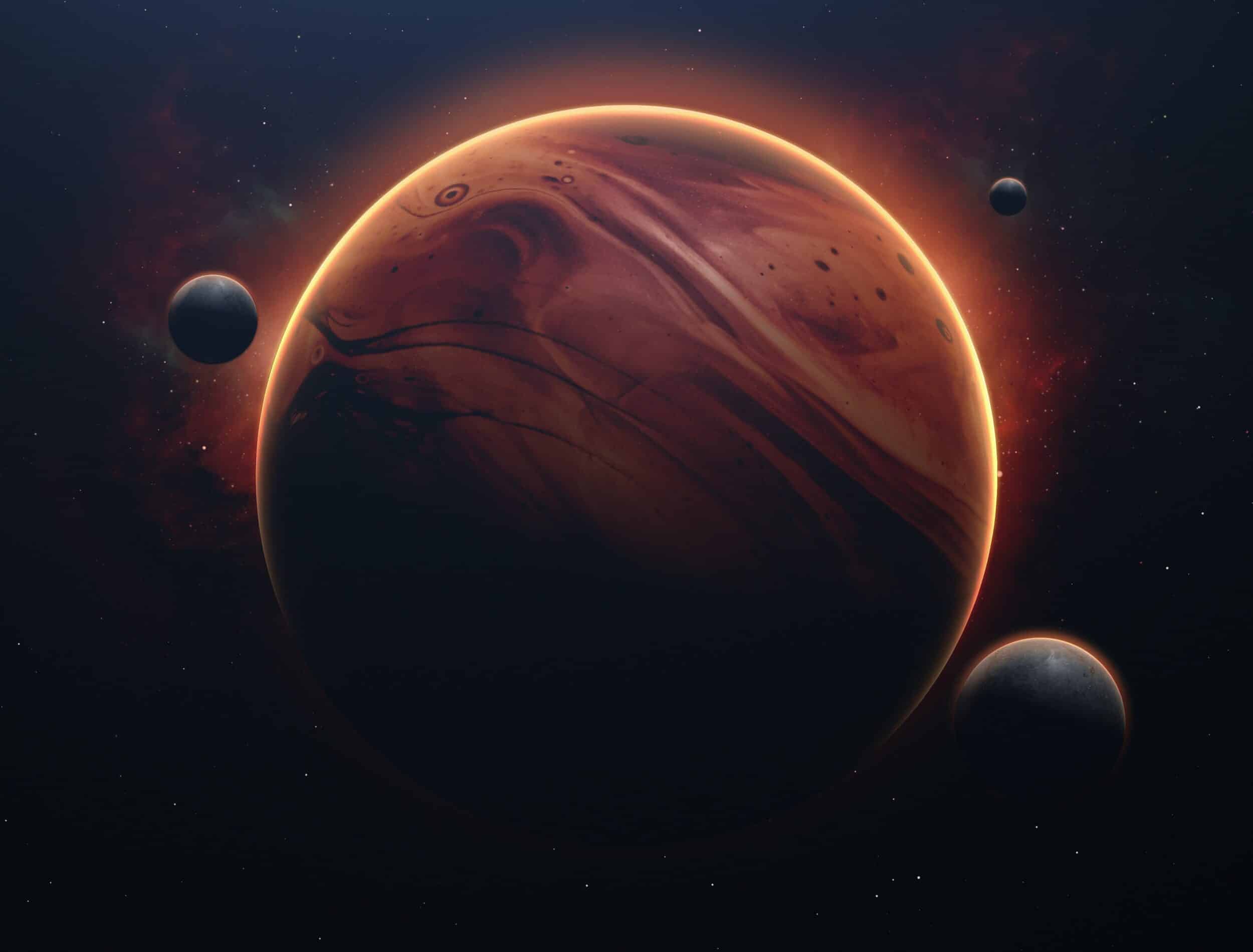
The discovery forces a reckoning with the current understanding of cosmic architecture. In the standard model of the universe, the size of a star usually dictates the potential size of its orbiting planets. Small stars are expected to have small planets. LHS 3154b ignores this rule entirely.
The Mass Discrepancy of LHS 3154b
The core of the problem is a stark mathematical imbalance. According to Pennsylvania State University researchers, the planet LHS 3154b possesses a mass more than 13 times that of Earth. This is a staggering figure when contrasted with its host, an ultra-cool star that is nine times less massive than our own Sun.
The math simply does not add up under current assumptions.
In a typical stellar system, the protoplanetary disk—the swirling ring of gas and dust from which planets emerge—is proportional to the mass of the parent star. A star as small as LHS 3154 should, theoretically, have a disk too meager to provide the raw materials required to construct a planet of this magnitude. To build a world 13 times the mass of Earth, the system would have needed a quantity of solid matter far exceeding what current models predict for ultra-cool stars.
Detection via the Habitable Zone Planet Finder

Identifying a planet around such a dim, cool star requires extreme precision. The team utilized a specialized astronomical spectrograph known as the Habitable Zone Planet Finder (HPF) to pinpoint the presence of LHS 3154b.
The HPF is designed specifically to hunt for planets orbiting M-dwarfs and other cool stars, where the signals of a planet’s gravitational tug are often subtle and easily lost in the noise of the star’s own activity. By capturing the precise shifts in the star’s light, researchers were able to confirm the mass of LHS 3154b, effectively proving that this “impossible” world exists despite the theoretical objections.
The Failure of Standard Accretion Models

To understand why this discovery is disruptive, one must look at how science believes planets are born. The process begins in nebulae—vast clouds of hydrogen, helium, and trace elements. When these clouds contract due to gravitational forces, often triggered by supernova shockwaves or interactions with other gas clouds, they form a hot, dense proto-star.
As the proto-star grows, a disk of gas and dust forms around it. The sequence follows a specific hierarchy:
For LHS 3154b, this chain of events hits a wall at the second and third steps. Current theories on planet formation suggest that the disk around an ultra-cool star simply wouldn’t contain enough solid matter to sustain the growth of a planetary embryo large enough to reach 13 Earth masses.
Rethinking Planetary Architecture

The existence of LHS 3154b suggests that the “rules” of planetary birth are more flexible than previously thought. If a tiny star can host a massive planet, it implies that either the initial disks around ultra-cool stars are far denser than we assumed, or the process of accretion is significantly more efficient in these environments.
This discovery shifts the focus of exoplanetary research. Astronomers must now consider whether other ultra-cool stars—the most common type of star in our galaxy—are hiding similar anomalies. If LHS 3154b is not a one-off fluke, the scientific community may need to rewrite the blueprints for how matter organizes itself in the wake of stellar birth.
The next phase of analysis will likely involve searching for companion planets in the LHS 3154 system. Finding additional worlds would help determine if the system had an unusually rich supply of raw materials or if a different, unknown mechanism drove the growth of this massive planet. For now, LHS 3154b remains a stubborn piece of evidence that the universe is far more creative—and less predictable—than our current models allow.
