
Researchers identified a terrestrial-mass planet, Ross 318 b, orbiting an M-dwarf star on May 11, 2026. The planet is a temperate Super-Earth located within the Conservative Habitable Zone, featuring a minimum mass of (6.21 ± 0.62)M⊕ and an orbital period of (39.6299 ± 0.29) days.
The discovery of Ross 318 b represents a precise exercise in signal extraction from a magnetically active stellar environment. According to a paper submitted May 11, 2026, by G. Conzo, M. Moriconi, and S.A. Corrêa Jr., the planet orbits Ross 318, an M3.5V red dwarf. This host star is characterized by significant magnetic activity and a stellar rotation period of approximately 51.5 days, factors that typically complicate the detection of small, terrestrial-mass planets.
Radial Velocity and Temporal Coherence
The detection of Ross 318 b relied on a systematic re-analysis of radial velocity (RV) data. The research team integrated observations from CARMENES and a decade-long dataset from HIRES. This combination provided a 15-year baseline, which allowed the researchers to confirm the dynamical nature of the planetary signal through its temporal coherence.
A critical component of the verification process was the signal’s achromaticity. By comparing visible and near-infrared channels, the researchers ensured the signal remained consistent across different wavelengths. In the study of M-dwarfs, achromaticity is a vital metric; stellar activity, such as starspots or plagues, often creates false positives in RV data that vary by wavelength. Because the signal for Ross 318 b did not change between channels, the team could distinguish the planet’s gravitational pull from the star’s own magnetic noise.
TESS Photometry and Transit Constraints
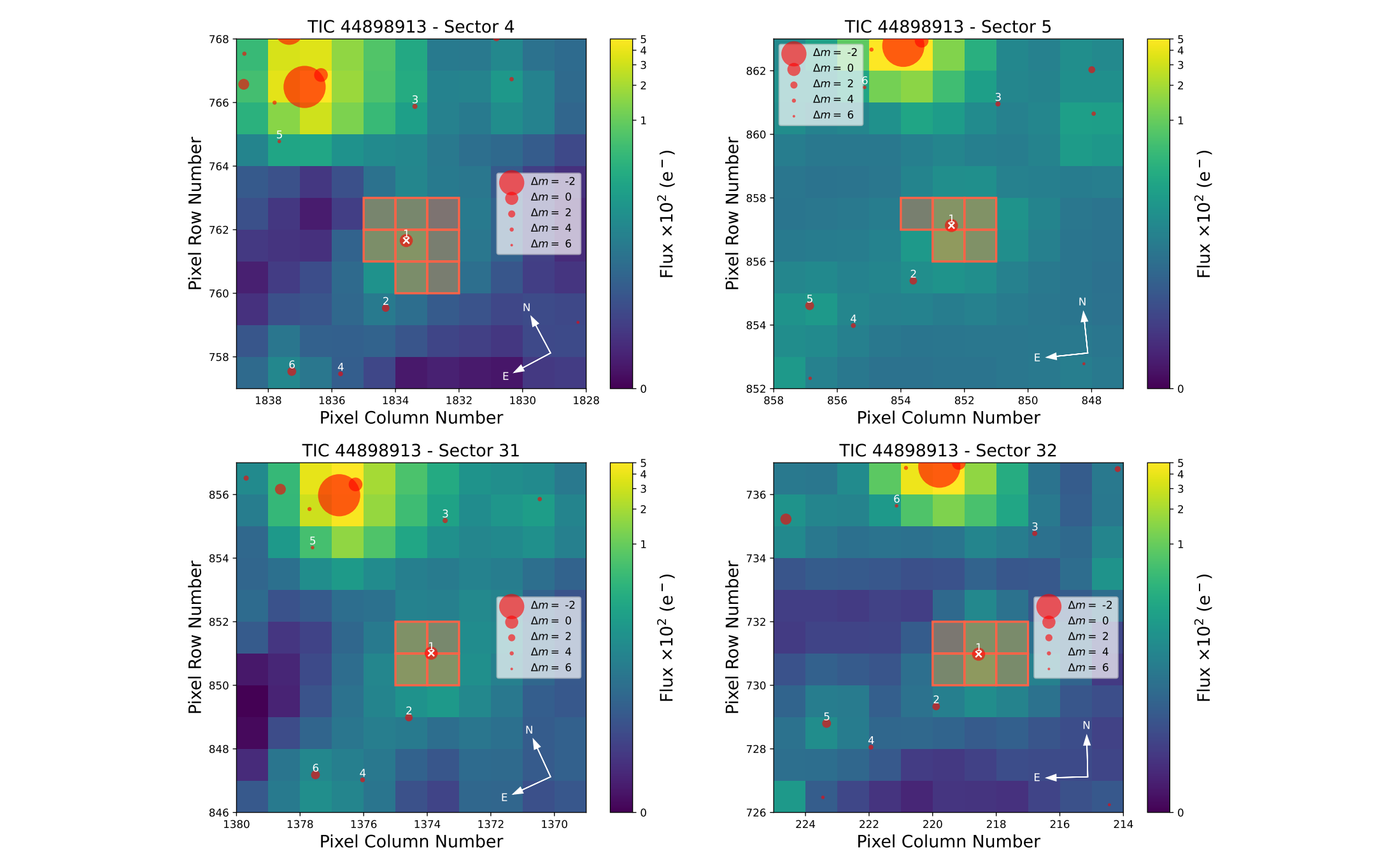
While the RV data confirmed the planet’s existence and mass, the researchers used space-based photometry from the Transiting Exoplanet Survey Satellite (TESS) to determine if the planet transits its host star from Earth’s perspective. The analysis covered Sectors 18, 19, 24, and 25, totaling 66,983 cadences over a 218.6-day baseline.
The TESS data revealed no transit at the orbital period of 39.63 days, with a False Alarm Probability (FAP) greater than 10%. To verify the sensitivity of this null result, the team conducted an injection-and-recovery test. They determined that a transit signal of 2200 ppm, which would correspond to a body with a radius of 1.74R⊕, would have been detected with a Signal-to-Pink-Noise Ratio (SPNR) greater than 12.
This result allowed the researchers to rule out a transiting geometry with high confidence. Consequently, the orbital inclination of Ross 318 b is constrained to i < 88.5°. Because the planet does not transit, its physical radius remains an estimate based on mass-radius relationships for Super-Earths, rather than a direct measurement.
Habitability and Stellar Flux
Ross 318 b is categorized as a temperate Super-Earth due to its position relative to its host star. The researchers calculated the bolometric luminosity of Ross 318 to be (0.01478 ± 0.00122)L⊙. With an incident stellar flux of S_{eff} ≈ 0.58S⊕, the planet sits within the Conservative Habitable Zone.
The Conservative Habitable Zone is the region around a star where the atmospheric pressure and stellar flux could allow liquid water to persist on a planetary surface. For planets orbiting M-dwarfs, this zone is much closer to the star than in our own solar system. Ross 318 b’s minimum mass of (6.21 ± 0.62)M⊕ places it firmly in the Super-Earth category, meaning it is more massive than Earth but significantly smaller than ice giants like Neptune.
The authors describe the planet as one of the most interesting temperate Super-Earths orbiting an M-dwarf
because of this combination of mass, temperature, and the stability of the orbital signal over a 15-year period.
Implications for M-Dwarf Planetary Systems
The characterization of Ross 318 b highlights the ongoing challenge of observing low-mass stars. M-dwarfs are the most common stars in the galaxy, but their magnetic activity often masks the signals of small planets. The use of long-baseline RV data combined with multi-wavelength analysis demonstrates the necessity of temporal coherence to validate terrestrial-mass candidates.
The fact that Ross 318 b does not transit limits the ability of current instruments to perform transmission spectroscopy, which is the primary method for analyzing exoplanet atmospheres. Without a transit, researchers cannot observe starlight filtering through the planet’s atmosphere to detect chemical signatures like oxygen, methane, or water vapor.
Despite the lack of a transit, the planet’s presence in the Conservative Habitable Zone makes it a primary target for future high-contrast imaging or extreme-precision radial velocity studies. The stability of the system and the precise orbital period of (39.6299 ± 0.29) days provide a reliable foundation for further dynamical modeling of the Ross 318 system.
