
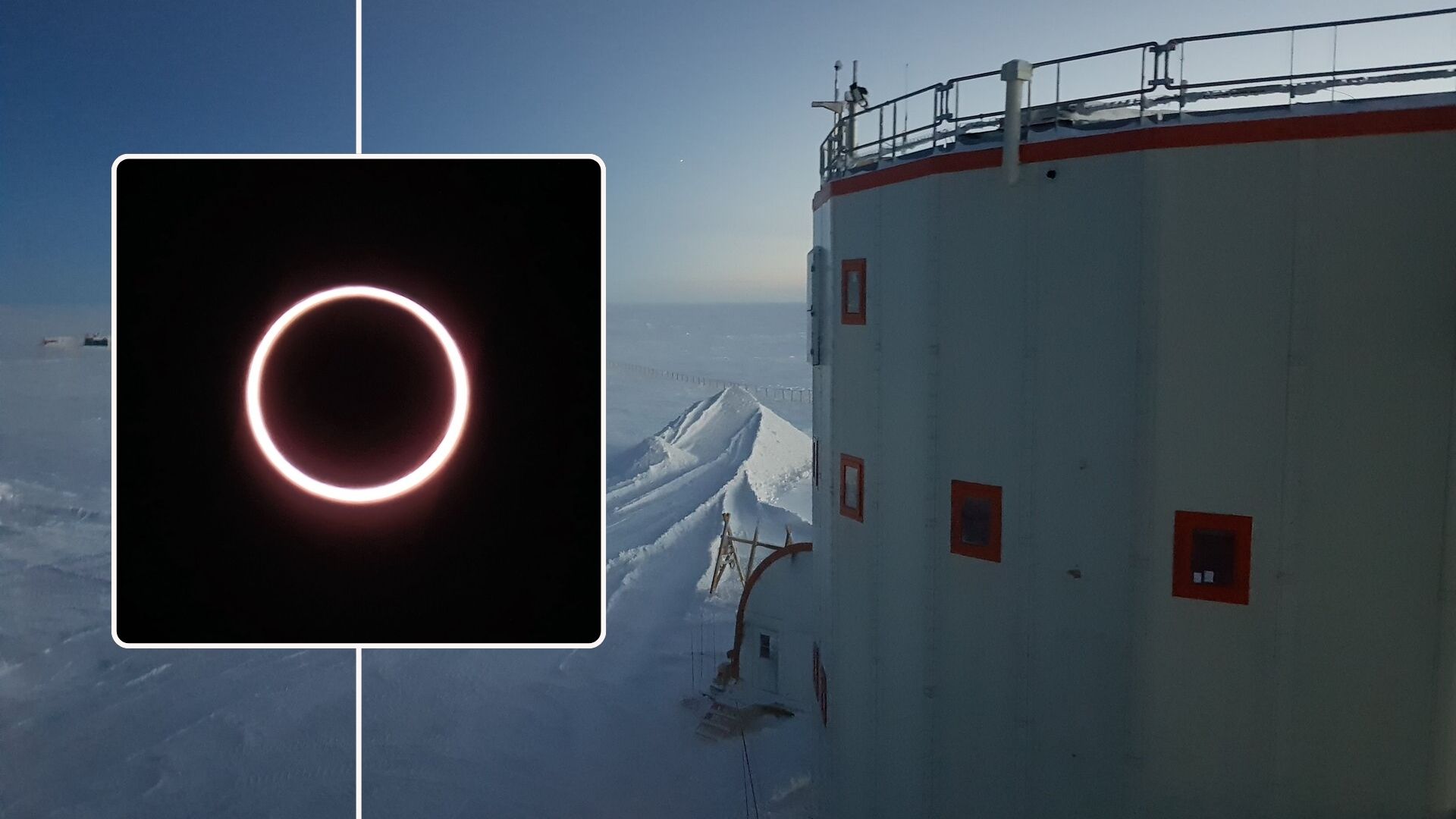
On February 17, 2026, a little team at the French-Italian Concordia Research Station in Antarctica witnessed an annular solar eclipse visible nowhere else on Earth.
The event, often called a “ring-of-fire” eclipse, occurred when the moon passed in front of the sun at a point in its orbit where it appeared too small to fully cover the solar disk, leaving a bright ring of sunlight around its edges. Unlike total solar eclipses, annular eclipses do not reveal the sun’s corona and require proper eye protection for safe viewing.
The path of annularity crossed Antarctica and passed over only two inhabited locations: Concordia Research Station and Russia’s Mirny Station. Cloud cover obscured the view at Mirny, leaving the Concordia crew as the sole witnesses to the full annular phase.
Andrea Traverso, a scientist overseeing geomagnetism, seismology, and meteorology experiments at the station, observed the eclipse from a window perfectly aligned with the event. He described the vantage point as offering multiple photographic opportunities due to the station’s layout of two cylindrical towers with multidirectional windows.
Concordia, located 750 miles inland at an altitude of 10,600 feet, endures average winter temperatures of -58°F and four months of total darkness each year. Despite these conditions, its remote location and dry polar desert environment make it ideal for glaciology, atmospheric science, astronomy, and space medicine research.
Traverso, who began his third winterover at Concordia in November 2025 and will remain until November 2026, improvises equipment and procedures to conduct scientific observations in extreme isolation. His role includes monitoring how solar wind interacts with the upper atmosphere — research directly relevant to understanding solar eclipses and space weather.
Why was Concordia uniquely positioned to observe this eclipse?
Concordia’s inland Antarctic location placed it directly in the narrow path of annularity, where the ring-of-fire effect is visible. Its high elevation and minimal light pollution further enhanced viewing conditions, though extreme cold required specialized equipment handling.
What scientific value does observing such an eclipse from Antarctica offer?
Observations from Concordia contribute to atmospheric science by allowing researchers to study sudden drops in solar radiation and their effects on temperature, wind patterns, and ionospheric behavior — data that is difficult to collect elsewhere due to the continent’s isolation and stability.
