
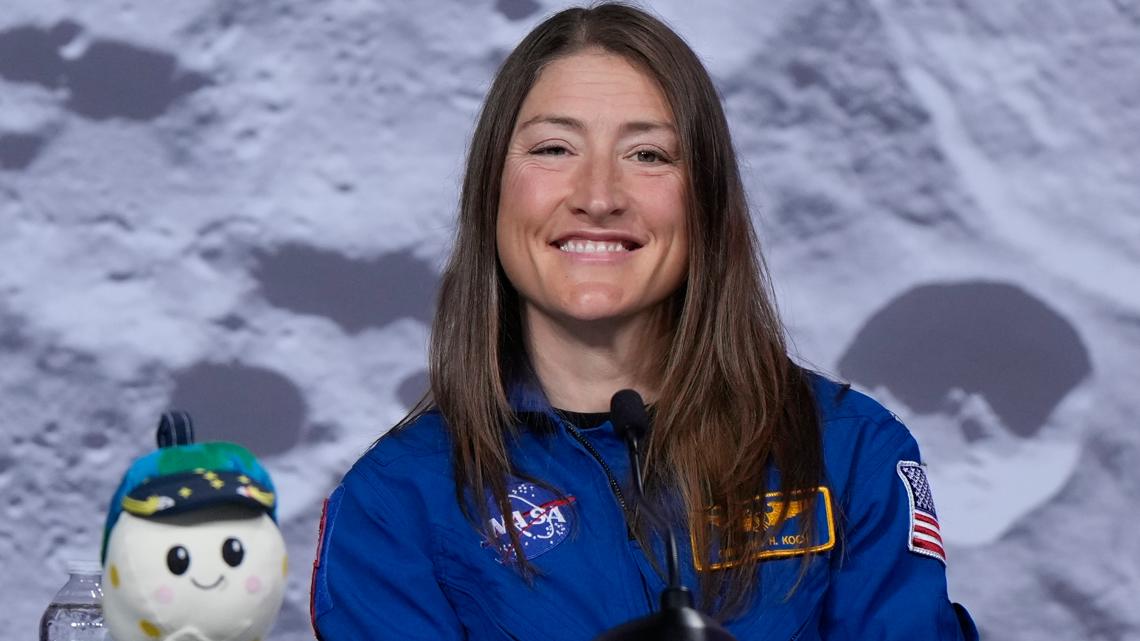
NASA astronaut Christina Koch is relearning how to walk after returning from the Artemis II mission, her body struggling to reconcile Earth’s gravity with weeks spent in microgravity.
Koch, who became the first woman to circle the moon, shared a video on Instagram showing her attempting a tandem walk with eyes closed—a test that exposed lingering balance issues stemming from how her vestibular system adapted to space. She described the sensation as disorienting, noting that her brain had learned to ignore signals from inner ear organs that normally facilitate track movement, forcing her to rely heavily on vision for orientation.
The video, posted nearly a week after splashdown off the coast of San Diego, drew attention not just for its personal struggle but for its scientific relevance. Koch explained that understanding this readjustment process could improve treatments for Earth-based conditions like vertigo, concussions, and other neuro-vestibular disorders.
Despite the initial wobbliness, Koch emphasized that adaptation is already underway. By day seven post-splashdown, she noted measurable progress in reacclimating to gravity, a timeline consistent with standard neurovestibular recovery observed in returning astronauts.
Her crewmates—Reid Wiseman, Victor Glover, and Jeremy Hansen—are undergoing similar evaluations, including balance tests, vision assessments, and strength measurements. As part of their reconditioning, they’ve performed exercises in simulated lunar gravity while wearing spacewalking suits to gauge future moonwalkers’ readiness for surface operations.
The Artemis II mission itself marked a historic leap in human spaceflight, carrying the crew farther from Earth than any previous mission, surpassing even the apogee of Apollo 13 in 1970. During the 10-day lunar flyby, the team gathered critical data on deep space operations, life support systems, and spacecraft performance.
Beyond the technical achievements, Koch highlighted the mission’s broader significance during a public panel, stating that global public support was as vital to the crew as technical success or teamwork. She framed the endeavor as a shared human effort, reinforcing NASA’s messaging that Artemis belongs to the world.
How vestibular adaptation affects astronauts returning from deep space
In microgravity, the otolith organs in the inner ear—which detect linear acceleration and head tilt relative to gravity—receive altered signals. Over time, the brain reduces reliance on these inputs and increases dependence on visual and proprioceptive cues. Upon return to Earth, this reinterpretation creates a mismatch: the brain expects the altered signaling patterns, but gravity reintroduces normal otolith input, causing dizziness, imbalance, and difficulty with tasks like walking with eyes closed until neural pathways recalibrate.
Why this recovery data matters for future lunar missions
The balance and coordination data collected from Koch and her crew will directly inform preparations for Artemis III and beyond, where astronauts are expected to perform complex tasks soon after landing on the moon. Understanding how quickly motor function recovers in partial gravity helps planners design suit mobility, EVA timelines, and emergency protocols that account for temporary neurovestibular impairment.
What the Artemis II crew’s postflight testing reveals about human limits in space
The comprehensive medical regimen—including repeated balance assessments, vision tracking, and strength evaluations—provides a longitudinal view of how the human body responds to and recovers from prolonged spaceflight. These metrics are essential for validating countermeasures like exercise regimens, pharmaceutical aids, and artificial gravity concepts intended for longer missions to Mars.
How long does it typically take for astronauts to regain balance after a space mission?
Based on Koch’s report and historical data, noticeable improvement in balance begins within a week of landing, with functional recovery continuing over several weeks as the brain reweights sensory inputs.
Could the balance issues Koch experienced affect astronauts performing moonwalks soon after landing?
Yes, which is why NASA tests crewmembers in simulated lunar gravity during recovery—to estimate how much dexterity and stability they’ll have when conducting surface operations during early lunar missions.
