
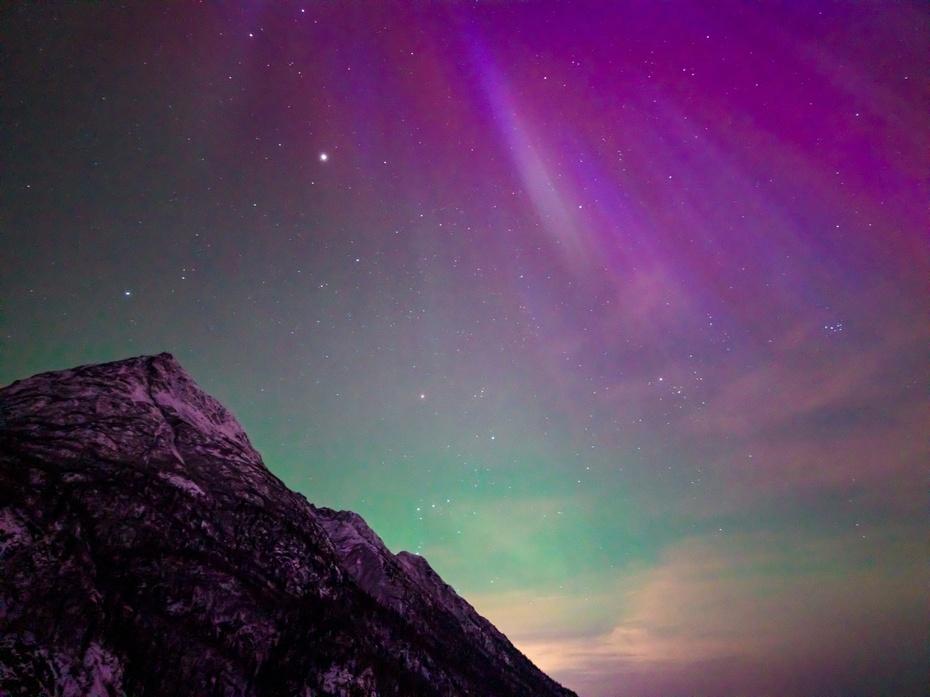
A surge of solar wind racing toward Earth at 430 miles per second has triggered a geomagnetic storm watch, raising the possibility that the northern lights could be seen as far south as Illinois and Oregon on the night of April 17.
The National Oceanic and Atmospheric Administration’s Space Weather Prediction Center issued a moderate (G2) storm watch for April 17-18, with forecasters at the U.K. Met Office noting a chance for stronger (G3) bursts if conditions intensify. Such activity could push the aurora borealis well beyond its typical polar range, making it visible across much of the northern United States.
According to NOAA’s aurora dashboard, the Kp index reached four for the night of April 17, indicating auroral activity strong enough to be “quite pleasing to seem at” under clear, dark skies. The viewing curve extended as far south as southern Iowa, with visibility increasing the farther north observers were located. States with the highest likelihood included Alaska, northern Montana, northern North Dakota, and northern Minnesota.
The solar wind’s interaction with Earth’s magnetosphere funnels charged particles into the upper atmosphere, where they collide with oxygen and nitrogen molecules, releasing energy as visible light. Stronger solar wind results in more dynamic and widespread displays, which is why forecasters are watching closely for any escalation to G3 levels.
This event follows a similarly active weekend when NOAA forecast auroras across 20 states amid a minor geomagnetic storm. The sun is currently in the active phase of its 11-year solar cycle, which peaked in October 2024 and is expected to continue elevating auroral chances through 2025.
For the best chance of seeing the lights, observers should seek locations with minimal light pollution and a clear view of the northern horizon between 10 p.m. And 2 a.m. Local time, when auroral activity is typically strongest. Allowing eyes at least 30 minutes to adjust to darkness improves night vision, and using a phone camera in night mode can help detect faint auroras before they become visible to the naked eye.
Photographers are advised to use tripods and low aperture settings, avoiding flash which can disrupt natural adaptation and wash out subtle colors. Warm clothing and patience remain essential, as aurora appearances depend on the precise timing of solar wind arrival and magnetic field alignment.
While the forecast offers promise, officials stress that auroras are never guaranteed — their visibility hinges on how effectively the solar wind couples with Earth’s magnetosphere. A strong display requires not just solar energy, but the right orientation of interplanetary magnetic fields to facilitate energy transfer.
How solar wind speed determines aurora reach
The speed and density of incoming solar wind directly influence how far south the northern lights can appear. At 430 miles per second, the current stream carries enough energy to disturb Earth’s magnetic field at mid-latitudes, potentially triggering G2 or G3 storm levels. Historical comparisons reveal that similar wind speeds in March 2023 produced visible auroras as far south as Colorado and Missouri under G3 conditions.
What the G-scale means for visibility
Geomagnetic storms are measured on a G1 to G5 scale, with G1 being minor and G5 extreme. A G2 watch, as issued for April 17, suggests possible voltage fluctuations at high-latitude power grids and satellite orientation irregularities, while G3 bursts could interfere with GPS and push auroras into states like Illinois and Oregon. The scale helps forecasters communicate not just visual potential but also technological impacts.
When is the best time to look for the northern lights tonight?
According to NOAA’s 3-day forecast, activity is expected to peak between 5:00 p.m. And 2:00 a.m. EDT on April 17, corresponding to 2100 to 0600 GMT, with moderate G2 conditions possible during that window.
Can the northern lights be seen in cities like Chicago or New York?
Northern Illinois and New York are included in the potential viewing area under G2 conditions, with visibility improving the farther north and away from urban light pollution observers are located.
