
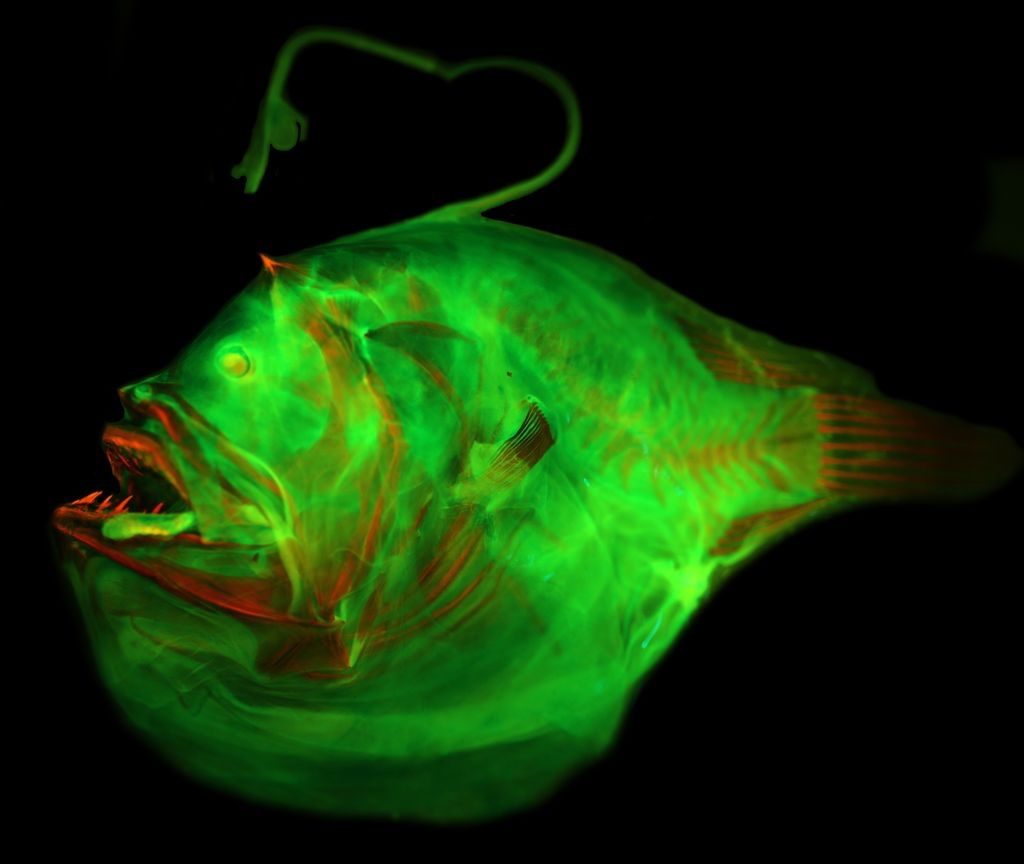
Researchers have traced the origin of the anglerfish’s distinctive lure to a common ancestor that lived approximately 72 million years ago during the Late Cretaceous period.
The finding comes from a study published in Ichthyology & Herpetology, in which Alex Maile and Matthew Davis analyzed 118 specimens representing 102 anglerfish species from museum collections. Their perform combined fossil evidence, evolutionary modeling, and computer simulations to map how the lure — a modified dorsal fin spine known as the illicium — evolved over time.
Initially, the lure was a purely mechanical structure, likely used to twitch or wiggle and attract prey through motion alone. It lacked both bioluminescence and chemical signaling. This early version proved effective in shallow, well-lit environments where visual cues could travel.
Around 34 to 23 million years ago, during the Oligocene epoch, some anglerfish lineages began developing bioluminescent lures as they migrated into the pelagic zone — the open ocean where sunlight diminishes with depth. This shift coincided with a notable increase in species diversity across the group.
The researchers suggest that the glowing lure did more than improve hunting efficiency. In the near-total darkness of the deep sea, it also became a tool for communication, particularly for attracting mates. Only female anglerfish possess lures, and males — equipped with large nostrils and relatively large eyes — may detect both the light and any chemical signals it emits.
Maile noted that the lure’s design includes adaptations like a “little window shutter,” allowing females to modulate light patterns by contracting muscles around the structure. This ability to control the glow supports the hypothesis that the lure functions in complex signaling, not just passive attraction.
Species with bioluminescent lures tend to have longer illicia, keeping the light source farther from the face — possibly to avoid startling prey or to increase visibility in vast, dark waters. This pattern mirrors evolutionary trends seen in other deep-sea fish such as lanternfishes and dragonfishes, which also use light for intraspecific communication.
Despite these advances, direct observation of anglerfish behavior in the wild remains rare. Davis emphasized that many species have never been filmed or observed alive, making museum specimens and indirect modeling essential for understanding their ecology.
The study highlights how a single anatomical innovation — the repurposing of a fin spine into a multifunctional lure — enabled anglerfish to exploit extreme environments while solving dual challenges of feeding and reproduction in one of Earth’s most hostile habitats.
How the lure’s dual function emerged in deep-sea anglerfish
As anglerfish descended into the aphotic zone, evolutionary pressure favored traits that enhanced survival in perpetual darkness. The addition of bioluminescence to the lure transformed it from a simple predatory tool into a multifunctional organ capable of both attracting prey and facilitating mate detection.
Computer modeling revealed a clear correlation: species inhabiting deeper waters were more likely to possess glowing lures with longer rods and greater structural complexity. These traits improved signal transmission in environments where visual communication is otherwise impossible.
The researchers argue that this dual-purpose adaptation likely reduced the energetic cost of maintaining separate systems for feeding and reproduction — a significant advantage in the low-energy conditions of the deep sea.
Why male anglerfish rely on female lures to uncover mates
Male anglerfish are significantly smaller than females and lack lures entirely. Their survival depends on locating a female quickly, as many species exhibit parasitic mating where the male fuses to the female’s body and shares her circulatory system.
Given this life history, the ability to detect a female’s lure from a distance is critical. Males possess enlarged olfactory organs and eyes adapted to low-light conditions, suggesting they are specialized to respond to both chemical and visual cues emitted by the lure.
Maile noted that the lure’s capacity to produce modulated light patterns — akin to a biological signal lamp — may allow females to convey species-specific information, helping males identify appropriate mates in the vast ocean.
What the fossil record reveals about lure evolution
By examining fossilized anglerfish remains and mapping them onto an evolutionary tree, the researchers determined that the earliest lures appeared in the Late Cretaceous, coinciding with a period of warming oceans and expanding marine biodiversity.
The transition from mechanical to bioluminescent lures aligns with geological evidence of increased deep-sea colonization during the Oligocene, when global temperatures dropped and ocean circulation patterns shifted, creating new ecological niches in deeper waters.
This timeline suggests that environmental change played a key role in driving innovation in anglerfish morphology, with the lure evolving in response to shifting light availability and habitat distribution.
Why do only female anglerfish have lures?
Only female anglerfish possess lures because the structure evolved as part of a reproductive strategy where females are the larger, dominant sex responsible for attracting mates in the deep sea.
How does the lure’s glow aid anglerfish survive in the deep ocean?
The bioluminescent lure helps anglerfish survive by attracting prey in darkness and simultaneously signaling to potential mates, combining feeding and reproductive functions in a single adaptation.
