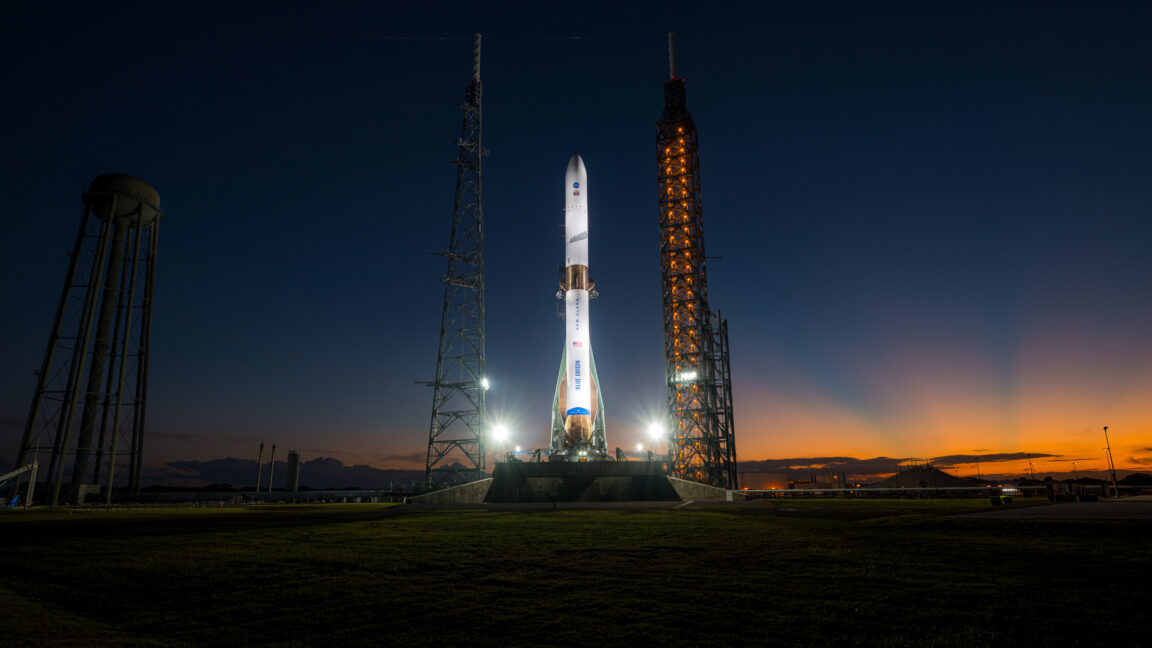
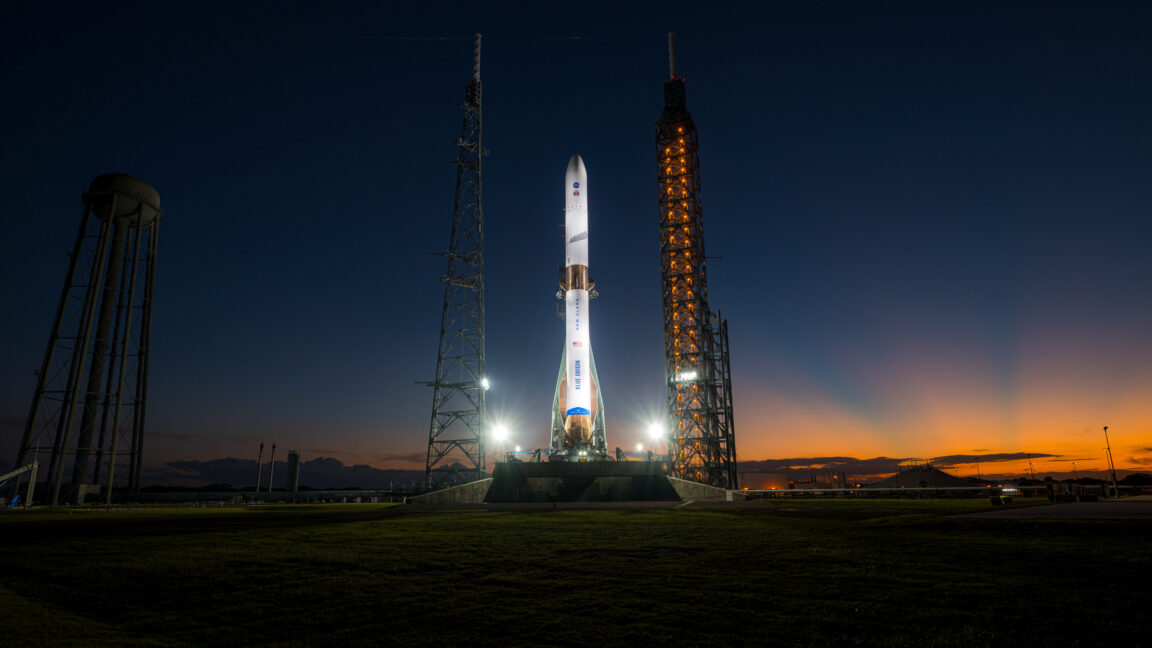
Blue Origin’s New Glenn rocket exploded during a static fire test in Cape Canaveral, Florida, on Thursday evening. The blast caused severe damage to launch infrastructure and represents one of the largest rocket explosions in U.S. history. All personnel were accounted for, though the failure significantly delays the company’s 2026 launch schedule.
Severe Infrastructure Damage at LC-36A
cluster (priority): spaceyv.com
The scale of the explosion was catastrophic for the ground site. While the rocket was intended for a static fire test, it was likely fully fueled, which amplified the blast. According to reports from Ars Technica, the launch infrastructure at LC-36A is severely damaged, with sources indicating that the transporter-erector and one of the lightning towers may be damaged beyond repair.
This creates a critical bottleneck for Blue Origin. Although the company has begun constructing a second launch site nearby, LC-36B, work there is still in its early stages. The company now faces a choice: attempt the grueling task of rebuilding LC-36A or accelerate the completion of LC-36B.
The immediate fallout is a stalled timeline. New Glenn will almost certainly not launch again in 2026. Given the extent of the site damage, a return to flight during the first half of 2027 would be considered a heroic achievement.
Bezos and the Financial Path to Recovery
cluster (priority): yahoo.com
The failure marks the worst setback in the history of Blue Origin, but the company possesses a unique safety net: the personal fortune of Jeff Bezos. Having invested tens of billions of dollars into the venture over the last quarter-century, Bezos has the financial wherewithal to sustain the company through this crisis and fund an aggressive recovery.
“It’s too early to know the root cause but we’re already working to find it. Very rough day, but we’ll rebuild whatever needs rebuilding and get back to flying. It’s worth it,”
Jeff Bezos, Founder of Blue Origin, via Yahoo
The human cost was avoided, as Blue Origin confirmed via X that “[a]ll personnel have been accounted for,” and Bezos added that they were “safe.” While the rocket was lost, a critical payload of Amazon Leo internet satellites remained safe in a nearby integration facility, awaiting a launch that will now be delayed by months, if not years.
The Competitive Friction with SpaceX
Blue Origin New Glenn rocket explodes on Florida launch pad
The explosion occurred against a backdrop of intense competition with Elon Musk’s SpaceX. Just hours before the New Glenn disaster, SpaceX conducted a Starship test that showcased the company’s current technical lead. While SpaceX’s upper stage suffered a “rapid unscheduled disassembly” over the Atlantic—which Musk attributed to an “oxygen/fuel leak”—the company successfully caught the first-stage booster in the “chopstick” arms of its launch tower for the second time.
Musk’s reaction to the Blue Origin failure was characteristically blunt. He wrote on X, “Most unfortunate. Rockets are hard,” adding, “I hope you recover quickly.”
This disaster follows a pattern of instability for the New Glenn program. While the NG-1 mission successfully reached orbital space on January 16, 2025, a subsequent mission failed when the upper stage failed to put an AST SpaceMobile satellite into orbit, resulting in a total loss.
Lunar Stakes and the NASA Partnership
cluster (priority): arstechnica.com
Beyond the commercial race for satellite deployment, the New Glenn failure jeopardizes NASA’s lunar ambitions. The agency is counting on the Blue Moon Mark 2 lander—designed to fly on a more powerful nine-engine version of the New Glenn rocket known as the 9×4—to carry humans to the Moon regularly.
Because the rocket that exploded on Thursday was the smaller 7×2 variant, Blue Origin may now pivot all its developmental efforts toward completing the larger 9×4 workhorse. However, the destruction of the launch pad affects all variants.
“work with our partners to support a thorough investigation of this anomaly, assess near-term mission impacts, and get back to launching rockets.”
Jared Isaacman, NASA Administrator, via Yahoo
Isaacman noted that NASA will “provide any impacts to the Artemis and Moon Base programs as it becomes available.” For NASA, Blue Origin is not just a contractor but a strategic necessity to ensure redundancy alongside SpaceX’s Starship.
Historical Echoes of the N1 Disaster
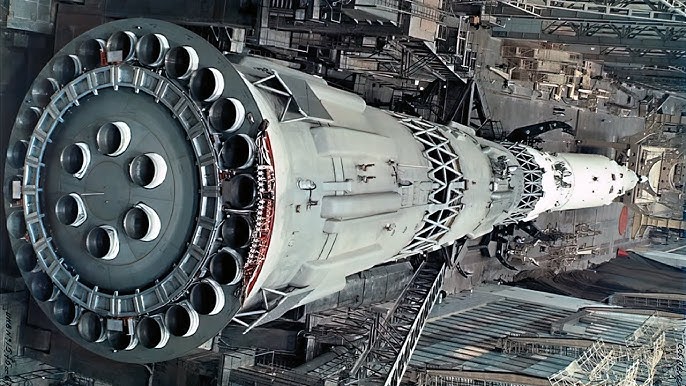
The sheer magnitude of the New Glenn blast has drawn comparisons to the Soviet Union’s N1 rocket program of the 1960s and 70s. Like New Glenn, the N1 was a massive effort to achieve lunar goals, but it was plagued by catastrophic failures. Between 1969 and 1972, all four N1 launch attempts ended in disaster, including a 1969 failure that remains one of the most powerful non-nuclear explosions in history.
While Blue Origin is not the USSR, the parallels in engineering hubris—specifically the challenge of managing massive amounts of fuel and complex engine arrays—are evident. The N1 failed largely due to an overcomplicated design with 30 engines in its first stage that were not properly tested as a full system.
Blue Origin now faces its own “N1 moment.” The company had planned as many as 12 launches for 2026 to challenge SpaceX’s dominance in national security and commercial orbits. That ambition has been replaced by a grueling rebuilding phase. The path forward requires not just a new rocket, but a new foundation at LC-36.