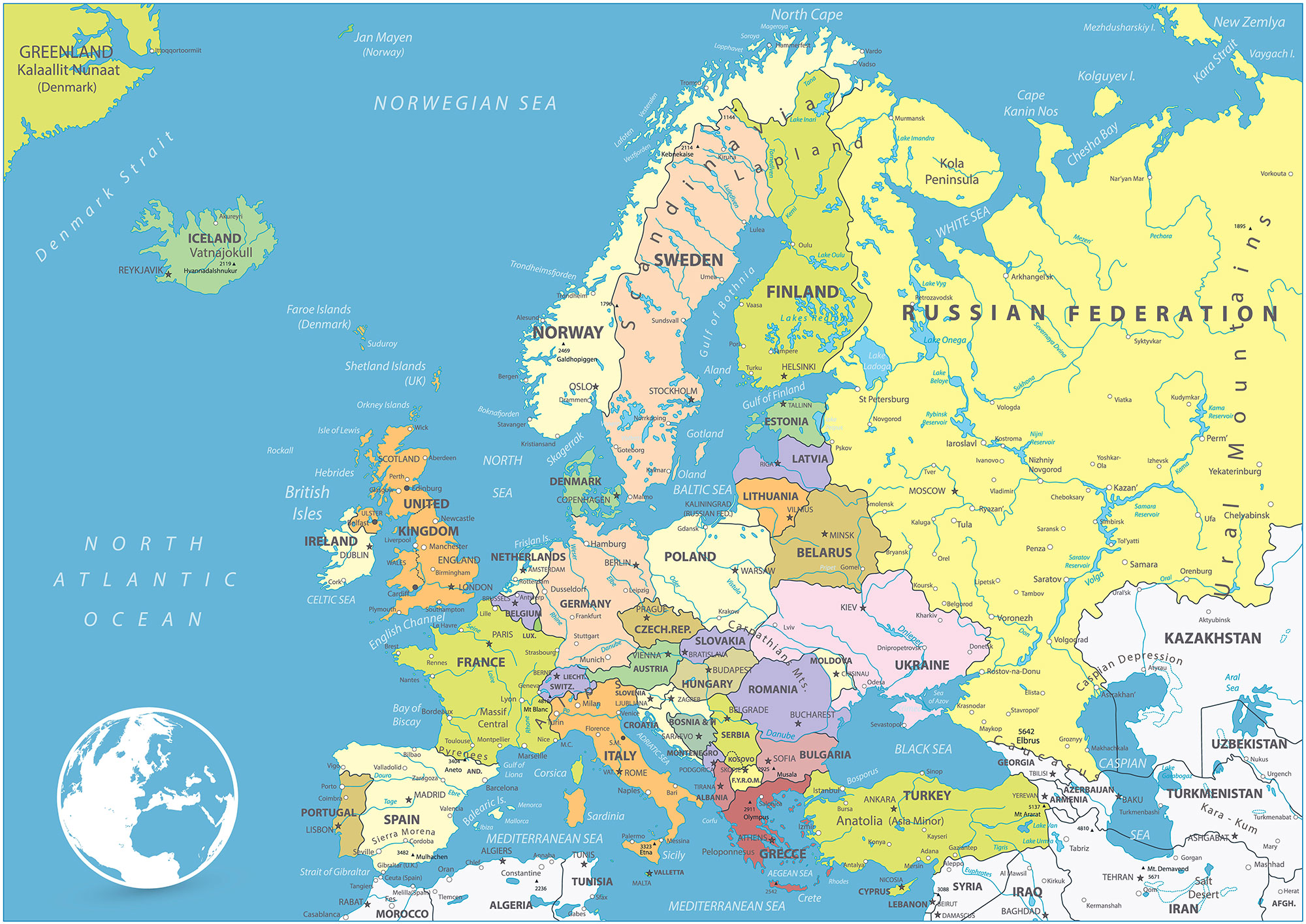
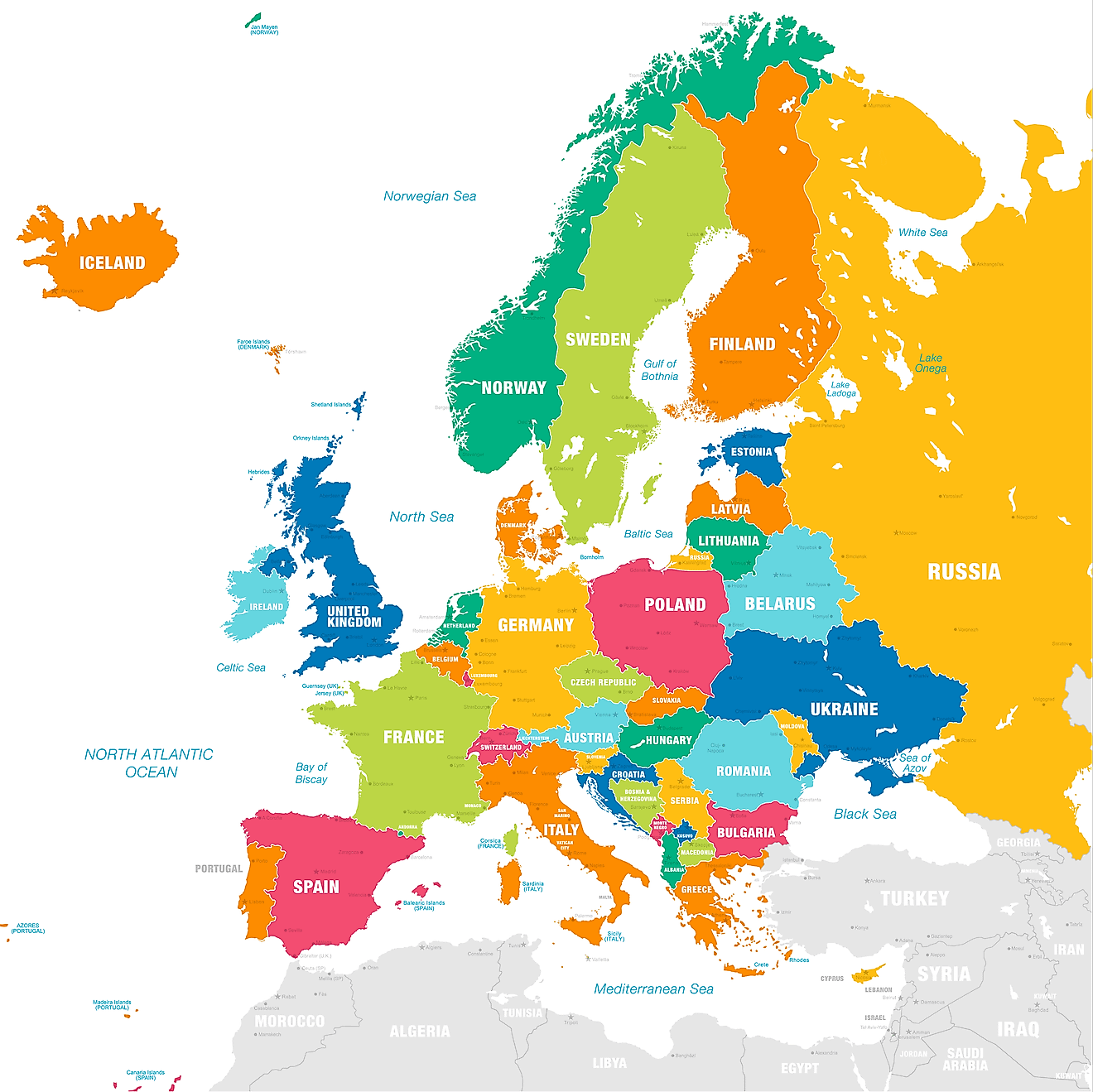
Europe comprises 51 countries with a total land area of 10,180,000 square kilometers and a population of 741,864,070 as of May 28, 2026. Bordered by the Arctic, Atlantic, and Mediterranean, the continent serves as the westernmost projection of the Eurasian landmass, blending diverse political alignments with complex geographic boundaries.
Physiographically, Europe is an anomaly. Larger only than Australia, it exists as a small appendage of Eurasia, yet its physical geography—characterized by a highly irregular coastline of approximately 24,000 miles—has created a relatively genial human habitat. As Britannica notes, this unique positioning allowed the region to develop as a distinctive civilization, concentrating
“infinite riches in a little room.”
Christopher Marlowe, via Britannica
Defining the Borders of the Eurasian Peninsula
Border Debate Russia
The delineation of Europe’s borders has long been a point of contention for geographers and politicians. Today, the consensus generally identifies the Ural Mountains in Russia, the Caspian Sea, and the Caucasus Mountains as the primary markers of the eastern boundary. This definition means that GIS Geography identifies Europe as the westernmost region of the Eurasian landmass, stretching from the North Atlantic to the watershed of the Urals.
The continent is defined by its projections. Major peninsulas, including the Iberian, Italian, Scandinavian, and Balkan peninsulas, push the landmass into the surrounding seas. To the north, the Arctic Ocean looms, while the west is defined by the Atlantic. The south is more fragmented, bordered by the Mediterranean Sea, the Black Sea, the Kuma-Manych Depression, and the Caspian Sea.
Beyond the mainland, Europe’s reach extends through significant archipelagoes and islands. These include:
The British Isles, Iceland, and the Faroe Islands in the North Atlantic.
Svalbard, Novaya Zemlya, and Franz Josef Land in the Arctic.
Mediterranean hubs including Corsica, Sardinia, Sicily, Malta, Crete, and Cyprus.
The UN Geoscheme and Regional Power Dynamics
cluster (priority): gisgeography.com
For statistical and administrative clarity, the United Nations’ Geoscheme divides the continent into four subregions: Eastern, Western, Southern, and Northern Europe. While these divisions are useful for data, WorldAtlas points out that they do not always align with historical or current cultural divisions.
Eastern Europe stands as the largest and most populous subregion, housing approximately 284.2 million people across 10 countries. This region is the primary theater for a modern struggle for influence. On one side, the European Union (EU) and NATO seek further expansion; on the other, Russia attempts to halt this growth to regain the influence it held during the Cold War era, prior to the collapse of the Soviet Union in 1991.
In contrast, Western Europe consists of nine countries with a population of about 199.6 million. The region is dominated by France and Germany, which together account for more than half of the subregion’s population. These two nations have transitioned from historical enemies to the primary drivers of European integration—a role that became even more critical following the withdrawal of the UK from the EU at the start of 2021.
Demographics of the 51 Sovereign States
The scale of European nations varies wildly. According to Countries of the World, Russia is the behemoth of the continent, occupying 37% of Europe’s total land area. At the opposite extreme is Vatican City, the smallest sovereign state, which occupies a mere 0.44 square kilometers in the center of Rome.
The demographic and economic distribution across these states creates a landscape of high-density urban centers and sparsely populated peripheries. Germany remains the most populous Western European nation with approximately 83 million people, while France follows with about 63 million.
MEPs CLASH Over Europe's BORDER SECURITY: MIGRATION, Physical Barriers, and NATIONAL SAFETY
Transcontinental Realities and Political Identity
cluster (priority): orldatlas.com
The definition of “European” often clashes with geographic reality. While 44 of the 51 European countries are located entirely within the continent’s borders, five are transcontinental: Russia, Kazakhstan, Azerbaijan, Georgia, and Turkey. These nations bridge the gap between Europe and Asia, often maintaining political and economic ties to both.
Further complicating the map are Armenia and Cyprus. Geographically, both are located entirely within West Asia, yet they are politically classified as European states due to their membership in all major European organizations.
This blending of geography and politics extends to the continent’s global appeal. France remains the most visited travel destination in the region, centered around Paris, followed by Spain, Italy, the United Kingdom, and Germany. This tourism draw underscores the enduring power of the European “construct”—a region that remains a global hub of culture and heritage despite its small physical footprint relative to the rest of Eurasia.