

Israel has used AI technology to increase accuracy when attacking targets in Gaza. Photo: THX/TTXVN
Artificial intelligence (AI) has many applications and implications for modern warfare, both on and off the battlefield. Below is an analysis of how AI helps the Israeli military select bombing targets in the Gaza Strip as well as the impacts and challenges of using AI in war.
The Gospel: Israel’s AI-based target attack optimization system
Israel used an AI-based system called “The Gospel” to evaluate and identify priority targets for airstrikes in Gaza. The Gospel is a platform that collects and analyzes data from various sources such as satellite imagery, drone footage, human intelligence and social media to identify targets potential involvement with Hamas.
The Gospel will then evaluate the importance, urgency and potential risk of each target, then send the list to Israeli military (IDF) commanders. The IDF claims that The Gospel has significantly increased the speed and accuracy of targeting.
Impact and challenges of using AI in warfare
However, there are also concerns and criticisms about the use of AI in Israel’s bombing campaign. Some of these issues include:
First, the lack of transparency and accountability of The Gospel and its algorithms. It is unclear how The Gospel collects, verifies and processes data, and how it levels and prioritizes its goals. There is also no independent oversight or review of The Gospel’s decisions and actions.
Second, the possibility of errors and biases in data and algorithms. Data sources used by The Gospel may be incomplete, inaccurate, out of date or manipulated. For example, The Gospel may receive false or misleading information on social media or may prioritize certain types of targets over others based on the data it receives.
Third, the ethical and legal issues of outsourcing human decisions to machines. The use of AI in warfare raises questions about the moral and legal responsibilities of operators and commanders as well as respect for the principles of international humanitarian law, such as discrimination, proportionality worthy. For example, who will be responsible if The Gospel makes mistakes or causes undue harm? How can the IDF ensure that The Gospel respects the human rights of civilians in Gaza? How can the IDF verify that targets are legitimate and proportionate to the threat?
Fourth, the use of AI in warfare also affects international relations and diplomacy, as it puts new topics on the international agenda such as the ethics, legal and social implications of AI, the development of develop standards and norms for AI as well as AI governance and regulation. These topics require multilateral cooperation and dialogue between different stakeholders such as governments, international organizations, civil society and the private sector.
Fifth, the use of AI in warfare also challenges geostrategic relationships because AI can enhance the military, economic, and social power of countries with advanced AI capabilities, while creating This creates asymmetry and inequality between countries with different levels of AI development and adoption. AI can also create new opportunities and threats to national security and international stability such as cyber attacks, autonomous weapons and disinformation campaigns.
However, the use of AI in war also serves as a tool for diplomats and negotiators, as AI can help collect and analyze data, support decision-making, and draft and translate documents. data as well as facilitate communication and collaboration. AI can also help monitor and implement international agreements and treaties such as the Paris Agreement on climate change or the Iran nuclear deal.
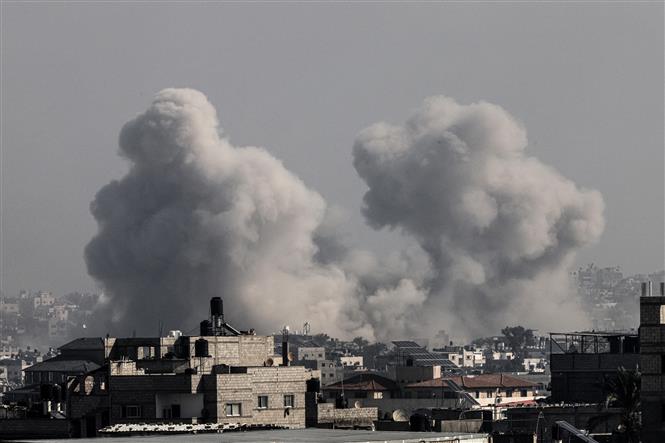
Smoke rises after Israel’s airstrike on the Gaza Strip on December 17, 2023. Photo: AFP/TTXVN
The future of AI in modern warfare
The future of AI in modern warfare is a topic widely discussed and debated by experts, scholars and policymakers. Some possible roles and impacts of AI in future warfare are:
Firstly, AI can enhance the command and control (C2) capabilities of military forces by collecting and analyzing data from various sources such as sensors, satellites, drones and human intelligence, while providing situational awareness, threat assessment and decision support to commanders and operators.
Second, AI can enable the development and deployment of autonomous lethal systems (LAS) such as robots, drones, missiles and weapons that can operate independently or in coordination with human operators. and can select and attack targets without human intervention.
Third, AI can improve the performance and accuracy of small arms and light weapons, such as rifles, pistols, and grenades, which can increase hit probability and reduce destruction. unintended by these weapons.
However, AI can also pose challenges and risks for modern warfare such as ethical and legal dilemmas, physical and cyber vulnerabilities, and strategic uncertainties. and operations, requiring careful consideration and adjustment by military and civilian agencies.
In short, in reality, the use of AI in war is a complex and sensitive issue, involving many factors and perspectives. AI is a powerful and transformative technology that can have a significant impact on the conduct and outcomes of war, and requires responsible use by all stakeholders. The case of Israel using AI to select bombing targets in Gaza raises many important questions and debates about the future of AI in war.
