

Researchers have detected ultra-fast winds emanating from the supermassive black hole J2318, reaching speeds of 30% the speed of light. Observed in the ultraviolet wavelength, these winds represent a record-breaking discovery in astrophysics, driven by the intense pressure of photons striking gas atoms within the quasar’s extreme environment.
Record-Breaking Ultraviolet Winds in J2318
The astronomical community is processing a significant observation regarding the quasar J2318, where researchers have identified winds moving at incredible velocities. As reported by News18, these winds have been clocked at 30% the speed of light when viewed through the ultraviolet wavelength.
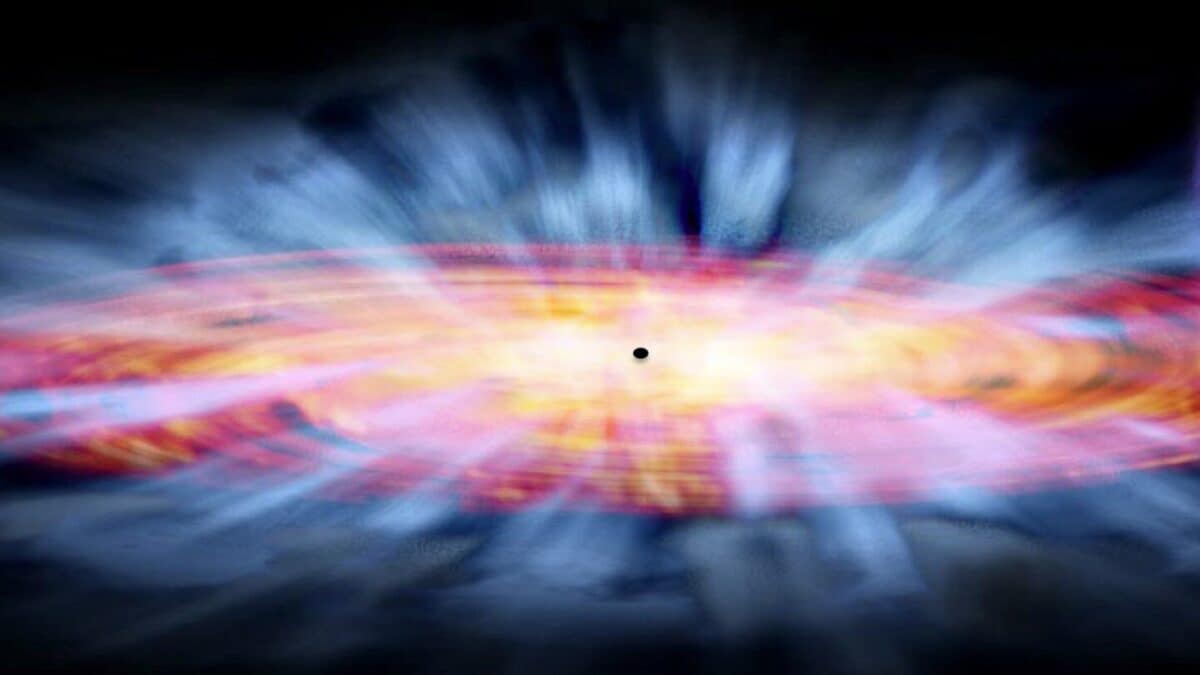
This discovery sets a new benchmark for the fastest winds ever recorded in the ultraviolet spectrum, effectively shattering previous astronomical records. While scientists have previously observed high-velocity winds in the X-ray wavelength—which may reach even higher speeds—this specific detection in the ultraviolet range marks a milestone in understanding how energy is transferred from a supermassive black hole to its surrounding environment.
The Physics of Photon Pressure
The mechanism driving these cosmic storms is fundamentally different from the atmospheric phenomena experienced on Earth. On our planet, winds are the result of changes in gas pressure. In the vicinity of a quasar, however, the force is much more direct and violent.
These space-based winds are propelled by the direct pressure of light itself. In physics, light travels in small packets known as photons. As these photons collide with gas atoms, they transfer momentum, imparting extreme velocity to the matter. This process, known as photon pressure, allows the quasar to act as one of the most aggressive forces in the known universe, pushing massive amounts of gas outward at relativistic speeds.
Ultraviolet Detection and Scientific Significance
The identification of these winds in the ultraviolet spectrum provides a unique window into the behavior of supermassive black holes. Lucas Seetun noted that the observation of these winds in J2318 specifically within the ultraviolet wavelength is what establishes this new record.
The implications of such high-speed outflows are vast. When a black hole ejects gas at 30% of the speed of light, it is not merely moving matter; it is redistributing energy across vast distances of space. This level of activity characterizes the quasar as a highly active and potentially transformative force in its host galaxy.
- **Target Entity:** Supermassive black hole/Quasar J2318
- **Observed Speed:** 30% of the speed of light
- **Primary Wavelength:** Ultraviolet (UV)
- **Driving Force:** Photon pressure (photons colliding with gas atoms)
