

The Atlas V’s Last Stand
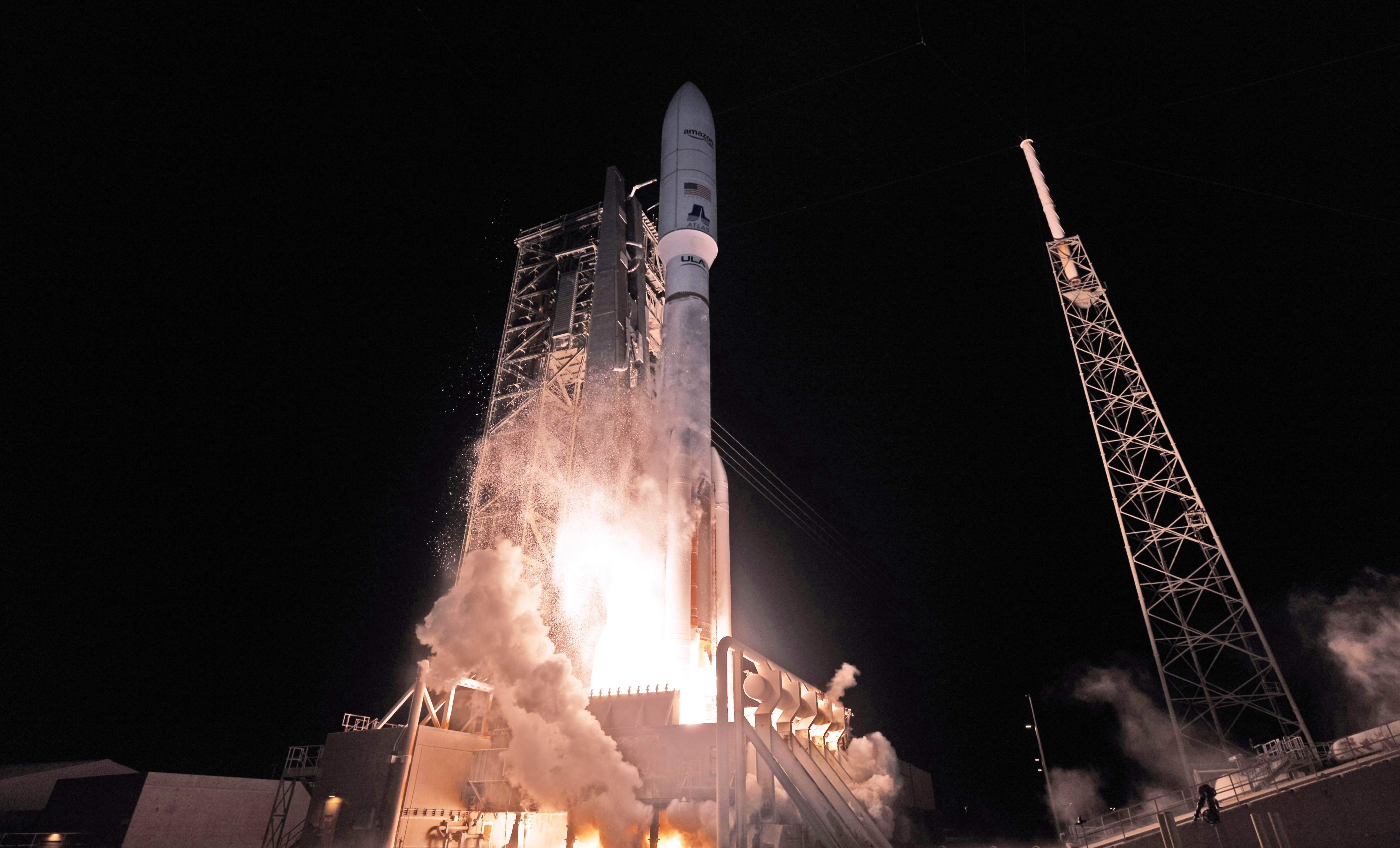
The Atlas V has been a reliable vehicle for two decades, but Monday night’s launch may represent one of its final missions in this capacity. Equipped with five solid boosters, the rocket delivered 29 Amazon Leo satellites into orbit, matching the 18-ton payload it achieved earlier in the month. The Atlas V was initially developed for government and defense payloads, yet it has become a key component of Amazon’s satellite deployment efforts. To date, it has completed six successful launches for Project Kuiper, a role it was not originally designed to fulfill.
The mission’s details highlight the scope of Amazon’s ambitions: 29 satellites deployed in a single launch, with 10 separate deployments occurring over 16 minutes. If Amazon’s plans proceed as outlined, the constellation will eventually grow to 3,200 satellites. However, the Atlas V’s future is uncertain. United Launch Alliance (ULA) is transitioning to the Vulcan Centaur, a rocket better suited for large-scale commercial satellite launches. For now, the Atlas V remains Amazon’s most capable launch option, offering the necessary lift capacity to support the company’s timeline.
The significance of this launch extends beyond the technical achievement. Amazon is entering a market where SpaceX has already established a dominant position with its Starlink network. The Atlas V’s ability to carry such a heavy payload provides Amazon with a means to accelerate its deployment schedule, though the company still faces challenges in closing the gap with its competitor.
The Rocket Shuffle
Amazon’s approach to deploying its satellite constellation relies on diversification. Unlike SpaceX, which primarily uses its own Falcon 9 rockets, Amazon has contracted with three launch providers: ULA’s Atlas V, SpaceX’s Falcon 9, and Europe’s Ariane 6. This strategy is designed to mitigate risks associated with relying on a single launch provider, though it introduces its own complexities.
The Ariane 6, for example, is scheduled to conduct its second Amazon Leo mission in the near future. Europe’s new rocket emerged from the continent’s efforts to maintain independent access to space following geopolitical shifts that disrupted previous launch partnerships. Amazon’s agreement with Arianespace serves both operational and strategic purposes, supporting Europe’s launch infrastructure while securing additional launch capacity for Project Kuiper. A similar dynamic exists with ULA, which has navigated challenges related to its historical reliance on Russian-made engines. The Atlas V’s final missions are as much about meeting Amazon’s deployment goals as they are about facilitating ULA’s transition to the Vulcan rocket.
SpaceX remains a critical part of Amazon’s launch strategy, though the scale of its involvement differs from Starlink’s self-reliance. SpaceX has already deployed thousands of Starlink satellites using its own rockets, while Amazon’s constellation currently consists of 29 satellites. The disparity reflects not only the difference in deployment timelines but also the level of control each company maintains over its launch operations. SpaceX owns its rockets, launch sites, and ground infrastructure, whereas Amazon must coordinate with multiple providers, each with its own schedules, regulatory requirements, and technical specifications.
This multi-provider approach offers flexibility but also introduces inefficiencies. Each rocket has distinct payload fairings, orbital insertion profiles, and operational characteristics. The 29 satellites launched on the Atlas V, for instance, may differ from those carried by the Ariane 6, requiring Amazon’s engineers to adapt designs and procedures for each mission. These adjustments add time and cost to a project already operating under tight deadlines.
The Broadband Chessboard
The competition in satellite broadband extends beyond technical capabilities to encompass regulatory influence and market positioning. SpaceX has spent years securing spectrum rights, expanding its subscriber base, and establishing Starlink as a global service. Amazon, by contrast, is still in the early stages of its deployment. While the Federal Communications Commission (FCC) has approved its constellation, the company has yet to begin commercial operations. Each launch brings Amazon closer to that goal, but the delay underscores the challenges of entering a market where first-mover advantage is significant.
The stakes are high. Starlink is already operational in numerous countries, serving remote communities, maritime operators, and government users. Amazon’s Project Kuiper, meanwhile, remains in the testing phase. The 29 satellites launched this week are prototypes, with beta testing expected to begin later this year. The timeline remains fluid, but the pressure is clear: Amazon must accelerate its deployment to avoid falling further behind in a sector where early dominance can shape long-term success.
The implications of this race extend beyond the companies involved. Europe’s Ariane 6 launches, for example, are not just about deploying satellites but also about maintaining Europe’s role in the global space economy. Similarly, ULA’s ability to compete with SpaceX’s lower launch costs depends in part on securing contracts like Amazon’s. If Project Kuiper succeeds, it could provide a much-needed boost to the commercial launch market. If it fails, it could leave providers like ULA and Arianespace with excess capacity and uncertain prospects.
Cost remains a critical factor. Satellite broadband requires substantial investment, and Amazon has allocated significant resources to Project Kuiper. However, the final expenses could exceed initial estimates. SpaceX has reduced costs through mass production and reusable rockets, while Amazon is still refining its satellite design. The 29 satellites launched this week are heavier than Starlink’s, which could increase launch costs. With dozens of additional launches planned, even minor inefficiencies could result in substantial additional spending.
What to Watch
The coming months will provide key insights into Amazon’s progress. The Ariane 6’s next launch from French Guiana will demonstrate whether Europe’s new rocket can meet reliability expectations. Success would give Amazon another dependable launch option, while failure could force the company to rely more heavily on ULA and SpaceX, neither of which can single-handedly deploy the full constellation.
Latency will also be a critical factor. Satellite broadband performance depends on the balance between coverage and speed. Starlink’s low Earth orbit constellation has achieved latency as low as 50 milliseconds in some cases, but Amazon’s satellites may operate at slightly different altitudes. Early tests will determine whether these differences translate into meaningful variations in user experience.
Regulatory developments will play a decisive role. While the FCC has approved Amazon’s constellation, other countries have been slower to grant spectrum rights. SpaceX has spent years navigating these challenges, securing approvals in key markets. Amazon will need to follow a similar path, and delays in regulatory clearance could further widen the gap between Project Kuiper and Starlink.
The Atlas V’s recent launch marks a milestone, but it is not the end of the journey. The satellite broadband race is shaped as much by ground-based decisions—regulatory approvals, launch contracts, and market strategies—as it is by technical achievements. Amazon has the resources to compete, but the clock is ticking, and the path ahead remains complex.
