

At Computex in Taipei on June 1, 2026, Nvidia and Microsoft unveiled the RTX Spark superchip and the Surface Laptop Ultra, respectively. This collaboration marks a shift toward AI personal computers designed to run advanced local agents, aiming to transform the traditional PC into a proactive, intelligent teammate.
The architecture of the RTX Spark superchip
The heart of this new computing era is the RTX Spark, a massive system-on-a-chip (SoC) that Nvidia calls the N1X. By fusing high-performance processing with high-capacity memory, the chip aims to move AI workloads away from the cloud and directly onto the user’s desk. NVIDIA’s new RTX Spark superchip combines a 20-core Nvidia Grace CPU with a Blackwell RTX GPU featuring 6,144 CUDA cores and fifth-generation Tensor Cores. To ensure the data moves fast enough to support these cores, the design utilizes the Nvidia NVLink-C2C chip-to-chip interconnect.

This architecture is not just about raw speed; it is about memory capacity. The superchip supports up to 128GB of unified memory, a specification that allows the hardware to handle massive datasets that previously required enterprise-grade servers. This memory pool enables the device to run 120-billion-parameter large language models (LLMs) locally, providing users with up to 1 million tokens of context without needing an internet connection.
| Technical Specification | RTX Spark (N1X) Capability |
|---|---|
| CPU Architecture | 20-core Nvidia Grace (Arm-based) |
| GPU Architecture | Blackwell RTX with 6,144 CUDA cores |
| Unified Memory | Up to 128GB |
| AI Compute Power | 1 Petaflop |
Surface Laptop Ultra design and form factor
While the chip provides the muscle, Microsoft’s Surface Laptop Ultra provides the chassis. The new flagship is designed to bridge the gap between thin-and-light ultraportables and heavy workstation laptops. According to PCMag, the Surface Laptop Ultra features an all-metal chassis that weighs less than 4.5 pounds and stays under 18mm in thickness. It will be available in Platinum and Nightfall finishes, featuring a 15-inch mini-LED Pixelsense Ultra display.

For more on this story, see Nvidia announces new AI chip for personal computers.
The device’s physical design includes a raised chassis that gives the appearance of the laptop floating above the desk. While Microsoft promises all-day battery life, the company has not yet specified the exact workloads used to reach that figure, though heavy AI or gaming sessions are expected to impact longevity.
A shift toward agentic AI and local models
The core motivation behind this hardware is the rise of “agentic AI”—autonomous software agents that do more than just respond to prompts. Instead of a user simply launching an app and typing a command, these new machines are designed for a workflow where the user asks a question and the computer executes the multi-step task.
“For forty years, you launched apps. Click. Type. With RTX Spark and Microsoft Windows, you ask — and the PC does the work. RTX Spark brings everything NVIDIA has built — CUDA, RTX, our AI platform — into a single superchip. Local agents. Frontier models. Creative workflows. RTX games. All on a laptop. This is the new PC. The personal AI computer.”
Jensen Huang, via NVIDIA Newsroom
This capability has immediate implications for professional creators. Adobe is already rearchitecting Photoshop and Premiere to take advantage of the RTX Spark, promising twice the speed for AI and graphics tasks. For gamers, the hardware is intended to support AAA titles at 1440p resolution with frame rates exceeding 100 frames per second.
This follows our earlier report, Nvidia Unveils First Windows PCs with ARM Processors Next Week.
Challenging the $200 billion CPU market
This move signals a major expansion for Nvidia, which has dominated the data center market but is now moving into the territory of established consumer chipmakers. Nvidia’s entry into the personal computer processor market places it in direct competition with Intel, AMD, Qualcomm, and Apple. The timing is critical; Nvidia recently noted that traditional CPUs were becoming a bottleneck for surging AI workflows.
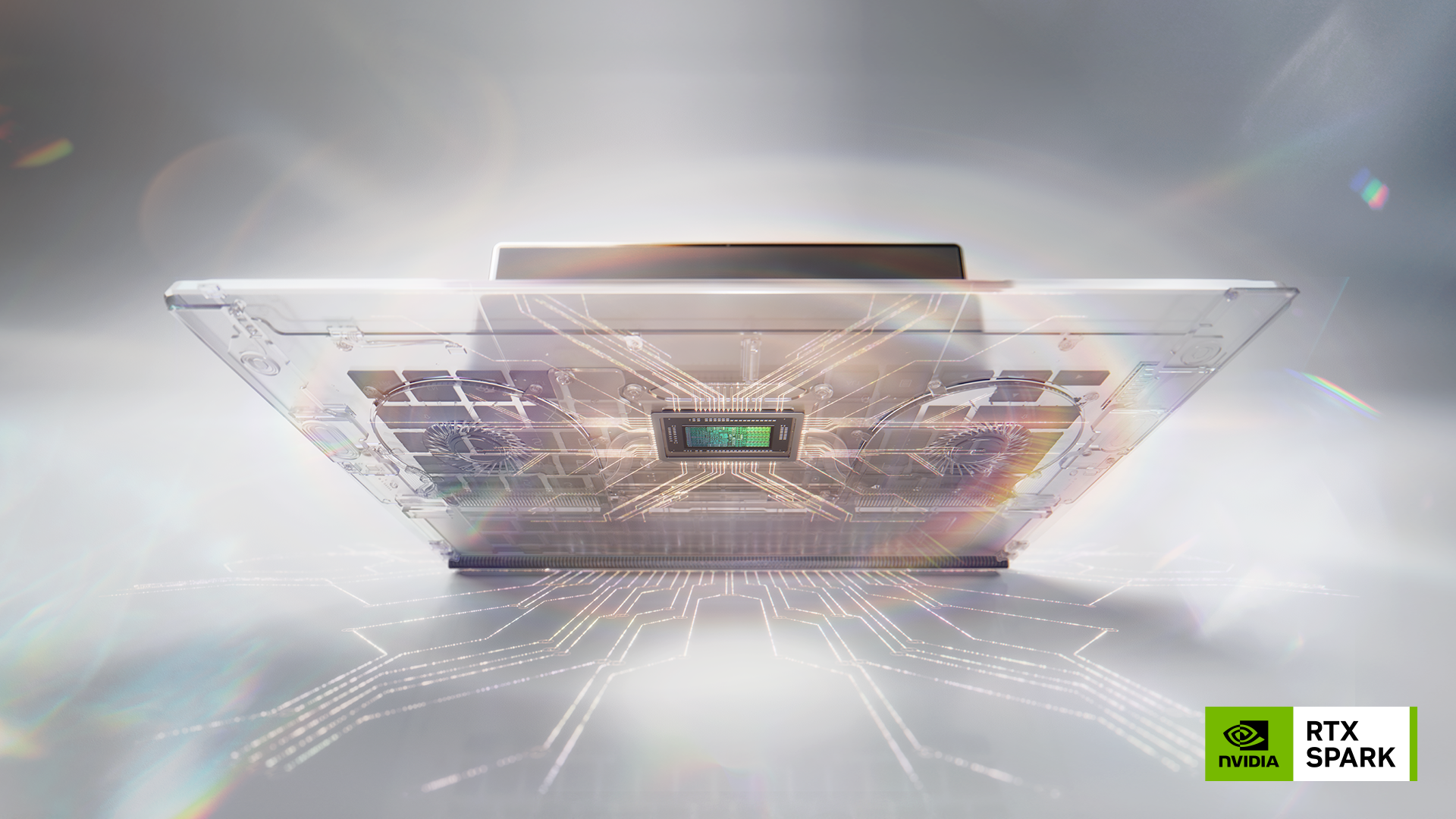
The shift toward Arm-based architecture is a key part of this strategy. By collaborating with MediaTek on a custom Arm CPU, Nvidia is positioning itself to capture a share of what Jensen Huang describes as a $200 billion CPU industry.
As reported by Al Jazeera, industry analysts see this as a revolutionary moment that could redefine the next decade of personal computing. While Microsoft is leading with the Surface line, the RTX Spark will also power compact desktops and laptops from Dell, HP, Lenovo, ASUS, and MSI, with models from Acer and GIGABYTE expected to follow later.
The rollout is scheduled for this fall. Whether these “AI personal computers” can truly move from being mere tools to becoming active teammates remains to be seen, but the hardware foundation is now firmly in place.
