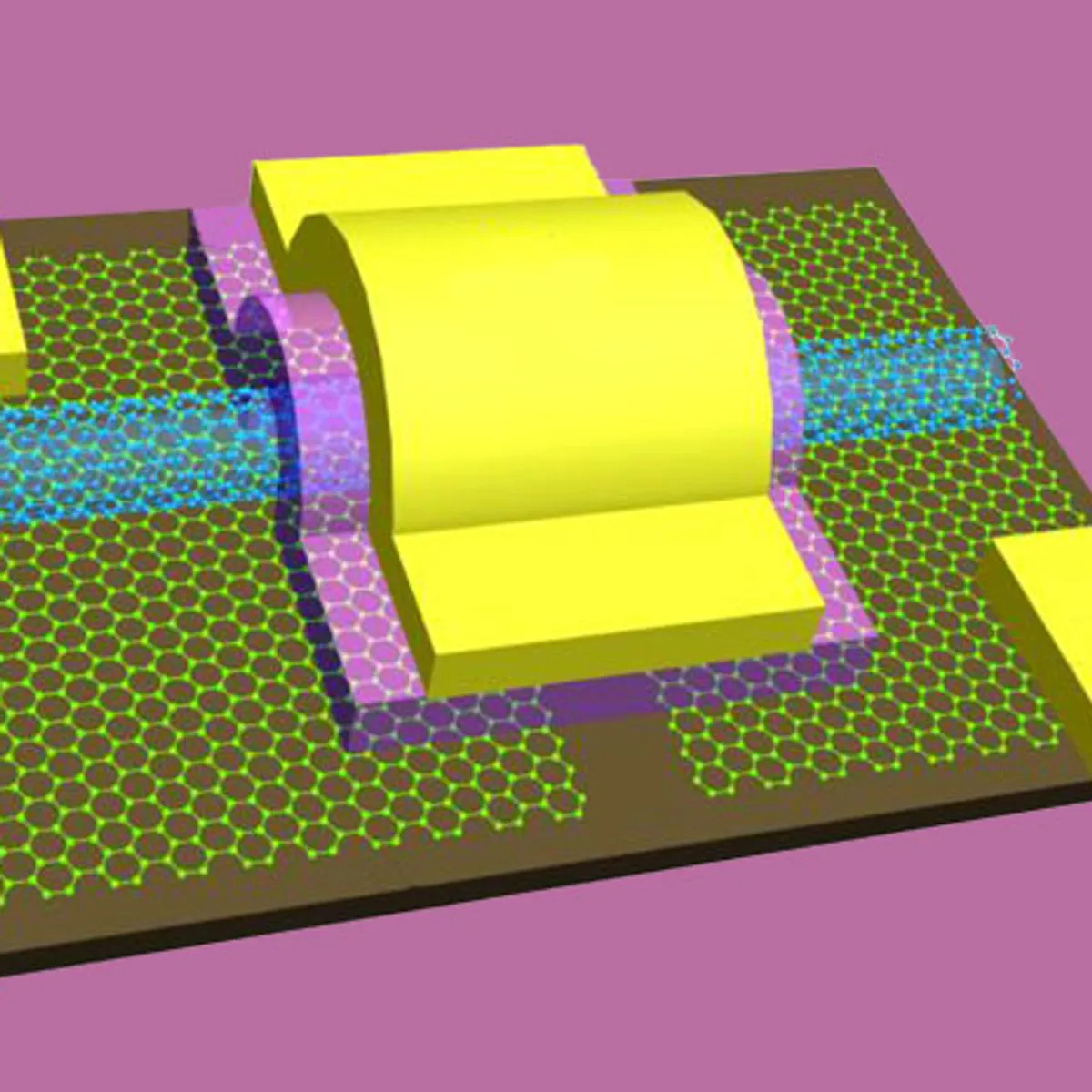
Researchers at the University of Tokyo synthesized the world’s smallest semiconducting nanotubes, measuring just 1 nanometer in diameter. By growing molybdenum disulfide inside protective boron nitride tubes, the team achieved atomic-level structural control, confirming theoretical predictions from 25 years ago and opening a path toward miniaturized gate-all-around transistors.
The 1-Nanometer Structural Breakthrough
Producing stable nanotube structures at the 1-nanometer scale has long been a struggle for materials science. Most conventional manufacturing methods are limited to diameters above 10 nanometers and often result in irregular atomic structures or multiwalled concentric tubes. The University of Tokyo team bypassed these limits by using a coaxial growth method.
The process involves triggering chemical reactions within the narrow, confined space of boron nitride (BN) nanotubes. These BN tubes act as a protective outer environment, constraining the growth of molybdenum disulfide (MoS2) and forcing it into highly uniform, single-walled arrangements. According to Associate Professor Yusuke Nakanishi, this confinement is what allows for the precise atomic arrangement necessary for engineered applications.
To verify the success of the synthesis, the team utilized electron microscopy images and chemical mapping. These tools confirmed that the resulting tubes are approximately 100,000 times thinner than a human hair.
Why Molybdenum Disulfide Displaces Carbon
For years, carbon nanotubes were the primary focus for the future of computing. However, carbon has a volatility problem. A microscopic twist in a carbon nanotube can randomly flip its identity, turning a reliable semiconductor into a chaotic metal conductor. This unpredictability makes mass-producing reliable computer processors nearly impossible.
By switching to molybdenum disulfide nanotubes, the researchers eliminated this instability. The material advantages are stark:
Consistency: MoS2 allows for atomic-level structural control, ensuring properties remain uniform across devices.
Predictability: Unlike carbon, MoS2 does not randomly shift between metallic and semiconducting states.
Precision: The coaxial structure provides a defect-free architecture suitable for high-resolution sensing and quantum-scale research.
This shift is more than a material substitution; it is a move toward reproducibility. In the world of semiconductors, consistency is the difference between a laboratory curiosity and a commercial product.
“In nanotubes, even small structural differences can strongly affect their properties. If the structure can be precisely controlled, the properties are more consistent, which is essential for reliable and reproducible transistor performance. Their biggest advantage is atomic-level structural control,”
— Yusuke Nakanishi, Associate Professor at the University of Tokyo
Settling a 25-Year-Old Scientific Debate
Beyond the engineering application, this synthesis settles a theoretical mystery that has lingered for a quarter century. For over 25 years, theorists predicted that the bandgap—the energy barrier that allows a semiconductor to switch between “on” and “off” states—would decrease as the diameter of the nanotube became smaller.
Until now, the lack of stable, ultra-fine nanotubes made it impossible to test this theory experimentally. By achieving the 1-nanometer threshold, the Tokyo team provided the first physical evidence that these theoretical predictions were correct.
“Our paper demonstrates a way for structural control of inorganic semiconducting nanotubes at the atomic scale. And we experimentally demonstrated that the bandgap (related to how materials work as semiconductors) of the nanotubes decreases as their diameters become smaller, in agreement with theoretical predictions proposed more than a quarter century ago.”
— Yusuke Nakanishi, Associate Professor at the University of Tokyo
Photo: Interesting Engineering
The ultimate goal of this research is the development of gate-all-around (GAA) transistors. Current silicon transistors are created by etching bulk silicon, a process that becomes increasingly prone to defects as sizes shrink. The coaxial structure of the MoS2 nanotube, wrapped in an insulating boron nitride shell, is a natural fit for the GAA architecture, which is among the most advanced transistor designs.
However, the transition from a successful synthesis to a working device is not immediate. The researchers face a significant scaling hurdle regarding the length of the tubes. Currently, the nanotubes only reach several hundred nanometers in length. To be viable for practical electronic devices, the team needs to extend that length to approximately 1 micrometer.
While practical applications remain several years away, the ability to control inorganic semiconductors at the atomic scale removes a primary bottleneck in miniaturization. The industry is no longer guessing how these materials behave at the 1-nanometer limit; they now have a blueprint for building them.