
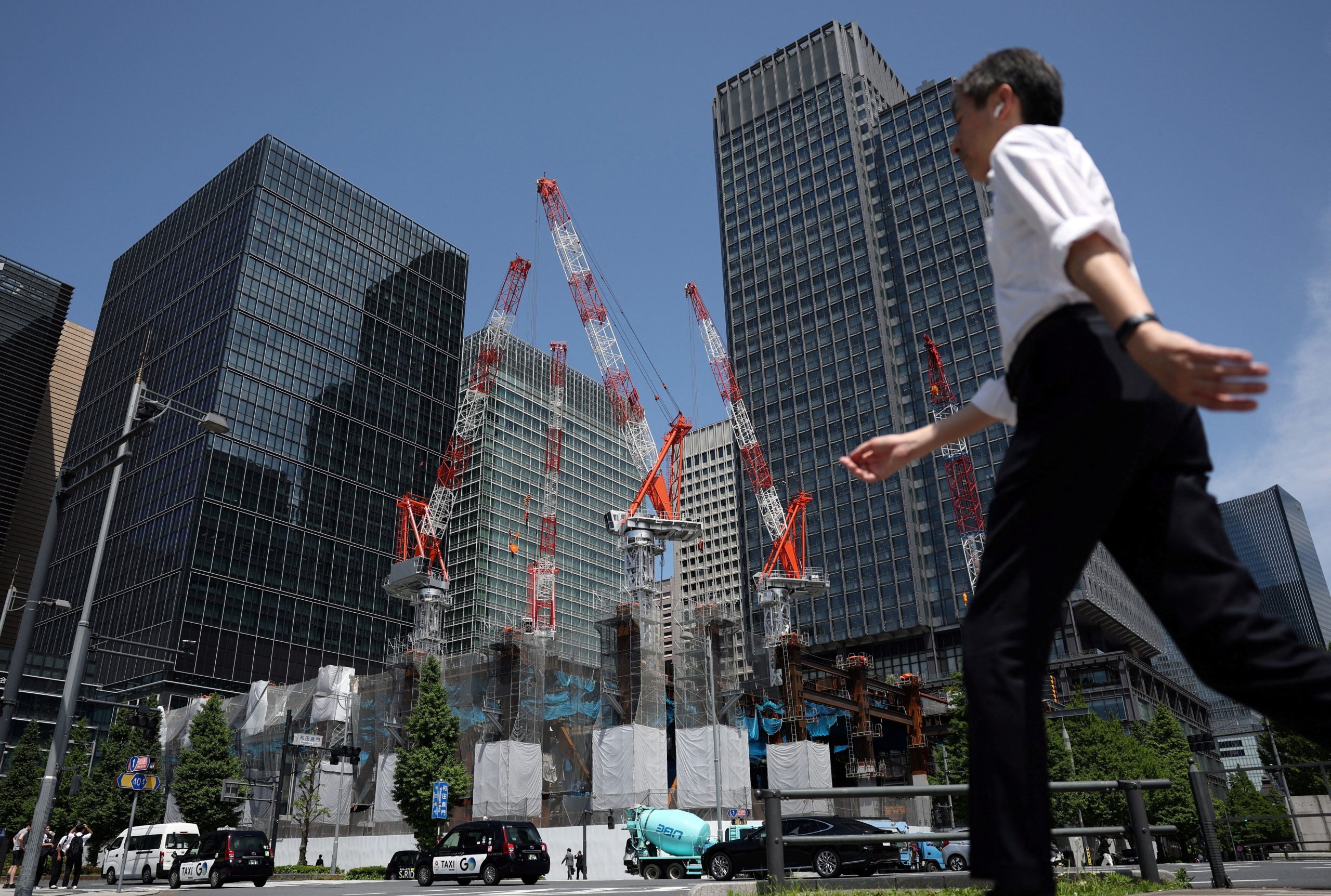
Japan’s economy slowed sharply in the first quarter of 2026, with growth of just 0.5% in non-annualized terms—half the pace of the previous quarter—and a deeper contraction in business investment than expected, according to revised gross domestic product data released by the Cabinet Office. The slowdown, driven by weakening investment and rising energy costs tied to Middle East tensions, has left policymakers scrambling to balance inflationary pressures with the risk of stagflation as the Bank of Japan prepares to tighten monetary policy.
First-Quarter GDP Revisions Reveal Deepening Economic Weakness
Japan’s first-quarter growth of 1.8% in annualized terms—revised down from an initial estimate of 2.1%—paints a picture of an economy losing momentum. The culprit? A 0.7% contraction in business investment, worse than the 0.3% decline anticipated by economists and a stark reversal from the 0.9% drop forecasted by market consensus. This downturn in capital spending, which accounts for a significant share of GDP, signals that companies are pulling back on expansion plans, likely due to uncertainty over energy costs and global demand.

Private consumption, the backbone of Japan’s economy and over half of its GDP, held up better, growing by 0.3% in line with preliminary estimates. Yet even this resilience is under threat: surging fuel prices, triggered by recent U.S.-led strikes on Iran and Tehran’s partial closure of the Strait of Hormuz—a conduit for a fifth of the world’s oil and gas—have squeezed household budgets and corporate margins. The Cabinet Office’s revised figures underscore how fragile the recovery remains, with external demand contributing just 0.3 percentage points to growth, unchanged from earlier estimates.
Output Gap Closes as Energy Crisis and Trade Pressures Intensify
The slowdown is not just a statistical blip. According to the Cabinet Office, Japan’s economy is now operating at or near full capacity, with the output gap—once a cushion against downturns—effectively closed. This means any further shocks, whether from energy price spikes or tighter U.S. trade policies, could push the economy into a dangerous slowdown. The risk of stagflation, where inflation persists alongside weak growth, is growing more tangible by the day.
U.S.-Japan Trade Deal Creates New Export Headwinds
The U.S.
Japan’s export-driven economy faces a new headwind: a bilateral trade deal with the U.S. that, while reducing some tariffs, has left others at punitive levels. The agreement, finalized in September 2025, cuts U.S. tariffs on Japanese goods to 15%—down from a peak of 25% announced earlier in the year—but maintains a 25% tariff on automobiles, a sector critical to Japan’s trade balance. The net effect? The average tariff on Japanese exports to the U.S. has fallen to 11.5%, but the damage is already being felt.
In the first half of 2025, Japan’s trade surplus narrowed as import growth outpaced exports, a trend that could worsen if U.S. demand for Japanese goods continues to soften. The automotive sector, which accounts for nearly a third of Japan’s exports to the U.S., is particularly exposed. Meanwhile, Japan has committed to a $550 billion investment in the U.S. economy by 2029, a move that could ease some trade tensions but also exposes domestic industries to further competition.
The trade deal is a double-edged sword. On one hand, it reduces some tariff barriers, potentially boosting Japanese exports in the long run. On the other, the high remaining tariffs—especially on automobiles—and the pressure to open Japan’s domestic market to U.S. goods, particularly in agriculture, could hurt key industries. The risk is that Japan’s export machine, which has powered growth for decades, may stall just as domestic demand shows signs of fatigue.
Bank of Japan Faces Inflation-Growth Dilemma as Rate Hike Looms
Inflation remains a stubborn challenge, with consumer prices still above the Bank of Japan’s 2% target. The latest data show that while private consumption has held up, the cost of living continues to rise, eroding purchasing power. The BoJ is now caught between two fires: the need to rein in inflation and the risk of choking off growth by raising interest rates too aggressively.

Sources close to the BoJ have indicated that a rate hike is likely in the coming weeks, unless the Middle East conflict escalates sharply and sends global oil prices spiraling. The central bank’s dilemma is clear: tighten too soon, and risk tipping the economy into recession; wait too long, and inflation could become entrenched. The revised GDP figures add urgency to this debate, as they show that the economy is already showing signs of overheating.
The BoJ’s next move will be critical. A rate hike could provide some relief on inflation, but it also risks further weakening an already fragile investment climate. The Cabinet Office’s budget supplement—an additional $19 billion to offset energy cost increases—is a stopgap measure, not a long-term solution. Without a clearer path on monetary policy and trade, Japan’s growth outlook remains clouded.
-
Stagflation Scenario: If energy prices remain elevated and the BoJ hikes rates, Japan could face a period of stagnant growth combined with high inflation—a nightmare for policymakers. This would test the resilience of private consumption and force the government to consider further fiscal stimulus.
-
Moderate Slowdown: If the Middle East conflict stabilizes and the BoJ adopts a cautious approach to rate hikes, Japan’s economy could settle into a slower but stable growth path. This would allow companies to rebuild investment confidence, but growth would remain subdued.
-
Surprise Resilience: The latest PMI data, which show a composite index of 52.0 in August—indicating expansion—suggest that some sectors may continue to perform strongly. If this momentum carries into the third quarter, Japan could avoid the worst-case outcomes, though the risks remain significant.
The coming months will be decisive. The BoJ’s policy stance, the evolution of the Middle East conflict, and the impact of U.S. trade policies will all shape Japan’s trajectory. One thing is clear: the days of easy growth are over. Japan’s economy is at a crossroads, and the choices made in the next few months will determine whether it can navigate the headwinds or succumb to them.
For now, the message from the data is unambiguous: Japan’s growth engine is sputtering. The question is whether policymakers can keep it running—or if the country is heading for a harder landing.
