

Ho Chi Minh City Real Estate Association (HoREA) has just sent a document to the Prime Minister and real estate corporations and businesses with a recommendation that real estate businesses should soon restructure market segments and reduce selling prices. housing products suitable for people’s income to both overcome difficulties in the real estate market and contribute to rescuing… ourselves.
3 years of absence apartment under 25 million/m2
According to HoREA’s statistics, from 2020 until now, the real estate market has fallen into difficulties with supply and demand imbalance, segment imbalance, and housing product imbalance.
Specifically, there is a lack of housing supply, especially affordable apartments. Typically in Ho Chi Minh City, the housing supply in projects in 2020 is 16,895 units, in 2021 it will decrease to 14,443 units, in 2022 it will decrease to 12,147 units and by the end of the 3 quarters of 2023 there will be signs of slight recovery. with 15,020 units.
Many types of accumulated costs make it difficult for many investors to reduce house prices. Photo: Quoc Hai
Along with that, the deviation towards the high-end segment and the lack of affordable housing has shown that the market is seriously unbalanced and has not developed sustainably.
Accordingly, the city’s high-end housing segment in 2020 accounts for 70%, in 2021 accounts for 72%, in 2022 accounts for 78.2% and in the first 9 months of 2023 accounts for 66.37%. Meanwhile, mid-range housing in 2020 accounts for 29%, in 2021 accounts for 28%, in 2022 accounts for 21.8% and in the first 9 months of 2023 accounts for 33.63%.
In particular, the affordable housing segment in 2020 has only 163 apartments, accounting for 1%. Entering 2021, 2022 and the first 9 months of 2023, there are no more affordable housing apartments appearing on the Ho Chi Minh City market.
Mr. Le Hoang Chau, Chairman of HoREA analyzed that the market segment mismatch, the shift towards the high-end housing segment and the lack of affordable housing apartments have shown the pyramid model of the current housing market. “upside down”, unbalanced, unsustainable.
Because the affordable housing segment includes affordable housing, social housing should account for the majority, the highest proportion, but in reality it is too little, even in the last 3 years there has been no more. this type of house. While the high-end housing segment should only account for the smallest proportion, in reality it accounts for the largest proportion, accounting for 70-80%, overwhelming the housing market.
“This situation has led to speculation and hoarding, distorting the real estate market and consuming a large amount of social resources. In economic terms, there has been a waste of social resources, in There is a wasteful situation due to ineffective use of land resources,” Mr. Chau worried.
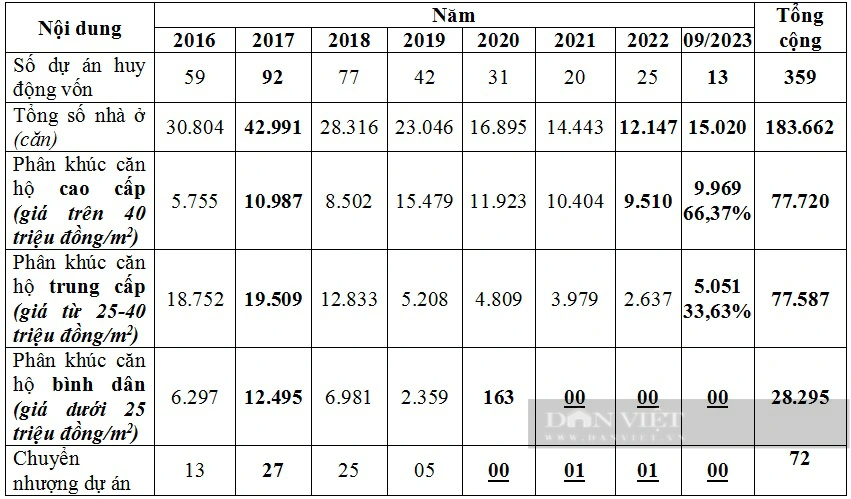
Summary of housing projects to be formed in the future period 2016 – September 2023 in Ho Chi Minh City. Source: HoREA.
In addition, in the past 3 years, the number of businesses in Ho Chi Minh City with housing products on the market is not many. Specifically, in 2021 there will be 20 businesses, in 2022 there will be 25 businesses. In the first 9 months of 2023 alone, there are 13 businesses with 15,020 apartments launched on the market, including 9,969 high-end apartments (accounting for 66.37%), the rest are 5,051 mid-range apartments and no low-cost apartments. affordable.
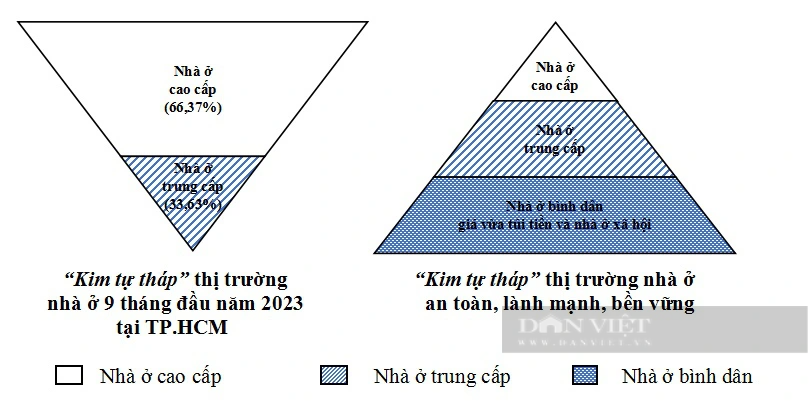
Housing market “pyramid” model in Ho Chi Minh City. Source: HoREA.
“According to the law of supply and demand, due to the lack of housing supply while the demand for housing is very large, especially the need for affordable housing, leading to a situation where house prices have increased continuously in recent years with an increase in housing prices. The average price is around 10%/year,” Mr. Chau explained.
Why is it difficult for investors to “cooperate” to reduce house prices?
Recently, the Prime Minister has continuously called on businesses to reduce house prices. According to HoREA’s comments, in fact, in high-end housing projects and mid-range housing projects, some investors have reduced selling prices but the level of price reduction is not significant.
Specifically, mainly investors implement discount, promotion and after-sales policies that are beneficial to customers to try to anchor prices. Because construction costs, raw materials, labor, financial costs, management costs all increase and there are even “nameless costs”.
Citing evidence, Mr. Chau said that investors are bearing many types of costs. First: Land costs of the project, including compensation costs, site clearance through receiving land use rights transfer, paying land use fees, land rent, and rice land protection fees (if any). rice land use) for the State.
Land costs account for about 15% of the cost for apartment projects; around 30% for townhouse projects; around 20% for villa projects.
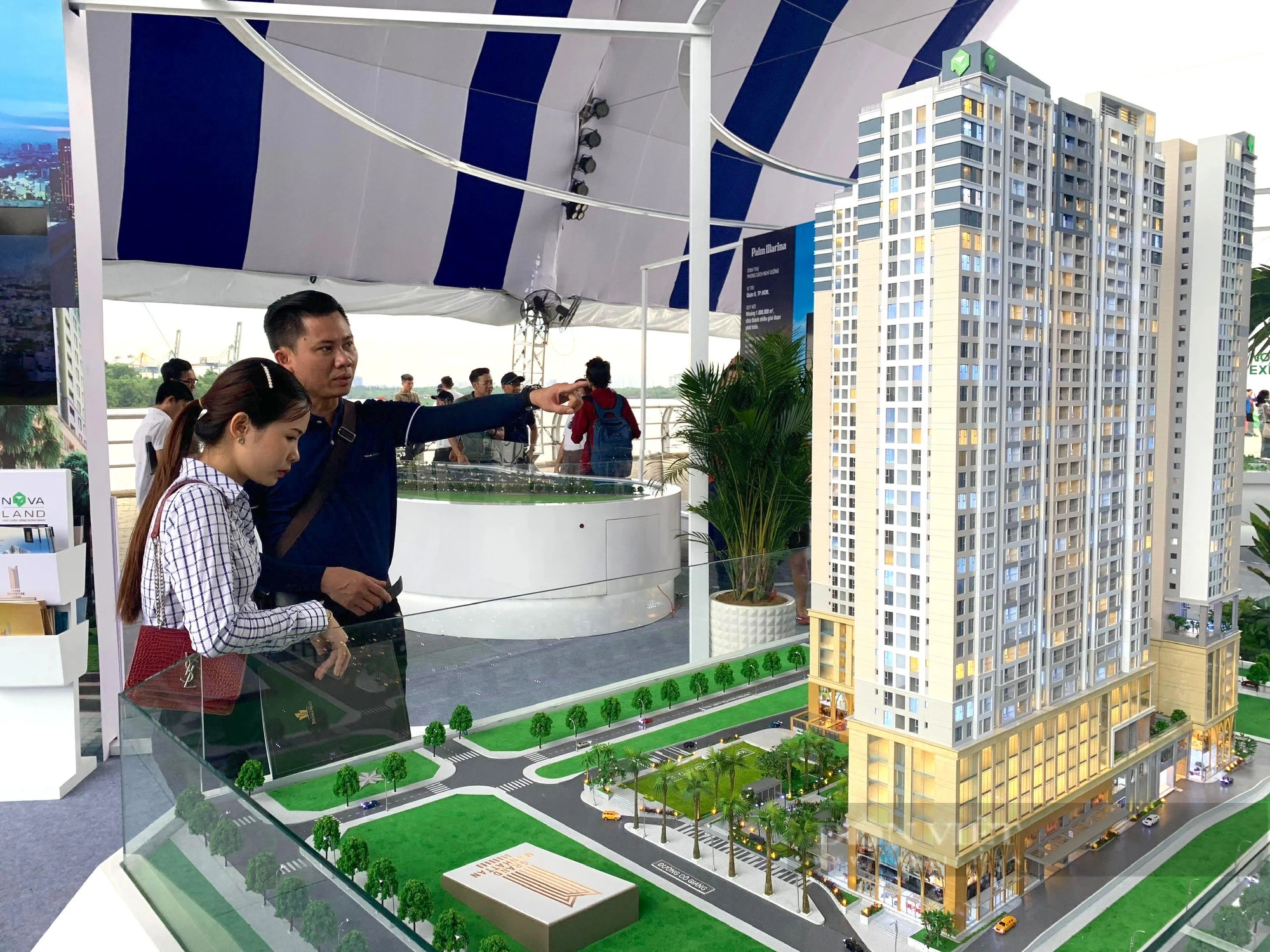
Due to the lack of housing supply while the demand for housing is very large, especially the need for affordable housing, house prices have increased continuously in recent years. Photo: DV
In particular, compensation and site clearance costs are currently usually deducted by competent state agencies at around 70% of the actual costs spent by businesses. The “remaining real costs” that have not been deducted are “considered profits” and businesses also have to pay an additional 20% corporate income tax, which is ultimately included in the selling price that customers bear when purchasing. home.
Second, construction costs account for around 50% of the cost for apartment projects, around 30% of the cost for townhouse projects, around 20% of the cost for villa projects and Construction costs tend to increase by as much as 1m2 Apartment building floor is up to 12-13 million VND/m22 Compared to before, it was only about 7-8 million VND/m22.
Third, financial costs including interest on credit loans and interest payments on other sources of capital usually account for about 10% of the cost.
Fourth, management costs usually account for about 5% of the cost.
“All of the above costs are calculated under normal market conditions for commercial housing projects that are implemented smoothly over an average period of 3 years, if prolonged due to legal problems as in reality. The economic situation that has occurred in recent years has resulted in the total investment cost being greatly increased. This situation has caused a shortage of project supply, leading to a shortage of housing supply, leading to a very short supply situation. Affordable housing project suitable for people’s income,” Mr. Le Hoang Chau explained.
Finally, there are also unnamed costs that are not valid and are not included in investment costs, but are ultimately included in the selling price that customers pay when buying a house.
