
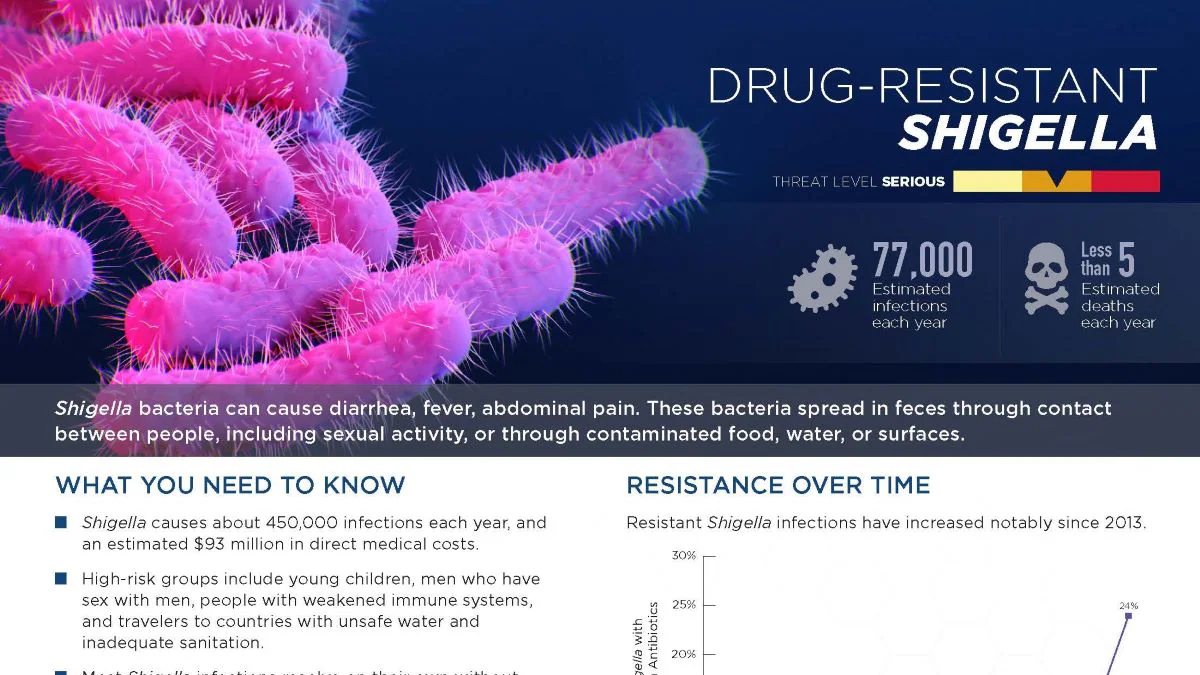
The Centers for Disease Control and Prevention reported a sharp rise in extensively drug-resistant Shigella infections in the United States, with the proportion of resistant strains jumping from zero to 8.5 percent between 2015 and 2023.
This increase mirrors a global trend highlighted by a University of Washington study showing one in four children in low- and middle-income countries suffers severe Shigella-related diarrhea requiring medical care within their first two years, many cases resistant to standard antibiotics.
Shigella causes approximately 450,000 infections annually in the U.S. And is linked to an estimated 100,000 deaths worldwide each year, primarily among children under five in developing nations.
The CDC’s analysis of 16,788 bacterial isolates collected through PulseNet from 2011 to 2023 identified 510 cases of extensively drug-resistant Shigella, defined by resistance to five commonly used antibiotics, leaving no approved oral treatment options.
While past outbreaks mainly affected children and were treatable with standard drugs, the resistant strains now predominantly infect adult males in the U.S. With an average age of 41, most of whom acquired the infection domestically without recent travel.
Among those with available data, 76.2 percent reported no recent domestic travel and 82.4 percent reported no recent international travel, underscoring local transmission as a key driver of the U.S. Surge.
Shigella spreads easily through fecal-oral transmission — via contaminated food, water, surfaces, or person-to-person contact — meaning even microscopic exposure can trigger infection characterized by severe diarrhea, fever, and stomach cramps.
Public health experts warn that rising antibiotic resistance not only complicates treatment but increases the risk of long-term health consequences, including impaired growth and chronic gut inflammation that may weaken vaccine response.
In settings like Seattle with advanced diagnostic capacity, researchers have documented Shigella rapidly developing resistance to antibiotics used clinically, signaling a broader threat even in high-resource areas.
The University of Washington study’s lead author emphasized that prevention through safe water and sanitation remains the most urgent priority, given the high burden of infection and dwindling treatment options.
How is Shigella transmitted, and who is most at risk?
Shigella spreads through ingestion of the bacteria, typically via contaminated food, water, or surfaces, or direct person-to-person contact. In the U.S., recent cases of drug-resistant strains have primarily affected adult males around age 41 who acquired the infection domestically, while globally, children under five in low- and middle-income countries face the highest burden of severe disease.

Why are treatment options for drug-resistant Shigella so limited?
Extensively drug-resistant Shigella strains resist five commonly used antibiotics, and the CDC has confirmed that no oral antibiotics approved by the FDA are currently available to treat these infections, leaving clinicians with few effective options.
