
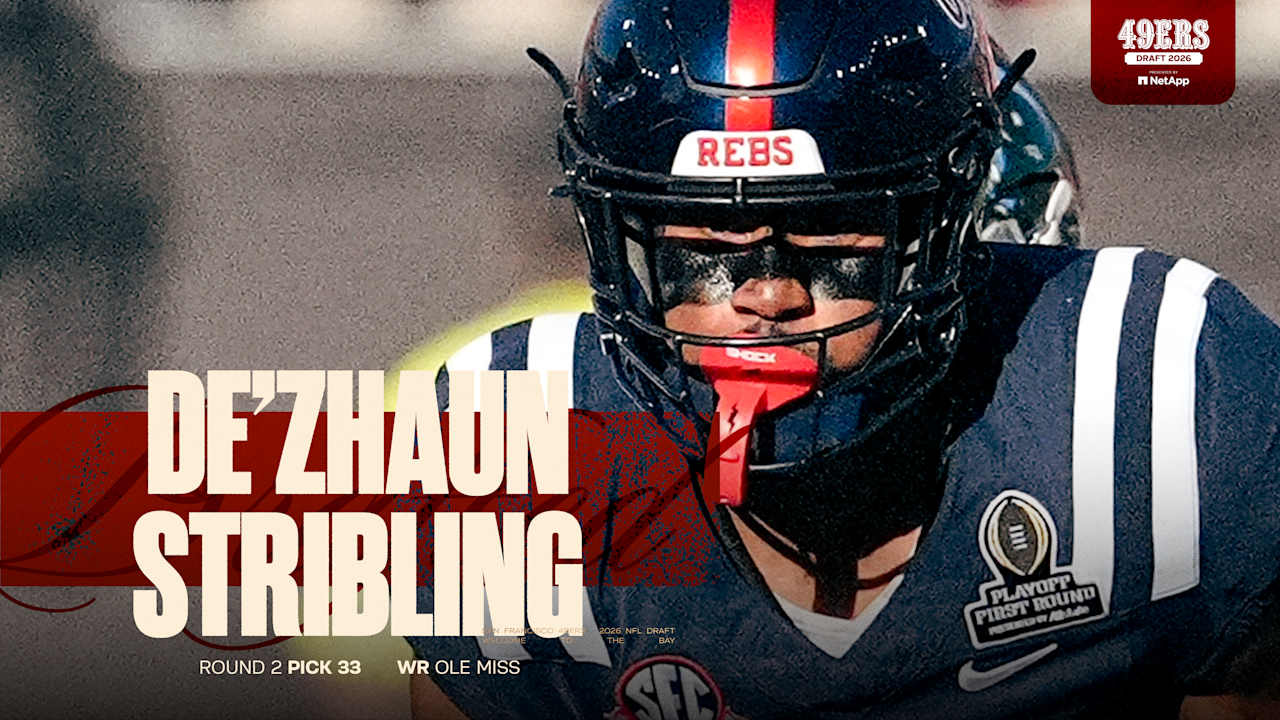
The San Francisco 49ers selected Ole Miss wide receiver De’Zhaun Stribling with the 33rd overall pick in the 2026 NFL Draft, the first selection of the second round after trading out of the first round on Thursday night.
The move completed a wide receiver overhaul that began after the 49ers moved on from Deebo Samuel last season, addressing a need for a playmaker after the catch to complement their existing receiving corps. Stribling, listed at 6-foot-2 and 207 pounds, ran a 4.36-second 40-yard dash at the NFL Scouting Combine and produced 107 catches for 1,693 yards and 12 touchdowns over his final two seasons, including a 2024 campaign at Oklahoma State.
General Manager John Lynch indicated Thursday night that the team had a target in mind for the No. 33 pick, saying, “We have a good idea where we’re going,” after executing two trades that netted the 49ers an additional fifth-round selection and reshaped their draft capital into seven total picks: Nos. 33, 58, 90, 127, 133, 139, and 179.
The 49ers’ offense ranked seventh in the NFL last season but features aging playmakers, including tight end George Kittle, who will turn 33 in November and is recovering from a torn Achilles, and running back Christian McCaffrey, whose 3.9 yards per carry average last season was the second-lowest of his nine-year career and included just one run over 20 yards.
Stribling’s ability to make defenders miss in open space and accumulate yards after the catch was highlighted by NFL.com as a direct replacement for the skill set lost when Samuel departed, with the potential to operate across all three receiver positions in Kyle Shanahan’s scheme.
Free-agent additions Mike Evans and Christian Kirk provide short-term veteran presence but are on essentially one-year deals, making Stribling a candidate to develop into a long-term running mate for second-year wideout Ricky Pearsall.
The Niners also hold the No. 58 overall pick later in the second round, which could be used to address defensive needs after prioritizing offensive playmaking in the early stages of Day 2.
Stribling’s college production reflects a trajectory of increasing offensive involvement
At Ole Miss, Stribling became a primary target in the passing game, posting his best statistical season in 2024 after transferring from Oklahoma State, where he began his college career. His 1,693 receiving yards over two seasons place him among the top productive wide receivers in the Power Five conferences during that span.
The 49ers’ receiver room now blends youth, veteran short-term help, and developmental potential
With Samuel gone, Aiyuk and Jennings remain as the primary returning receivers, but neither profiles as a pure speed threat after the catch. Stribling’s 4.36-second 40 time contrasts with the team’s fastest ball carrier last season being linebacker Dee Winters, who reached 20.15 mph on a pick-six — a figure that translates to approximately 4.39 seconds in the 40-yard dash.
Shanahan’s scheme requires versatile receivers capable of operating in multiple roles
Stribling’s ability to line up inside and outside, combined with his quickness in space, aligns with the 49ers’ offensive philosophy of creating mismatches through pre-snap motion and post-catch creativity — a system that has historically maximized players with his skill set.
:max_bytes(150000):strip_icc():focal(999x0:1001x2)/kyle-shanahan-mike-shanahan-6-7785f44ba64b4188847a23ce53486940.jpg "Stribling Shanahan Kyle Shanahan")
Why did the 49ers trade out of the first round?
The 49ers moved back six spots in the first round to acquire additional draft capital, specifically a third-round pick from one trade and a fifth-rounder from the New York Jets in another, giving them more flexibility to address multiple positions across Rounds 2 through 5.
What makes Stribling a fit for Kyle Shanahan’s offense?
Stribling’s quickness, run-after-catch ability, and positional flexibility allow him to operate in Shanahan’s motion-heavy, scheme-diverse offense, where receivers are frequently used in jet sweeps, screens, and vertical concepts to create yards after the catch.
