Four Palestine Action activists face sentencing at Woolwich Crown Court on Friday, June 12, 2026, following a 2024 raid on an Elbit Systems factory. Judge Mr Justice Johnson must determine if the crimes had a “terrorist connection”, a ruling that would trigger harsher penalties despite the jury’s lack of a terrorism conviction.
The Legal Debate Over “Terrorist Connection” Sentencing
The core of the current legal battle centers on a specific power granted to judges under section 69 of the Sentencing Act 2020. This allows a judge to treat an offense as having a “terrorist connection” during sentencing, even if the jury never convicted the defendant of a terrorism-specific charge. In this case, the four defendants were convicted of criminal damage, not terrorism.
Michael Mansfield KC, a prominent human rights lawyer, argues that applying this label without a jury trial constitutes a “constitutional threat”. According to reporting by The Guardian, Mansfield contends that the state is essentially elevating the nature of the crime after the trial has ended.
“It’s a recategorising the offence without a trial,” Mansfield said. “The fundamental principle is you should not be convicted on any statutory offence for which you have not been charged.”
The stakes for the defendants are significant. A finding of a terrorist connection doesn’t just increase the length of a prison term; it fundamentally alters the terms of incarceration and life after prison. While non-terrorist prisoners typically serve about 40 percent of their sentence in custody before release, those linked to terrorism serve a much higher proportion. Furthermore, they face lifetime requirements to notify police about changes in their personal circumstances.
Penny Green, a professor of law and globalisation at Queen Mary University of London, described the state’s approach as “beyond shocking” given that the activists’ intent was to prevent the killing of Palestinians. An open letter signed by over 50 legal experts warned that “blurring the distinction between principled direct action and terrorism is the hallmark of authoritarian regimes.”
The August 2024 Raid on Elbit Systems
Photo: Al Jazeera
The sentencing stems from a raid on August 6, 2024, at an Elbit Systems research and development facility in Filton, near Bristol. As detailed by Al Jazeera, the activists used an old prison van to smash into the site, armed with crowbars and sledgehammers.
The group targeted military drones and equipment, claiming the action was necessary to save lives in Gaza during Israel’s war, which began in October 2023. Prosecutors estimated the raid caused approximately one million pounds ($1.36m) in damage.
Defendant
Age
Conviction
Samuel Corner
23
Criminal damage; Grievous bodily harm (GBH)
Charlotte Head
30
Criminal damage
Leona Kamio
30
Criminal damage
Fatema Rajwani
21
Criminal damage
The case is marked by a sharp contrast in jury findings. While the “Filton 4” were convicted of criminal damage, the jury previously acquitted all six defendants in the trial of aggravated burglary. Samuel Corner faces the most severe penalties due to a separate conviction for striking a police officer with a sledgehammer, which resulted in a fractured spine.
Met Police Arrests and Court Protests
London Protesters Arrested as Hundreds of Police Crack Down on Palestine Action Demonstration
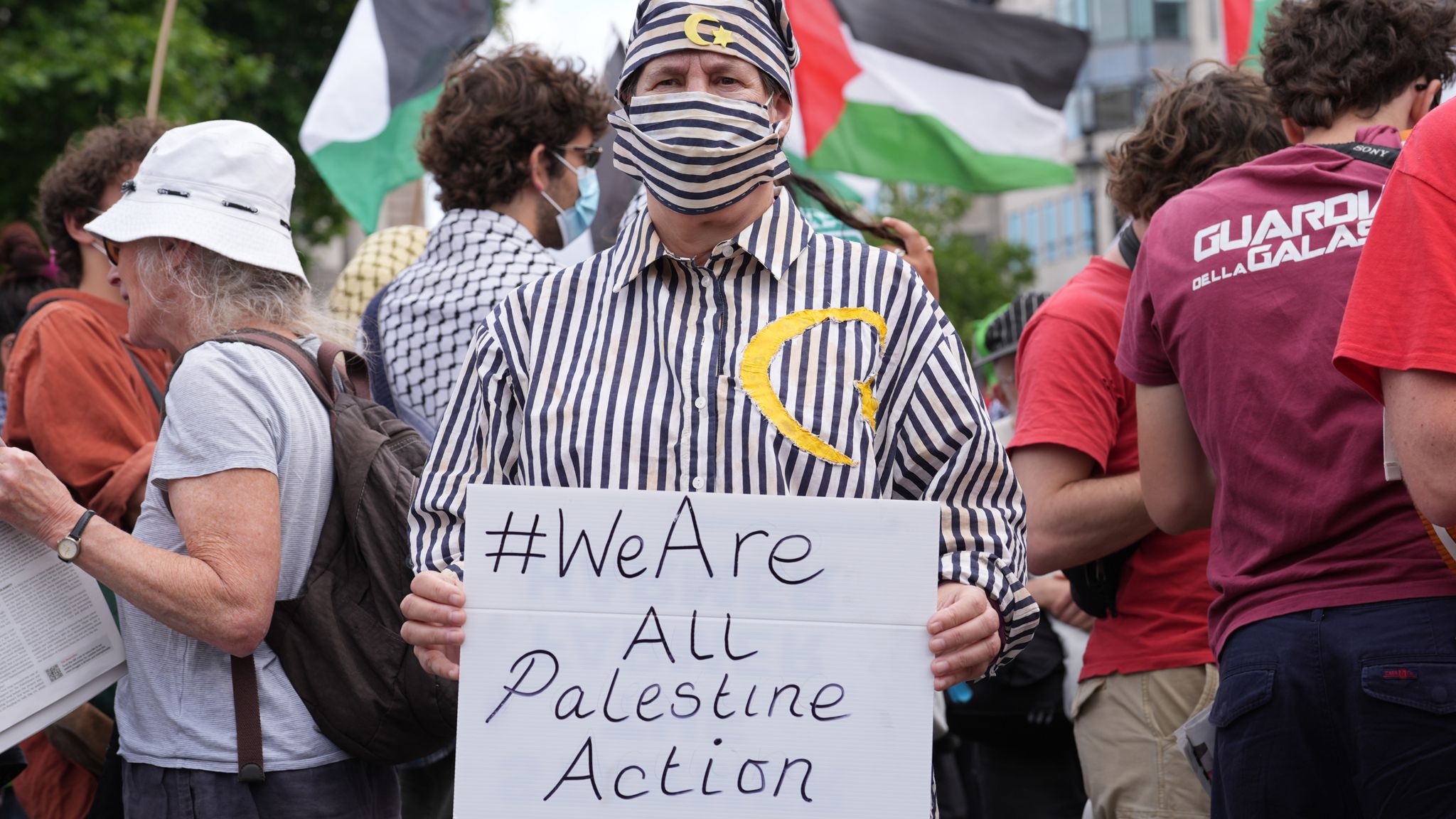
The legal proceedings sparked immediate unrest outside Woolwich Crown Court. The Metropolitan Police arrested 72 people during a demonstration where protesters waved Palestine flags and used megaphones to chant that the police were “complicit in genocide.”
According to The Independent, the arrests were made on the grounds of supporting a proscribed terrorist organisation. Protesters carried signs asserting that “Direct Action is not Terrorism” and “saving lives is not terrorism.”
The Metropolitan Police confirmed that all 72 individuals were taken into custody. This aggressive policing reflects the government’s broader strategy to categorize Palestine Action’s disruptive tactics—which target corporate enablers of the Israeli military—as terrorist activity.
The current sentencing takes place amidst a volatile legal status for Palestine Action. The UK parliament voted to proscribe the group as a terrorist organisation on July 2, 2025, placing it in the same legal category as al-Qaeda and ISIL (ISIS). This move followed a breach of an air force base in southern England.
However, the High Court subsequently ruled that this proscription was unlawful. This creates a paradoxical situation: the state is attempting to sentence individuals as terrorists based on their connection to a group whose official terrorist designation has been challenged in court.
The Court of Appeal is scheduled to decide on Monday whether to uphold the High Court’s ruling. If the court restores the proscription, the judge’s ability to find a “terrorist connection” on Friday is bolstered. If the proscription is permanently struck down, the legal basis for harsher “terror” sentencing becomes significantly more fragile.
A judicial spokesperson defended the process, stating that judges act “without fear or favour” and apply the law as set by parliament and the independent Sentencing Council. The decision by Mr Justice Johnson will serve as a critical bellwether for where the UK draws the line between criminal damage for political motives and domestic terrorism.