
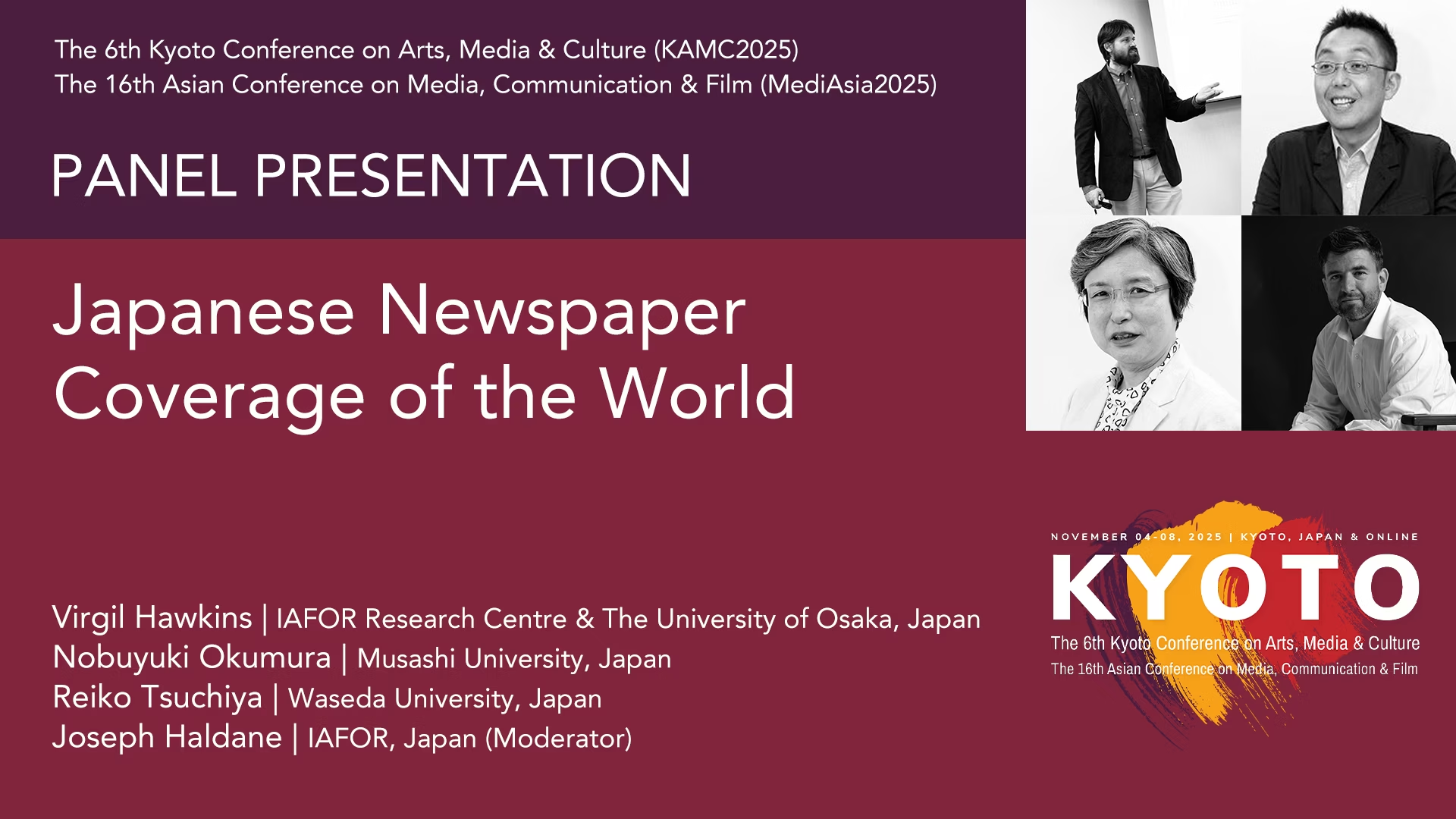
Panel Discussion: Virgil Hawkins, Nobuyuki Okumura, Reiko Tsuchiya, Joseph Haldane (Moderator)
Tuesday, November 4, 2025 | 13:55-14:55 | Science Hall (4F) & Online
The major Japanese broadsheet newspapers in circulation today have a history spanning 150 years, but unlike many of their city-focused Western counterparts, these leading newspapers tend to operate at a national level. They primarily focus on domestic issues, allocating a certain amount of page space to world news and maintaining a network of foreign bureaus. But how do they choose to cover the world? It is reasonable to assume a strong ‘home’ lens, in which countries, regions, and events perceived as impacting Japan’s national interests are prioritised when covering global news. We can also assume that powerful Western countries exert influence on what is reported. However, long-term research on how Japanese newspapers cover world affairs remains limited, and our understanding of broader trends in coverage is still developing.
This panel examines how Japanese newspapers construct and prioritise their coverage of the world, with attention to both historical and contemporary patterns. By bringing together new research on the international orientation of the press, the panel seeks to highlight how domestic concerns, geopolitical pressures, and broader media transformations intersect to shape reporting choices.
Virgil Hawkins
Dr Virgil Hawkins is a professor specialising in world affairs and the news media, and is based at the Osaka School of International Public Policy (OSIPP), The University of Osaka, Japan. He obtained his PhD in International Public Policy from OSIPP, where he focused on international politics, conflict, the UN Security Council, and the news media. He proceeded to work for five years for a non-governmental aid organisation, primarily in Cambodia and Zambia, before returning to the university as a faculty member. He has written and edited a number of books, including Stealth Conflicts: How the World’s Worst Violence is Ignored (2008), and Communication and Peace: Mapping an Emerging Field (co-edited, 2015). His work focuses on furthering our understanding of how and why the vast majority of the world remains relatively uncovered by the news media.
To these ends, Professor Hawkins has since shifted his focus to work at a more practical level. He co-established the Southern African Centre for Collaboration on Peace and Security (SACCPS) (saccps.org) in 2010, which is a network that has brought together researchers and practitioners working on these issues throughout the region. He went on to establish Global News View (GNV) (globalnewsview.org), a large-scale media project that analyses trends and deficiencies in the world news coverage by the Japanese news media, and attempts to compensate for those deficiencies by providing analysis on undercovered global issues.
Likes: 0
Viewed:
