
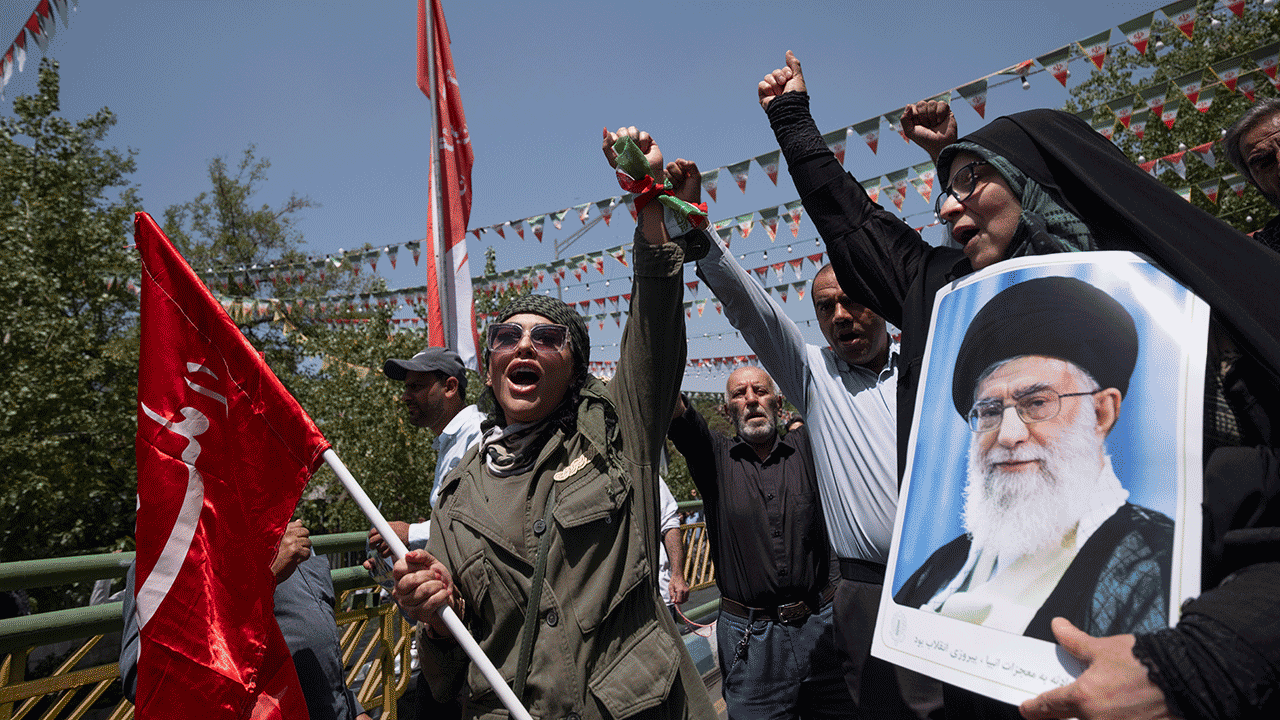
U.S. authorities charged a man linked to an Iranian-backed proxy with terrorism offenses following March attacks on a U.S. consulate and a synagogue in Canada. The suspect, identified as Al-Saadi, allegedly admitted to undercover officers that his associates carried out the strikes under the direction of the Islamic Republic’s proxies.
The United States has linked a series of violent incidents in Canada to a network of operatives acting on behalf of the Iranian government. Federal charges filed against a man identified as Al-Saadi allege that he served as a conduit for the Islamic Republic’s proxy forces, coordinating attacks against diplomatic and religious targets on Canadian soil. According to law enforcement reports, Al-Saadi provided critical admissions to an undercover officer, stating that his people
were responsible for two specific operations: a shooting at a U.S. consulate and an attack on a synagogue.
The Toronto Consulate and Synagogue Operations
The investigation centers on a shooting at the U.S. consulate in Toronto that occurred in March 2026. U.S. officials have formally tied this attack to a commander backed by Iran, framing the incident not as an isolated act of violence but as a directed operation. The charges against Al-Saadi indicate that the consulate shooting was part of a broader pattern of aggression targeting U.S. interests abroad.
Parallel to the consulate attack, the investigation revealed an operation against a synagogue in Canada. The targeting of a Jewish house of worship suggests a strategic alignment with Tehran’s regional rhetoric and its use of proxies to project power far beyond the borders of West Asia. The admission by Al-Saadi to undercover agents provides a direct causal link between the execution of these attacks and the directives issued by Iranian-backed entities.
Kata’ib Hizballah and the Global Proxy Network
Evidence gathered by the FBI and other intelligence agencies points to the involvement of Kata’ib Hizballah, a senior Iranian-backed militia. Reports indicate that a senior commander within Kata’ib Hizballah directed the Toronto consulate attack. The scope of the conspiracy appears to extend beyond Canada, with allegations that the same network plotted a bombing of a synagogue in New York.
This network operates through a sophisticated financial infrastructure designed to evade international sanctions and monitoring. FBI wiretaps have confirmed the use of currency exchanges as a primary mechanism for funding these operations. These exchanges function similarly to cartel-style payment systems, allowing the Islamic Revolutionary Guard Corps (IRGC) and its proxies to move capital across borders to pay for terror strikes across Europe and North America.
Escalation Amid the Broader Iran War
These revelations emerge during a period of open conflict. As of May 17, 2026, the region is embroiled in what is being described as the Iran war
, characterized by a cycle of U.S.-Israel strikes and Iranian retaliation. The conflict has been marked by nuclear threats and severe shocks to the global oil market, with the risk of a total regional war remaining high.
Tehran has recently signaled an intention to increase pressure on international shipping. The Iranian government is expected to reveal a plan to implement tolls in the Strait of Hormuz, a critical chokepoint for global energy supplies. This move coincides with ongoing Israeli attacks in Lebanon and Gaza. In response to these developments, Donald Trump has warned that Iran is heading toward a very bad time
.
Diplomatic Rupture and Internal Governance
The diplomatic relationship between Washington and Tehran has reached a nadir. Iran’s foreign minister, Araghchi, has stated that his government has no trust
in the United States. Araghchi cited contradictory messages
from U.S. officials as a primary obstacle to any serious negotiations aimed at ending the current war.
Internally, the Islamic Republic remains under a unitary presidential theocratic system, which observers describe as an authoritarian dictatorship. The state is led by Supreme Leader Mojtaba Khamenei and President Masoud Pezeshkian. The government continues to maintain a strict grip on domestic affairs while utilizing its external proxies to engage in asymmetric warfare against its adversaries.
The combination of clandestine attacks in North America and overt threats to the Strait of Hormuz suggests a strategy of multi-front pressure. By targeting diplomatic missions and religious sites in Canada and plotting strikes in the U.S., Tehran is demonstrating its ability to penetrate Western security perimeters. The use of Kata’ib Hizballah as a proxy allows the Iranian state to maintain a degree of plausible deniability, though the current U.S. indictments and the confession of Al-Saadi have significantly eroded that shield.
The immediate future of the conflict depends on whether the U.S. and its allies can neutralize the financial conduits—such as the currency exchanges—that fuel these proxy operations. Without disrupting the flow of capital from Tehran to commanders in groups like Kata’ib Hizballah, the risk of further attacks on Western soil remains a persistent threat. As the U.S. continues to process the terrorism charges against Al-Saadi, the broader geopolitical focus remains on the volatility of the Persian Gulf and the escalating military exchanges between Iran, Israel, and the United States.
