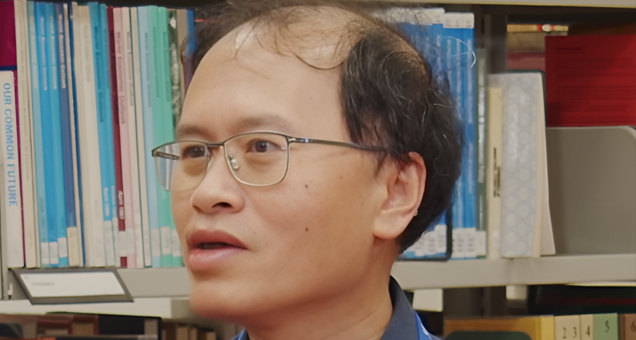
Dam Thanh Son, a University Professor at the University of Chicago, has transitioned from a 1984 International Mathematical Olympiad gold medalist to a premier theoretical physicist. His research, which includes the influential KSS limit, spans nuclear and condensed matter physics, marking a profound scientific trajectory from his early years in Hanoi.
The 1984 IMO gold medal and mathematical roots
Born in Hanoi in 1969 to a family of intellectuals, Son displayed an early aptitude for mathematics that surpassed his peers. His father, Professor of Pharmacy Dam Trung Bao, and mother, Associate Professor Nguyen Thi Hao, a PhD in Biochemistry, provided a scientific foundation for his development.
By the second grade, Son was already solving mathematical problems intended for tenth-grade students. This precocity led the Hanoi Department of Education to allow him to skip grades in mathematics. After attending the specialized Natural Science High School, he reached a global milestone in 1984. At just 15 years old, he earned a perfect 42/42 score at the International Mathematical Olympiad held in Prague, matching the historic achievements of previous Vietnamese mathematicians.
Despite this success in pure mathematics, Son chose to pivot toward the physical sciences. In 1985, he moved to Moscow to study at Lomonosov Moscow State University, specifically enrolling in the physics department rather than mathematics.
Academic progression from Moscow to Seattle
Son’s academic path reflects a steady ascent through the world’s most rigorous research environments. After graduating from Lomonosov in 1991, he earned his PhD in physics from the Moscow Institute of Nuclear Research in 1995.
His post-doctoral career established his presence in the American scientific community. According to reports from VietnamNet, his professional timeline includes:
1995–1997: Postdoctoral researcher at the University of Washington in Seattle.
1997–1999: Researcher at the Massachusetts Institute of Technology (MIT).
1999–2002: Professor at Columbia University and scholar for the RIKEN-BNL program.
2002–2012: Senior researcher and professor at the University of Washington.
This decade of diverse experience across leading institutes allowed him to refine his expertise in using quantum field theory as a universal tool to study phenomena across vastly different energy scales.
The KSS limit and quantum breakthroughs
Dam Thanh Son. the Univ. of Chicago, The emergent “graviton” in the fractional quantum Hall effect.
Son has published over 120 scientific works, with much of his influence stemming from his ability to model complex quantum states. One of his most significant contributions came in 2005 through a study conducted with Pavel Kovtun and Andrei Starinets. This research identified the lowest possible limit of the ratio between viscosity and entropy density in strongly interacting quantum systems, a discovery now widely recognized as the “KSS limit.”
Beyond the KSS limit, his research has explored:
Heavy ion collision research.
The study of Fermi gases and strongly interacting matter.
Liquid black hole models within 10-dimensional space.
Fractional quantum Hall effect states.
His ability to bridge abstract mathematical modeling with physical reality is noted by colleagues. Dr. Vu Nguyen Thanh, a former classmate in Russia and current director of a microbiology laboratory, observed that Son seeks to solve problems completely rather than merely discussing them. He noted an instance where Son modeled and calculated the speed of a mold cell using theoretical frameworks that were later verified through experimental testing.
University Professor status at Chicago
In September 2012, Son reached the pinnacle of academic achievement when he was appointed University Professor at the University of Chicago. This is the institution’s highest academic title, placing him in the same intellectual lineage as legendary physicists Enrico Fermi and Subrahmanyan Chandrasekhar.
“Chandrasekhar’s famous journey from India to Europe planted many emotions and dreams in my heart, as a young boy in Vietnam. And Fermi’s brilliant lectures deeply influenced me as a student in Moscow. I have worked with great excitement for 10 years at the Institute for Nuclear Theory at the University of Washington, and now I am ready to embrace new challenges.”
Photo: vnexpress.net
Dam Thanh Son, via VnExpress
His standing in the global scientific community was further solidified in 2014. During that year, he was elected as a member of both the American Academy of Arts and Sciences and the National Academy of Sciences. Today, he continues to lead research at the Enrico Fermi Institute and the Kadanoff Center for Theoretical Physics, pushing the boundaries of how we understand the fundamental nature of matter and energy.