

Income is not enough to live, 40% of female workers have to spend frugally
At 37 years old, Ms. Nguyen Thi Nham (Nam Dinh), a Canon Company worker, had to temporarily live in a dormitory for workers. As a single mother, she had to take care of her two children alone, so she had to leave her two children behind and ask her grandparents in her hometown to help raise them and go to Hanoi to work.
Ms. Nham said: “In the past, because the couple worked far apart, their relationship was not harmonious. After the divorce, I went to Hanoi to work, my monthly salary was only nearly 7 million VND, just for expenses, food and drinks. I also have to take care of my children, so life is very difficult.”
Fortunately, in early 2023, she received support from the company to find accommodation in a dormitory for workers. Only have to pay 45 thousand for accommodation each month. Previously, when she rented a house, she spent 800,000 VND each month, more than 1/10 of her monthly salary.
Ms. Nham said that with a low salary and having to raise two children, life is very difficult. Photo: Nguyet Ta
Not only Ms. Nham, the lives of most female workers and laborers in industrial zones are very difficult. Results of a survey on the real life situation and exercise of the right to raise and care for children of female migrant workers in industrial and export processing zones recently published by the Women’s Committee of the Vietnam General Confederation of Labor (Confederation of Labor). Dad once again confirmed this.
Accordingly, married female migrant workers account for the largest proportion (more than 85%), unmarried female workers account for 3.3% and divorced and separated female workers account for about 10%.
The workshop announced the results of the survey on “The current situation of life and the implementation of the right to raise and care for children of female migrant workers in industrial parks and export processing zones” and the implementation of a pilot model on ” Caring for and protecting the rights of female workers through dialogue at the workplace” organized by the Women’s Department, Vietnam General Confederation of Labor on December 15, 2023.
The survey was conducted from June to August 2023. The group interviewed 906 workers, 32 employers and 62 grassroots union officials in industrial parks and export processing zones in 10 provinces/cities, and the Central Industry Trade Union.
The report clearly shows that the majority of female migrant workers have to rent motels to stay (53.7%), the number who have their own house when migrating is small (19.1%), while the number of workers are arranged by businesses. houses and collective dormitories are very low (0.3%).
The housing situation of female migrant workers still has many difficulties and shortcomings. 64.7% of female migrant workers live in cramped boarding houses that do not ensure minimum living conditions such as light, clean water, sanitation, lack of living amenities, and do not ensure safety.
Due to their low income, this group of workers often save money and do not buy necessary household items such as air conditioners, washing machines, refrigerators, etc. Even when they are sick, they limit their visits to medical examination and treatment.
Female workers face an unstable married life
Ms. Tran Thu Phuong – Deputy Head of the Women’s Department (General Confederation of Labor of Vietnam) also said that a survey by the Women’s Department of the General Confederation of Labor of Vietnam shows that a family of female migrant workers has to spend nearly 10 million VND on rent. housing, school fees for children, electricity, water, food… Of which, the cost for renting a house is from 1 to 2 million VND.
“Because of unfavorable conditions, the majority of female migrant workers have to accept a life away from their children. The above factors are barriers in family life, directly affecting the care and upbringing of children of female migrant workers,” Ms. Phuong added.
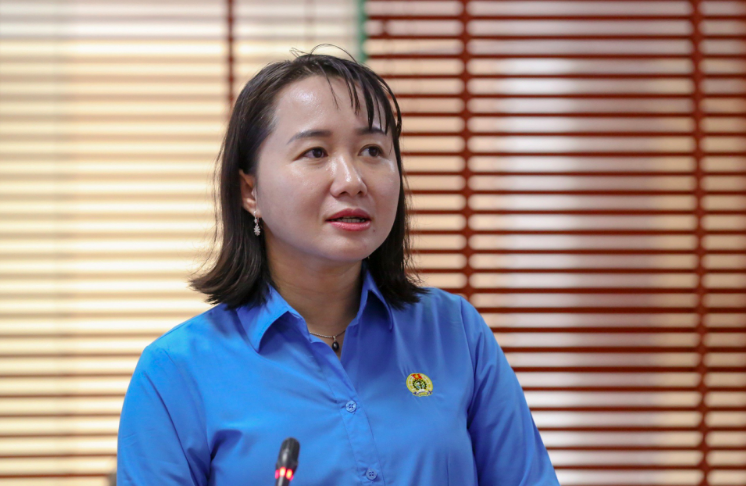
Ms. Tran Thu Phuong – Deputy Head of the Women’s Department, Vietnam General Confederation of Labor shared the research results. Photo: MQ
However, according to Ms. Phuong, the most worrying thing today is the increasing trend of divorce and separation among workers in industrial parks and export processing zones. Accordingly, the rate of single female workers having to raise children alone also increased, creating a significant burden for this group. Many single female workers have no choice but to send their children back home.
“This causes great disadvantages for children when they lack the direct care and upbringing of their parents. It can significantly affect the child’s physical and psychological development, and also affect their physical and psychological development. affects the employees’ emotions and psychology when they have to be away from their children,” Ms. Tran Thu Phuong shared.
To ensure the rights of female migrant workers, the Women’s Union proposed that the union should have a policy to support rent, build social housing for low-income people, etc. Strengthen propaganda sessions for workers. migration on topics such as gender equality, parenting, family, and legal policy. In addition to helping difficult situations, trade unions also need to regularly survey union members to get real voices from the grassroots.
“In addition, there needs to be more policies to support children going to school; increase communication on gender equality; provide additional funding for grassroots unions to invite health consultants for female workers… “, Ms. Van said.
