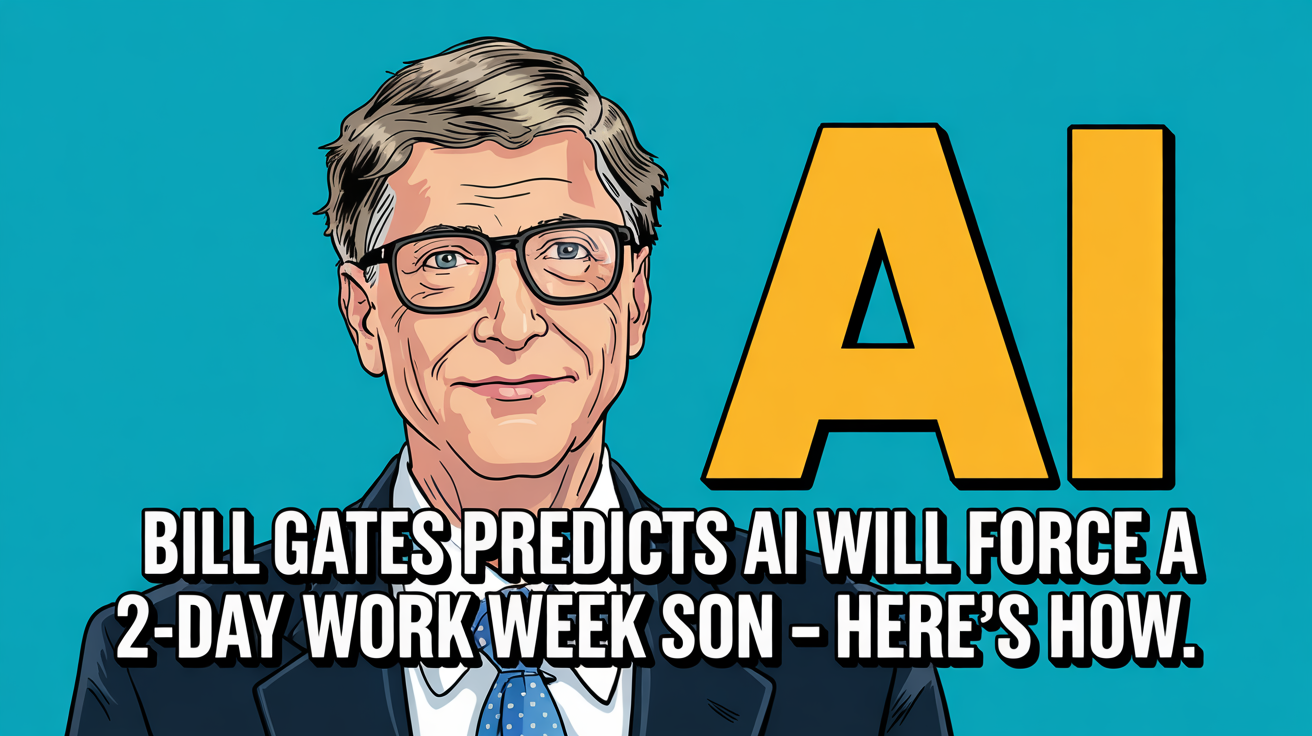
AI Automation and the Reduction of Labor Hours

The forecast for a shorter workweek centers on the ability of artificial intelligence to handle cognitive tasks that previously required full-time human attention. Gates suggests that as AI agents become capable of managing schedules, drafting documents, and analyzing data, the volume of hours required to maintain current productivity levels will drop.
This shift relies on the transition from human-led execution to human-led oversight. In this model, employees no longer spend the majority of their time performing repetitive digital labor but instead act as editors and strategists for AI-generated work.
wp:quote
If AI does a significant portion of the work, it’s possible that we could move to a three-day workweek. The productivity gains could be so great that we don’t need to spend as much time in the office to get the same results.
Bill Gates, Co-founder of Microsoft
The Shift From Hours to Value Output
The economic logic behind the three-day forecast is a move away from time-based compensation toward value-based output. Gates argues that the traditional 40-hour week is a legacy of the industrial era and does not align with the efficiency of the AI era.
According to Gates, the integration of AI into the workplace creates a productivity surplus. If a worker can produce the same value in 24 hours that previously took 40, the surplus time becomes a societal asset. However, he notes that this transition depends on how companies choose to distribute those gains.
The potential for a shorter week is not a guaranteed outcome of the technology itself but a policy choice. Gates suggests that society must decide whether the AI-driven efficiency results in more output from the same hours or the same output in fewer hours.
Comparison With Global Four-Day Workweek Trials
The three-day prediction is a more aggressive timeline than the four-day workweek trials currently implemented in several jurisdictions. Data from 4 Day Week Global, which coordinated trials in the UK and US, showed that companies implementing a 32-hour week often maintained or increased productivity while reducing employee burnout.
While the four-day movement focuses on mental health and work-life balance, the Gates forecast is rooted in technical capacity. The four-day model often involves compressing existing work or slight efficiency gains. In contrast, the three-day model assumes a fundamental collapse in the time required to perform professional tasks due to AI automation.
The difference in scale is significant:
– Four-day trials: Focus on 20% reduction in time via better management.
– Gates’ forecast: Focus on 40% or more reduction via AI agency.
Economic Risks and Labor Displacement
A reduction in work hours does not automatically translate to higher standards of living for all workers. Economists warn that a three-day workweek could lead to wage instability if pay is tied strictly to hours worked.
If AI reduces the need for human hours, there is a risk that companies will reduce headcounts rather than reducing the hours of their existing staff. This creates a divide between those who benefit from increased leisure time and those who face structural unemployment.
Gates has previously addressed this by suggesting that governments may need to implement new tax structures or social safety nets to redistribute the wealth generated by AI productivity. Without such mechanisms, the productivity gains of the AI era could concentrate wealth among the owners of the technology rather than the workforce.
The technical catalyst for this change is the move from generative AI—which produces text or images—to autonomous AI agents. These agents can execute multi-step workflows, such as researching a lead, updating a CRM, and scheduling a meeting without human intervention at every step.
As these agents integrate into corporate software, the administrative burden of professional roles diminishes. Gates believes this will eventually apply to high-skill sectors, including law, medicine, and software engineering, where a large portion of the workday is currently spent on documentation and coordination.
The timeline for this shift remains uncertain. While the tools exist in early forms, the widespread adoption of a three-day week requires a cultural shift in management and a legal shift in labor contracts. The transition will likely be gradual, beginning with flexible arrangements before becoming a standardized corporate expectation.
Find more reporting in our Technology section.