

The Scale of the Chaos and Conflicting Tolls
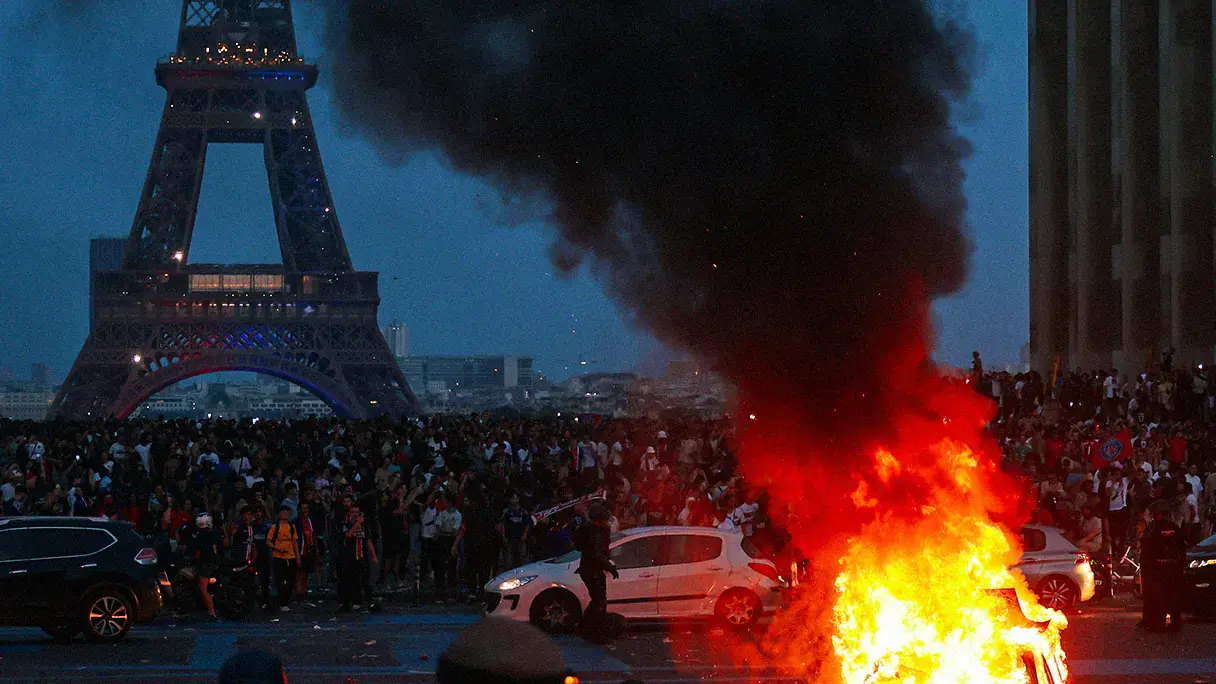
The celebrations followed a tense Champions League final in Budapest, where PSG secured the trophy after defeating Arsenal in a penalty shootout. While the victory marked a historic era of dominance for the Parisian club, the aftermath on the streets of France was characterized by volatility rather than sport.
The sheer volume of law enforcement required to manage the event underscores the French government’s anxiety over repeat performances of previous years’ unrest. Officials deployed 22,000 police officers to monitor the festivities, yet the security perimeter failed to prevent widespread disorder.
Data regarding the fallout varies across reports, reflecting the chaotic nature of the weekend. According to Aftonbladet, Interior Minister Laurent Nuñez stated that more than 890 people were arrested—a 45 percent increase compared to the previous year. Other reports provide lower figures; Omni reports 780 arrests.
The discrepancy extends to police casualties. While Omni reports that 57 officers were injured—most with minor wounds—Aftonbladet cites the Interior Minister claiming that nearly 180 officers were hurt during the unrest.
Violence on the Champs-Élysées and Urban Warfare

The epicenter of the unrest was the Champs-Élysées, where Svenska Dagbladet reports approximately 20,000 supporters gathered. For many business owners in the capital, the celebration was a threat to be weathered; many had preemptively barricaded doors and windows to stave off the looting that has plagued previous title runs.
The disorder was not limited to celebratory crowds. The violence took on an aggressive, targeted tone in several locations.
Key incidents reported during the riots include:
These events suggest a shift from spontaneous fan exuberance to calculated aggression, turning a sporting triumph into a security crisis.
Political Undercurrents and Macron’s Response
President Emmanuel Macron did not mince words during a Sunday parade on the Champs-Élysées, distancing the state’s sporting pride from the street violence.
“Now is enough. This is not football, not sport, not what we love.”
Emmanuel Macron, President of France
However, the violence may be a symptom of deeper societal fractures rather than mere football hooliganism. Analysis from Kvartal suggests that the riots are an outlet for systemic frustration. Photographer Kristofer Sandberg, who resides in France, noted that there is a very strongly underpinned dissatisfaction with President Macron.
In this context, the football victory serves as a catalyst. The gathering of thousands of young people provides a convenient cover for political venting, allowing a “small clique” to weaponize a sporting celebration to express antipathy toward the current administration.
Stabilization and the “Small Clique” Narrative

Despite the high arrest counts and injuries, the French government is keen to frame the violence as the work of a minority. Interior Minister Laurent Nuñez maintained that the majority of the celebrations remained peaceful and that the situation was under control by Sunday.
This framing attempts to protect the image of the victory while isolating the rioters. Yet, the fact that arrests increased by nearly 50 percent over last year suggests that the “small clique” is either growing or becoming more emboldened.
As France recovers from the weekend, the tension remains. The contrast between the glory of a second consecutive European crown and the image of burning cars on the Champs-Élysées leaves a bitter taste for the city. For PSG, the trophy is secure; for the French state, the victory has once again exposed a volatile relationship between the government and the streets.