

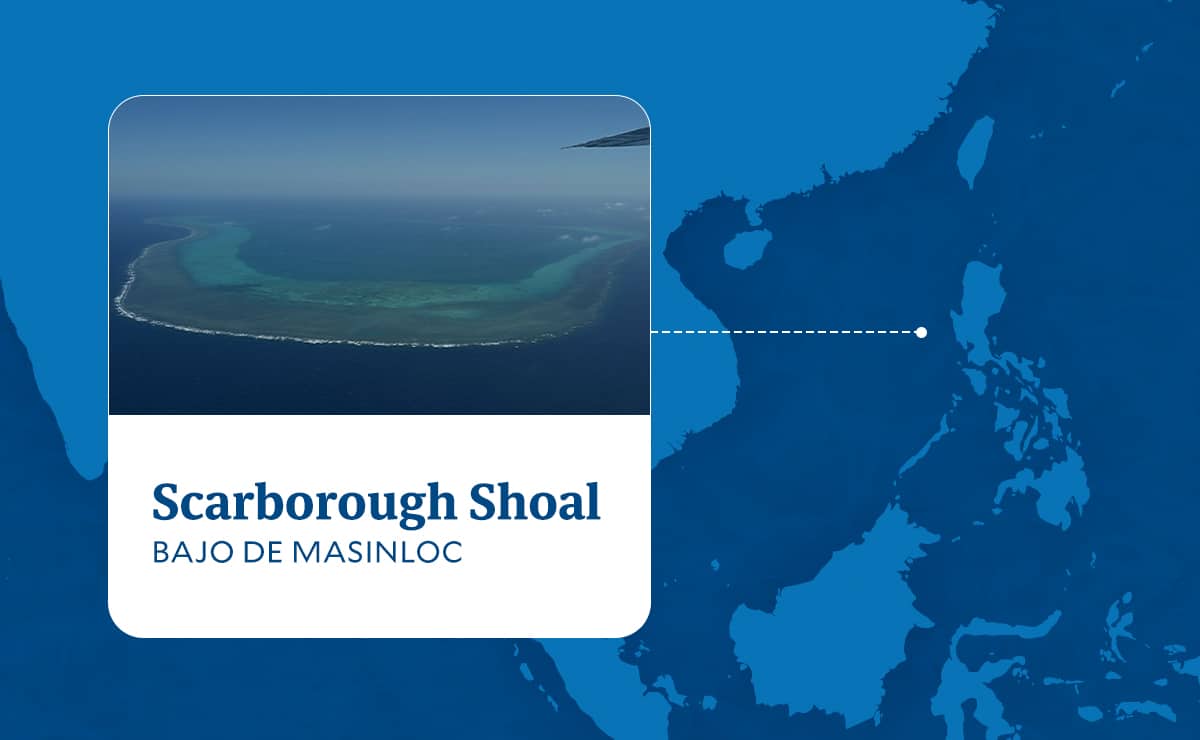
The Philippines is currently verifying reports of a suspected Chinese structure inside Scarborough Shoal, according to Defense Secretary Gilberto Teodoro Jr. While the military has monitored a small 6-by-6 meter object, Manila is simultaneously denying Chinese claims of coordinated military drills in the area while seeking deeper defense ties with Taiwan.
The 6-by-6 Meter Mystery at Scarborough Shoal
Manila is currently processing raw information
suggesting that Beijing may have installed a new physical presence within the lagoon of Scarborough Shoal. While the reports are concerning, the Philippine government is maintaining a posture of cautious verification. Defense Secretary Gilberto Teodoro Jr. announced that authorities cannot yet definitively categorize the object, stating, We’re not even sure if it’s a structure.
The uncertainty stems from the nature of the shoal itself. Teodoro noted that objects like buoys are frequently placed in the area or simply drift in from the open sea. However, the military’s internal monitoring suggests something more deliberate.

Gen. Romeo Brawner Jr., the Philippine military chief, reported the detection of a small structure
measuring approximately 6 by 6 square meters. The critical question for Manila now is whether this object is a floating platform or a fixed installation. A fixed structure would represent a significant escalation in China’s effort to solidify its hold on the shoal, which it has effectively controlled since a 2012 standoff.
This tension exists against a backdrop of legal invalidation. A 2016 international arbitral ruling stripped China of its expansive claims in the South China Sea, though Beijing continues to ignore the decision. The potential for new construction in Scarborough Shoal suggests a strategy of “creating facts on the ground” to override international law.
Conflicting Accounts of Chinese Naval Drills
While the Philippines investigates the physical structure, a war of narratives has erupted over naval activity in the vicinity of Bajo de Masinloc. Beijing claimed to be conducting combat readiness and law enforcement patrols as a response to what it termed rights violations and provocative acts.
The Armed Forces of the Philippines (AFP) has dismissed these claims as fiction. Rear Admiral Roy Vincent Trinidad, the AFP spokesperson for the West Philippine Sea, asserted that coordinated maritime domain awareness shows no evidence of organized tactical maneuvers.
What our forces actually observed on the ground was merely a scattered presence of Chinese vessels operating independently. There was absolutely no monitored organized movement, tactical maneuvers or joint formations involving their ships or aircraft that would constitute a military exercise.
Rear Admiral Roy Vincent Trinidad, AFP Spokesperson
This discrepancy is more than a disagreement over ship formations; it is a battle over legitimacy. By claiming to conduct “drills,” China attempts to normalize its military presence as a standard sovereign activity. By exposing these as “scattered” independent movements, the AFP is attempting to paint Beijing’s claims as mere propaganda.
The May Maritime Cooperative Activity
To counter this pressure, the Philippines has leaned heavily into its alliance with the United States. From May 26 to 30, the two nations conducted a maritime cooperative activity near Scarborough Shoal. This specific operation was notable for the inclusion of the Legend-class cutter USCGC Midgett (WMSL 757), marking the first time a U.S. Coast Guard cutter joined the joint patrol.

- Naval Assets: BRP Antonio Luna (FFG-15) and the USCGC Midgett.
- Air Support: Two FA-50 light fighters, two A-29B Super Tucano, and a Cessna C-208B Grand Caravan EX.
- Specialized Craft: A Sokol search and rescue helicopter and the BRP Melchora Aquino (MRRV 9702).
The exercises focused on high-stakes maritime skills, including maritime interdiction, visit, board, search and seizure operations, and search and rescue. These are not merely training drills; they are the specific tools required to challenge a blockade or intercept illegal installations in disputed waters.
Manila’s Strategic Pivot Toward Taiwan
Perhaps the most significant shift in Manila’s strategy is the move beyond the U.S. bilateral umbrella. During the Shangri-La Dialogue in Singapore, Secretary Teodoro revealed that the Philippines is actively seeking closer relations with Taiwan and other partners like Japan and Vietnam. He described this as a convergence endeavor aimed at countering Beijing’s nefarious plans.
We don’t want to be characterized as a bloc, but as an active defense alliance.
Secretary Gilberto Teodoro, Philippine Defense Secretary
This is a delicate diplomatic dance. The Philippines must maintain its official “one China” policy while simultaneously building “non-taboo” relationships with Taipei. Teodoro pointed to an emerging economic corridor between Taiwan and the Philippines as a vital component that provides indirect but very important implications
for defense space.
The stakes are visceral. President Ferdinand Marcos Jr. warned in May that the proximity of Taiwan makes it inevitable that the Philippines would be drawn into any conflict in the Taiwan Strait. To prepare for this, Teodoro stated there is no political objection
to providing humanitarian safe havens in northern Philippine provinces for civilians fleeing a conflict—a critical consideration given that roughly 200,000 Filipinos currently reside in Taiwan.
By diversifying its security partners and increasing the transparency of Chinese movements, Manila is attempting to raise the cost of aggression. Whether a 6-by-6 meter object is a buoy or a base, the Philippine response indicates a country no longer willing to watch the South China Sea be reshaped in silence.