
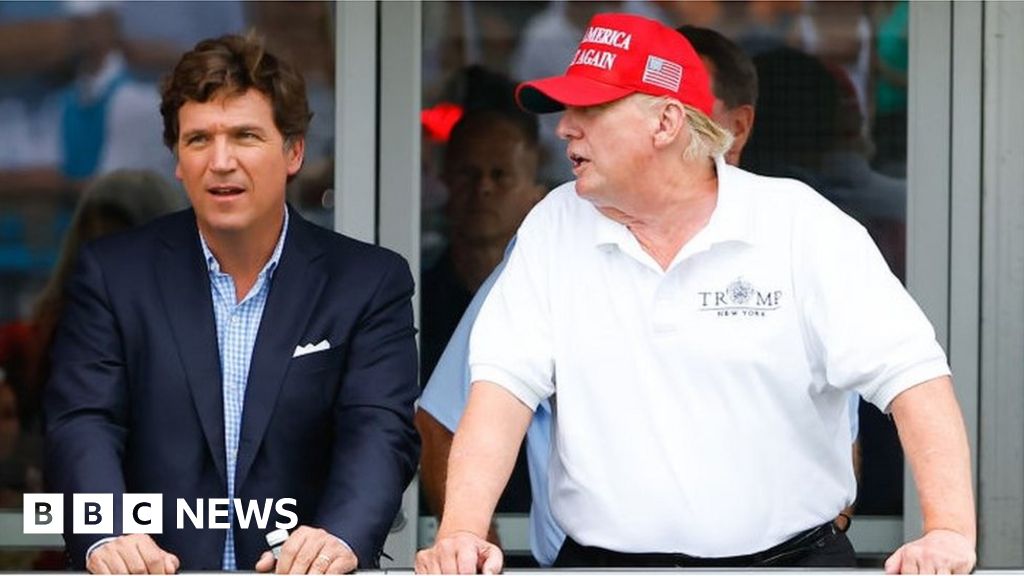
The confrontation occurred during a nearly two-hour sit-down for the New York Times podcast, The Interview
. Host Lulu Garcia-Navarro questioned Carlson on his commentary regarding the president, specifically asking if he had suggested that Donald Trump could be the Antichrist. Carlson’s response was an immediate and firm denial.
“I have not said that,” Carlson replied. Tucker Carlson, media personality
The denial did not end there. When Garcia-Navarro read back his own words from a previous broadcast—Here’s a leader mocking the gods of his ancestors… Could this be the Antichrist?
—Carlson maintained his position. He claimed the words were not his and expressed a lack of familiarity with the concept itself.
“I actually did not say ‘could this be the Antichrist,’” Carlson insisted. “I don’t know where that comes from, but I know that those words never left my lips because I’m not sure I fully understand what the Antichrist is.” Tucker Carlson, media personality
The tension of the exchange peaked when the interviewer played a video clip of Carlson saying the exact words he had just denied. The playback served as a correction to the record, returning the focus to the specific phrasing used in the original broadcast.
The 2026 Iran campaign as a political catalyst
While the spiritual rhetoric provided the interview’s most surreal moments, the underlying friction is rooted in a concrete policy divide. Once a primary media ally for Donald Trump, Carlson has pivoted toward vocal criticism of the administration’s foreign policy. The breaking point, according to Carlson, was the decision to strike Iran.
This dissent is specifically tied to the 2026 US-Israeli air campaign against Iran. Carlson has emerged as a leading voice for a faction of the right that views such international interventions as a betrayal of domestic priorities. In the interview, he admitted to harboring private doubts about the president for years, though he previously chose to ignore or justify them.
“Did I have reservations about Trump? Of course. To some extent, I sublimated them or rationalized them away or focused on areas where I agreed with him,” Carlson shared. “All my fault. But I told myself—and I to some extent still believe—it’s the big decisions that matter.” Tucker Carlson, media personality
This ideological drift positions Carlson as a bellwether for a potential broader rift within the GOP. Lulu Garcia-Navarro observed that by opposing the Iran campaign, Carlson appears to be signaling a move toward a more radical, outsider version of conservatism that rejects the established geopolitical pressures of the American right.
Spiritual forces and the “dreamland” of influence
The interview revealed a recurring pattern in Carlson’s current worldview: a reliance on spiritual or supernatural explanations for political dynamics. Garcia-Navarro noted that Carlson frequently invoked unseen forces
to describe the environment surrounding the president.
Carlson did not just describe the president’s influence as persuasive; he characterized it as something akin to a supernatural hold over those in his orbit. He suggested that the experience of being near Trump was an altered state of consciousness, comparing the psychological effect to a drug-induced haze.
“I think it probably literally is a spell,” Carlson said. “You spend a day with Trump and you’re in this kind of dreamland. It’s like smoking hash or something.” Tucker Carlson, media personality
This framing allows Carlson to maintain a contradictory view of the president. In the same conversation, he portrayed Trump as both morally responsible for his actions and a slave
to geopolitical pressures. In the context of the interview, Carlson suggested that the people surrounding the leader were either too enthralled by this spell
or too fearful to offer resistance.
The conversation veered further into the surreal when Carlson proposed a theory that individuals within Trump’s inner circle had been mysteriously harmed
. Even as he presented the idea, Carlson acknowledged that the theory was probably insane
.
The tactical challenge of the agile orator
The ability of the Daily Beast and the New York Times to document this contradiction was not the result of a lucky catch, but of immersive preparation. The interview process was designed to test the delivery of a subject who is experienced in high-profile media appearances.
For the NYT team, the goal was to move beyond the surface-level dialogue and employ adversarial real-time judgment. This involved weeks of speaking with former colleagues and ideological rivals to map out Carlson’s rhetorical patterns. The result was an interview that used the subject’s own recorded history as a primary tool for verification.
This approach to accountability has resonance beyond the US. Reporting from Streamline Feed indicates that Carlson’s shift toward isolationism and his critiques of mainstream institutions have found a receptive audience in Kenya. In cities like Nairobi and Eldoret, his content is shared within political circles that are skeptical of Western interventionism and aligned with hustler
narratives.
The Kenyan media landscape has viewed the NYT’s handling of the interview as a case study in how to manage public figures who bypass traditional media gatekeepers via podcasts and algorithms. The difficulty of pinning down a deft orator
requires a level of independent verification that traditional question-and-answer formats often lack.
As Carlson continues to influence the MAGA movement from the periphery, his transition from ardent supporter to critical dissenter creates a new friction point within the conservative movement. The contrast between his public denials and his recorded statements highlights a tension that reflects the current internal dynamics of the GOP. By framing the president’s influence as a spell
while simultaneously opposing his most critical foreign policy decisions, Carlson is carving out a space where political dissent is blended with spiritual speculation.

