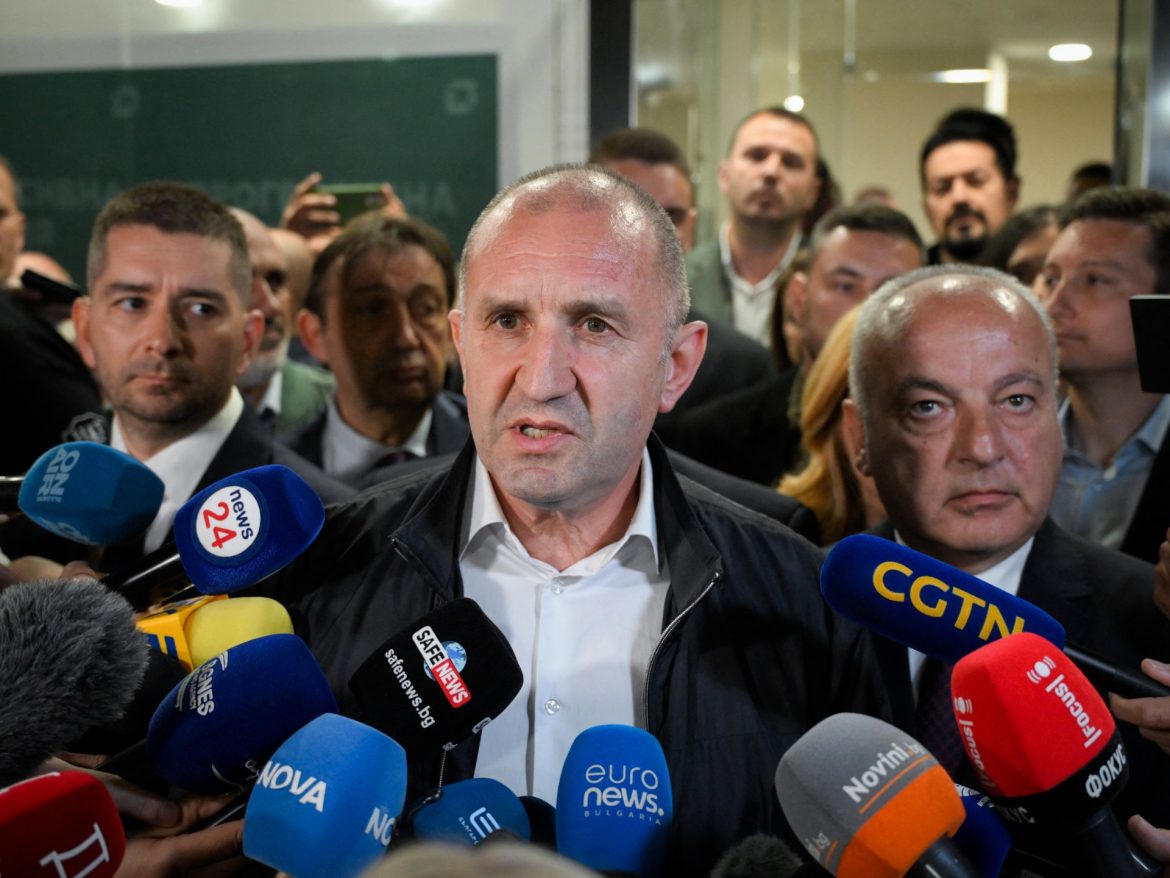
Rumen Radev’s Progressive Bulgaria party is leading early results in the country’s parliamentary election, according to official counts released Monday morning.
With 32 percent of ballots processed, the party secured 44.59 percent of the vote, surpassing an earlier exit poll that projected 44 percent support. The conservative GERB party, led by former Prime Minister Boyko Borissov, trailed with 12.5 percent in the same poll, while the reformist We Continue the Change-Democratic Bulgaria coalition was projected to finish third.
Bulgarians voted on Sunday for the eighth time in five years, following mass protests in December that toppled the previous government. Radev, who stepped down as president in January after nine years in office, launched his campaign promising to dismantle what he called an “oligarchic governance model.”
He framed the vote as a rejection of political instability, telling reporters after the exit poll: “We will do everything possible not to allow us to head [to elections] again. It is ruinous for Bulgaria.”
Radev, a self-described left-leaning eurosceptic, has criticized EU military support for Ukraine and called for renewed dialogue with Russia. He opposed a 10-year defence agreement between Bulgaria and Ukraine signed in March and has repeatedly stated that Crimea’s status as Russian is a “realistic position,” a remark that drew renewed criticism during his campaign when a video of his meeting with Vladimir Putin was shown at a rally.
For more on this story, see Rumen Radev leads polls for Bulgaria’s April 19 parliamentary election.
Despite these positions, Radev affirmed Bulgaria’s commitment to European integration, telling Euronews: “Bulgaria will continue on its European path. A strong Bulgaria in a strong Europe requires critical thinking and pragmatism.” He added that Europe has become “a victim of its ambition to act as a moral leader in a world without clear rules” and argued that restoring industrial competitiveness must be the continent’s priority.
Borissov acknowledged the limits of the electoral outcome, writing on Facebook: “Elections decide who comes first, but negotiations will decide who governs.” Radev said he remains open to cooperation with the reformist coalition but did not rule out forming a minority government.
The country has struggled with fragmented parliaments since 2021, with no coalition lasting more than a year. Bulgaria joined the EU in 2007 and adopted the euro as its currency in January 2026.
This follows our earlier report, Rumen Radev vows to reclaim Bulgaria from oligarchs in election.
What does Radev’s lead mean for Bulgaria’s governance?
While Radev’s party leads, it does not yet hold a majority, meaning coalition talks or a minority government will be necessary to pass legislation and avoid another snap election.
How has Radev’s stance on Russia and Ukraine affected his campaign?
His opposition to military aid for Ukraine, calls for dialogue with Putin, and repeated assertion that Crimea is Russian have drawn international criticism and domestic protests, though he maintains these positions reflect realism rather than alignment with Moscow.