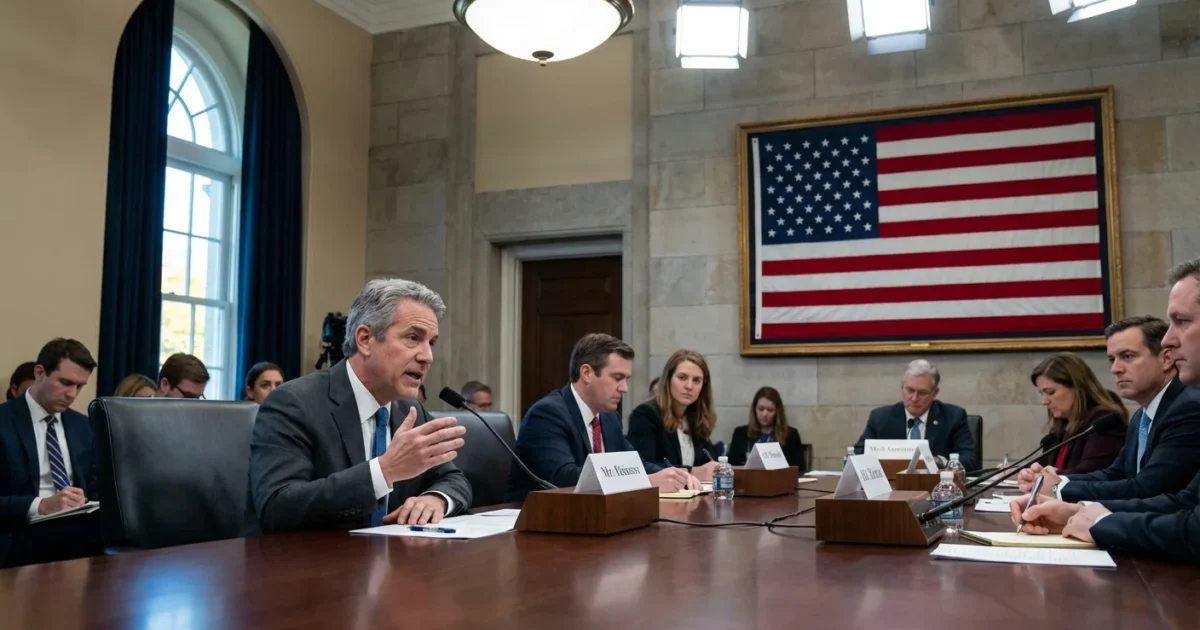
Federal Reserve Governor Michael Barr warned on Wednesday that recent deregulatory shifts are disproportionately benefiting large banks while undermining long-term financial stability. Speaking at a Community Development Bankers Association event, Barr argued that capital relief and reduced supervision could create systemic vulnerabilities that threaten the broader economy and community development institutions.
Capital Relief Favors Global Giants
Governor Barr Capital Relief
The current trajectory of financial deregulation appears to be creating a widening gap between the nation’s largest institutions and its community-focused lenders. During his address, Barr noted that the eight global systemically important banks have already enjoyed $65 billion of capital relief due to recent regulatory changes.
While proponents of deregulation argue that reducing restrictions fosters growth, Barr contends that this extra capacity is not being used to fuel the broader economy through increased lending. Instead, the benefits are being captured by bank executives and shareholders.
“The share of executive compensation as a share of revenue went up by 18% from last year and the share buybacks are up 66%. That’s not benefiting communities around the country, that’s not benefiting community development banks and I think that’s a problem.”
Michael Barr, Federal Reserve Governor, via American Banker
This shift leaves community development financial institutions, or CDFIs, effectively overlooked as the regulatory environment pivots toward the needs of massive, interconnected banks.
Weakening the Watchdogs
Beyond the immediate distribution of capital, Barr expressed deep concern over the systematic reduction of supervisory discretion. Federal agencies, including the Federal Reserve, the FDIC, and the Office of the Comptroller of the Currency, are currently paring down their ability to oversee bank management.
Specific moves include the removal of reputational risk from supervisory considerations and a proposal that would limit the ability of examiners to cite banks for management-related issues. These changes, combined with lowering capital requirements, suggest a move toward a lighter-touch era of oversight.
According to the Federal Reserve, these deregulatory steps may provide a short-term economic boost, but they risk long-term instability. Barr warned that while the financial system appears sound today, the lack of safeguards could lead to significant trouble in the future.
<!
cluster (priority): American Banker
Michael Barr, Federal Reserve Governor
The Push to End Quarterly Reporting
Bank Supervision | A conversation with Governor Michael S. Barr
The movement to reduce regulatory friction is not limited to the banking sector; it is also extending to the requirements for publicly held companies. The Securities and Exchange Commission (SEC) has proposed ending the requirement for mandatory quarterly reporting, which would allow companies to move to a semiannual schedule instead.
As Forbes reported, the SEC argues this flexibility would allow companies to better manage the costs of preparation and align reporting with their specific stage of business development.
However, this proposal has sparked a debate regarding market efficiency and transparency. While the Harvard Law School Forum on Corporate Governance noted that smaller companies might benefit from reduced compliance burdens, there are significant concerns regarding the impact on retail investors. Critics argue that quarterly reporting is vital for market efficiency and provides a lower cost of capital by ensuring investors have timely access to information.
The SEC’s stance on the matter highlights the ongoing tension between corporate ease and investor protection:
cluster (priority): Forbes
The current deregulatory momentum is being met with skepticism by those who point to history as a warning. Critics note that patterns of reducing regulation have preceded various economic crises, including the savings and loan crisis of the 1980s, the dot-com disaster, the Great Recession, and the 2025 stock market crash.
The central conflict remains a balancing act: providing banks with enough room to support innovation and lending while maintaining the safeguards necessary to prevent a systemic collapse. As supervisory discretion is pared down and capital requirements are lowered, the industry faces a critical question of whether today’s efficiency is being bought at the expense of tomorrow’s stability.
Gold prices climbed on Tuesday as markets reacted to a partial ceasefire between Israel and Hezbollah alongside falling U.S. Treasury yields. Spot gold rose as much as 1.1% to $4,532.74 per ounce, according to Al Riyadh, as investors brace for upcoming U.S. employment reports that could dictate the Federal Reserve’s next interest rate moves.
Geopolitical Shifts and Middle East De-escalation
cluster (priority): صحيفة سبق الإلكترونية
The precious metals market is currently caught in a tug-of-war between regional stability and economic uncertainty. On Monday, Lebanon announced a partial ceasefire between Hezbollah and Israel, a move intended to limit escalation in a conflict that has already claimed thousands of lives and threatened a broader war involving Iran. This sudden shift in the geopolitical risk profile has provided a complex backdrop for gold, which often serves as a primary hedge during periods of intense conflict.
However, the path to stability remains murky. While U.S. President Donald Trump has stated that negotiations with Iran are proceeding “at a fast pace,” contradictions remain regarding the long-term viability of recent diplomatic efforts. Official Iranian media has reported that Tehran has paused indirect negotiations with the United States and suggested that the current ceasefire could potentially be terminated. This volatility ensures that while the immediate threat of escalation has dipped, the underlying tension remains a significant driver for safe-haven assets.
Reconciling the Gold Price Discrepancy
What Happens to Gold During a Rate-Hike Period?
Market data regarding the exact magnitude of Tuesday’s rally shows slight variations depending on the reporting source, likely due to the specific timing of spot transactions and exchange tracking. Al Riyadh reported that spot gold rose 1.1% to $4,532.74 per ounce, with U.S. gold futures for August delivery climbing 1.3% to $4,562.90.
In contrast, Sabq reported a more conservative increase, noting that spot gold rose 0.5% to $4,504.36 per ounce following a 2% decline on Monday. Sabq also noted that U.S. gold futures rose 0.6% to reach $4,534 per ounce.
Beyond the geopolitical landscape, the primary technical driver for the rally appears to be the movement in the fixed-income market. The yield on the benchmark 10-year U.S. Treasury note declined, which directly lowers the opportunity cost of holding gold—an asset that pays no interest.
“It seems that the ceasefire between Israel and Hezbollah is what is driving us to raise gold prices.” Brian Lane, Managing Director of Gold Silver Central
Performance of Silver, Platinum, and Palladium
cluster (priority): جريدة الرياض
The upward momentum was not limited to gold. Other precious metals saw gains as investors repositioned their portfolios in response to both the Middle East developments and the anticipation of shifting U.S. monetary policy.
According to data compiled by Sabq, the broader metals complex saw the following performance:
Silver: Increased 1.4% to $75.85 per ounce.
Platinum: Increased 1.1% to $1,944.05 per ounce.
Palladium: Increased 0.6% to $1,370.75 per ounce.
Federal Reserve Policy and the Labor Market
As the geopolitical dust settles, the focus of the global financial community is shifting toward the United States’ domestic economic health. Investors are looking ahead to critical non-farm payroll and employment reports scheduled for release later this week. These figures will be essential in determining whether the U.S. labor market remains resilient or if inflation concerns, exacerbated by Middle East conflicts, will force a different path for the Federal Reserve.
Market participants are closely monitoring the rhetoric of key Federal Reserve policymakers to find clues regarding future interest rate trajectories. Specifically, attention is centered on upcoming statements from Cleveland Fed President Beth Hammack and Fed Governor Michael Barr.
The coming days will likely reveal whether gold’s recent recovery is a temporary reaction to a localized ceasefire or the beginning of a sustained trend driven by a weakening dollar and a shift in U.S. economic expectations. If the upcoming jobs data signals a cooling labor market, the downward pressure on Treasury yields could provide the sustained tailwind gold needs to push toward new heights.
Kevin Warsh faced pointed questions about his finances and ties to President Trump during his Senate confirmation hearing for Federal Reserve chair, yet his proposal to redefine inflation and overhaul the Fed’s operations went largely unchallenged.
Warsh defended his independence from Trump while affirming plans for rapid rate cuts
Under repeated questioning, Warsh said the president never instructed him to commit to any specific interest rate path, attempting to dispel concerns about undue influence. He welcomed internal dissent within the Federal Open Market Committee, describing potential objections from fellow policymakers as a “good family fight” that could advance his goal of overturning the Fed’s current approach. Warsh has long advocated for lowering rates aggressively, aligning with Trump’s public demand for rates as low as 1%.
His plan to redefine inflation remained central and unexamined
The core of Warsh’s vision — what he calls “regime change” at the Fed — includes a fundamental shift in how inflation is defined and measured, a concept he has refined since leaving the Fed in 2011. This proposal passed through the hearing with minimal scrutiny, despite its potential to alter the foundation of monetary policy. Former Chair Janet Yellen expressed skepticism that Warsh could secure the 11 votes needed on the FOMC to enact such changes in the near term.
Warsh Friedman
Warsh cited his work with Milton Friedman as intellectual grounding
He recalled a phrase from Friedman that had stayed with him, referencing his time as a research assistant for the conservative economist. This background informs his skepticism of current Fed practices and his push for structural change. Warsh’s confirmation would place him in a position to attempt an overhaul, though any move to quickly lower rates or redefine inflation is likely to provoke significant resistance within the central bank.
Watch: Kevin Warsh criticizes Fed for "fatal policy error" in dealing with inflation
What does Warsh indicate by “regime change” at the Federal Reserve?
Warsh seeks to sharply change how the Fed operates, including revising the definition of inflation, a plan he has developed since 2011 and presented largely intact during his hearing.
How did Warsh respond to concerns about his relationship with Trump?
He stated under questioning that Trump never generally or specifically instructed him to commit to any interest rate path, denying direct influence on his policy views.
Kevin Warsh appeared before the Senate Banking Committee on Tuesday, April 21, 2026, for his nomination hearing to chair the Federal Reserve, facing sharp questions about his independence from President Donald Trump amid an ongoing Justice Department investigation into current Fed Chair Jerome Powell.
Warsh, 56, a former Fed governor and economic adviser to George W. Bush, is Trump’s nominee to replace Powell, whose term ends May 15. The president has repeatedly criticized Powell, calling him a “jerk” and “a stubborn MORON,” and has threatened to fire him, creating unprecedented political pressure on the central bank.
Trump’s desire for lower interest rates has driven his push for Warsh, whom allies view as more likely to accommodate the administration’s preferences. However, Warsh’s close ties to Trump have grow a liability, with Democrats and some Republicans questioning whether he can resist political influence.
At the hearing, Warsh defended the importance of Fed independence but argued it “has to be earned” by delivering on the central bank’s promises. He said the Fed’s failure to meet expectations has invited political interference, a remark that drew sharp rebuttals from senators.
Massachusetts Senator Elizabeth Warren led the Democratic challenge, pressing Warsh to name a point of disagreement with Trump’s economic agenda. He responded that he disagreed with being described as a nominee “out of central casting,” prompting Warren to retort that independence requires courage, which she implied he lacked.
Warsh insisted Trump had never asked him to commit to any specific interest rate decision, stating, “The president never asked me to predetermine, commit, fix, decide on any interest rate decision in any of our discussions, nor would I ever agree to do so.”
His financial disclosures likewise drew scrutiny, particularly his marriage to Jane Lauder, heiress to the Estée Lauder fortune, with Democrats questioning potential conflicts of interest tied to his wealth and background.
Warsh’s career includes undergraduate studies at Stanford under Milton Friedman, a law degree from Harvard, and work in mergers and acquisitions at Morgan Stanley. He joined the Bush administration in 2002 as an economic policy adviser and executive secretary of the National Economic Council.
Appointed to the Fed’s board of governors in 2006 at age 35, Warsh helped broker the sale of Bear Stearns to JPMorgan Chase in 2008 during the financial crisis. He developed a reputation as an inflation hawk, advocating for rate increases to combat rising prices even at the cost of higher unemployment.
The nomination remains uncertain, with at least one Republican senator indicating he may block Warsh’s confirmation until the Justice Department investigation into Powell is dropped. Senators have not yet scheduled a formal vote, leaving the outcome tied to the resolution of the probe into the current chair.
Key Context The Fed chair holds immense influence over U.S. Economic policy, including control over interest rates that affect borrowing costs, inflation, and employment across the economy.
Why is Trump pushing for Warsh to lead the Fed?
Trump wants lower interest rates to stimulate economic activity and believes Warsh, unlike Powell, is more likely to accommodate that preference, though Warsh has denied being asked to pre-commit to any rate decisions.
Warsh Trump Powell
What is the status of the investigation into Jerome Powell?
The Justice Department is investigating Powell’s handling of renovations at the Fed’s headquarters, a probe that Powell and many observers describe as politically motivated; its outcome may influence whether Warsh’s nomination proceeds.
Kevin Warsh Defends Fed’s Rate-Setting Independence Amid Pressure