

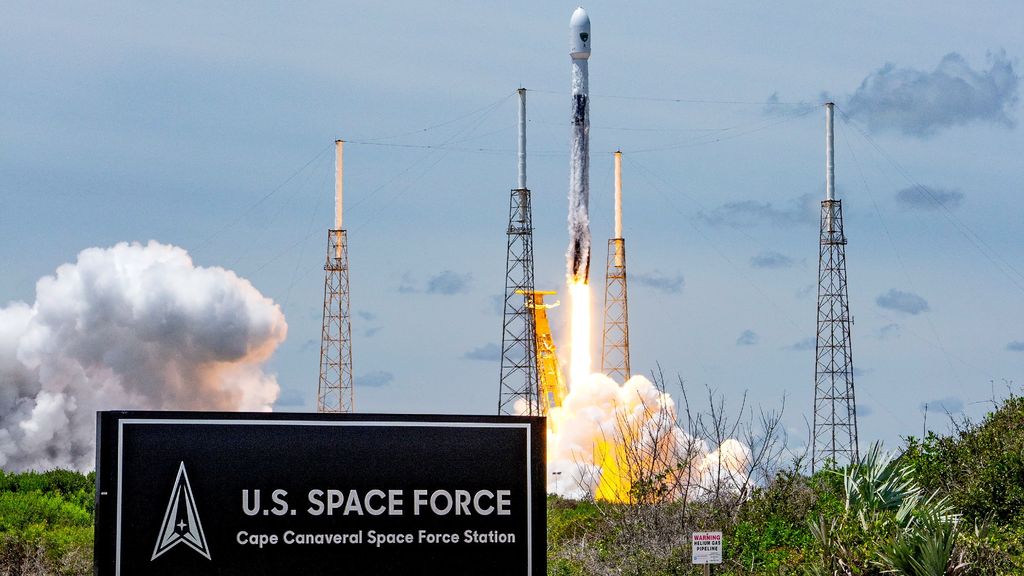
The U.S. Space Force launched its final GPS III satellite into medium Earth orbit early Tuesday, April 21, 2026, aboard a SpaceX Falcon 9 rocket from Cape Canaveral Space Force Station.
Liftoff occurred at 2:53:25 a.m. EDT after a one-day delay caused by poor weather in the booster recovery zone. The mission carried the GPS III-8 satellite, officially designated Space Vehicle 10 (SV10) and nicknamed ‘Hedy Lamar’ in honor of the actress and inventor whose frequency-hopping function laid groundwork for modern wireless technologies including GPS, WiFi, and Bluetooth.
This launch concludes the GPS III block, a multi-year effort to modernize the constellation with improved accuracy, anti-jamming capabilities, and a longer operational lifespan. Col. Stephen Hobbs of Mission Delta 31 described the event as closing a chapter while emphasizing it serves as a foundation for the upcoming GPS IIIF generation, which will deliver enhanced capabilities for both military and civilian users worldwide.
The Falcon 9 booster used, B1095, completed its seventh flight having previously supported six Starlink missions. It landed on the drone ship ‘Just Read the Instructions’ approximately eight and a half minutes after liftoff, marking the 158th and final landing for that vessel, which SpaceX will now dedicate to supporting its Starship program.
One half of the payload fairing was novel while the other had flown previously on the GPS III-9 mission in January, a reuse strategy noted by Anne Mason, SpaceX’s director of National Security Space Launch, as providing mission assurance benefits. Both fairing halves were scheduled for recovery after splashdown downrange.
The mission also marked the fourth instance where SpaceX launched a GPS satellite originally assigned to United Launch Alliance under the National Security Space Launch Phase 2 contract, highlighting the evolving dynamics of the U.S. Launch services market.
How the satellite’s name reflects its technological legacy
The decision to name the satellite after Hedy Lamar connects the mission to a historical figure whose 1940s patent for a frequency-hopping spread spectrum system anticipated core principles used in modern GPS, Bluetooth, and WiFi technologies. This recognition underscores the interdisciplinary roots of satellite navigation beyond pure aerospace engineering.
What the delay reveals about launch priorities
The 24-hour postponement due to recovery zone weather illustrates how SpaceX and the Space Force prioritize booster retrieval over strict schedule adherence, especially when flying a flight-proven core stage on a national security mission where reusability and mission assurance are critical.
Why this launch matters for the future of GPS
While the GPS III block has delivered significant upgrades over legacy satellites, officials confirm the transition to GPS IIIF is already underway, promising further improvements in signal strength, accuracy, and resistance to interference — ensuring the system remains robust for both military operations and the billions of civilian users who depend on it daily for navigation, timing, and synchronization.
What does the ‘Hedy Lamar’ name signify for this GPS satellite?
The satellite is named after Hedy Lamar, the Austrian-American actress and inventor, whose pioneering work on frequency-hopping spread spectrum technology contributed to the development of modern wireless systems including GPS, WiFi, and Bluetooth.
Why was the drone ship ‘Just Read the Instructions’ retired after this mission?
SpaceX stated the drone ship will be devoted to supporting the Starship program, making this its final flight in the Falcon 9 recovery role after 158 successful landings.