uh the condition of the other helicopters did they manage to get to safety did they land there have They carried on and of course we also don’t know who reported that hard Landing was it the pilot on board president reac’s helicopter was it one of the other pilot in that helicopter Convoy returning a reminder from aaban to Iran so Ash we we just began speaking about a rescue operation there uh when we heard that got that breaking news in from the chief of Army staff uh in Iran about um them deploying all resources it’s clear from the pictures that we’re getting that there are no aircraft which would be the quickest way to locate as we’ve often seen in in natural disasters and all sorts of disasters you get an aircraft into the air to search for uh the location of uh an incident like this people are having to look on foot indeed um I think it’s a good call for for the um the head of the army to suggest that more bodies on the ground is going to be helpful particularly if they don’t know exactly where the helicopter went down having more people that are looking is is a good call I think this is a classic case where um they could could leverage potentially drones uh drones can get to difficult sites far quicker than people on foot and it doesn’t look like vehicles are able to get into the area that they they believe the helicopter did crash uh so drones as First Responders which is a capab that that we in the west are now developing quite aggressively uh this would probably be the quickest way to pinpoint um where the helicopter is and even provide you know footage back to The Rescuers to know what the condition of the aircraft is and indeed the state of of any casualties U but if it’s just people walking on foot this is still going to take a lot of time and time is not on their side I would suggest yeah time weather and of course they’re losing light because as it’s late in the evening at local time Ash Alexander Cooper thanks very much indeed for joining us for your analysis of this breaking news situation this afternoon you’re watching Sky News we are covering live as and when we get any information on that helicopter that suffered what is being described as a hard Landing one Iranian official did call it a helicopter crash carrying president Ibrahim REI and foreign minister Hussein Amir Abdul aan and other dignitaries on their return from aaban to Iran stay with us we’re going to take a quick break but we will be back with more

Asia
The Asian entertainment clip and video market promises to earn hundreds of billions of dollars
A new study from research and consulting firm Media Partners Asia says the Asian video industry is expected to experience strong growth, at a rate of 2.6% annually over the next five years, expected reaching $165 billion in 2028. This is an increase after the expected 5.5% growth in 2023.
The Asian entertainment clip and video market promises to earn hundreds of billions of dollars
The company’s “Broadband and Video Industry Asia Pacific 2024” report analyzed a wide range, including free-to-air TV, pay TV, SVOD (pay video on demand premium), premium AVOD (free video), plus user-generated content and social video in 14 Asia-Pacific countries and territories. This report exposed the profound changes behind the shift from traditional television to online platforms, described as a “habit shift”.
With a series of attractive dramas and game shows, this market is expected to reach 165 billion USD by 2028. Photo: Netflix.
“Enhanced connectivity and growing penetration of connected TV, combined with the growth of the creative economy, said Vivek Couto, CEO and Executive Officer of MPA. Investment in local premium content as well as the widespread availability of online services will continue to drive growth.”
China maintains its position as the largest and most tightly regulated video market in the region, expected to reach $64 billion in revenue by 2023.
Except for China, other important markets in 2023 include Japan (32 billion USD), India (13 billion USD), South Korea (12 billion USD) and Australia (9.5 billion USD), followed by followed by Taiwan and Indonesia, both at around $3 billion.
The company’s growth forecast indicates that total video industry revenue in the Asia-Pacific region will increase at a compound average growth rate of 2.6% between 2023 and 2028, reaching 165 billion USD by 2028. Meanwhile, China is expected to grow at a rate of 1.7%, reaching 70 billion USD by 2028, while other countries are expected to have a growth rate of 3 .3%, reaching 95 billion USD by 2028.
In terms of sector, forecasts indicate that the online video component in the region will grow at a CAGR of 6.7%, reaching 78.5 billion USD by 2028. As for China, the expected growth rate is expected to be 9.2%, reaching 46 billion USD at the same time. Asia’s TV industry revenues, including advertising and subscriptions, are forecast to decline slightly at a CAGR of -0.4% between 2023 and 2028, reaching USD 86.5 billion in 2028. Outside China, the downward trend will be a bit stronger at a -1% CAGR, falling to USD 49 billion in 2028. In the bigger picture, some territories, especially India, Japan, South Korea and Indonesia, could still achieve net growth, but face risks of “significant declines” in TV advertising in many of the same territories.
While traditional television may no longer hold the advantage it once did, the online model combined with advertising is becoming increasingly important. The report points out: “Advertising contributed 51% to online video revenue in 2023. It is expected that this contribution will increase to 54% in 2028 and to 63% in the Asia-Thai region Binh Duong, excluding China (compared to 58% in 2023)”.
According to MPA, eight companies will account for a total of 65% of the online video revenue market share in the Asia-Pacific region by 2023, including Amazon Prime Video, ByteDance (including TikTok), Disney, and YouTube. owned by Google, iQiyi, Meta (video), Netflix and Tencent.
New investments from strategic investors and private equity in the online video sector in China, India, Indonesia, Japan, Korea and Southeast Asia are supporting local companies and area to compete. The online video sector is also becoming streamlined with price increases in the SVOD category along with disciplined content and marketing investments, introduction of advertising tiers, new strategies to drive monetization and startups. initiated the process of local market consolidation in Korea, Japan and India.
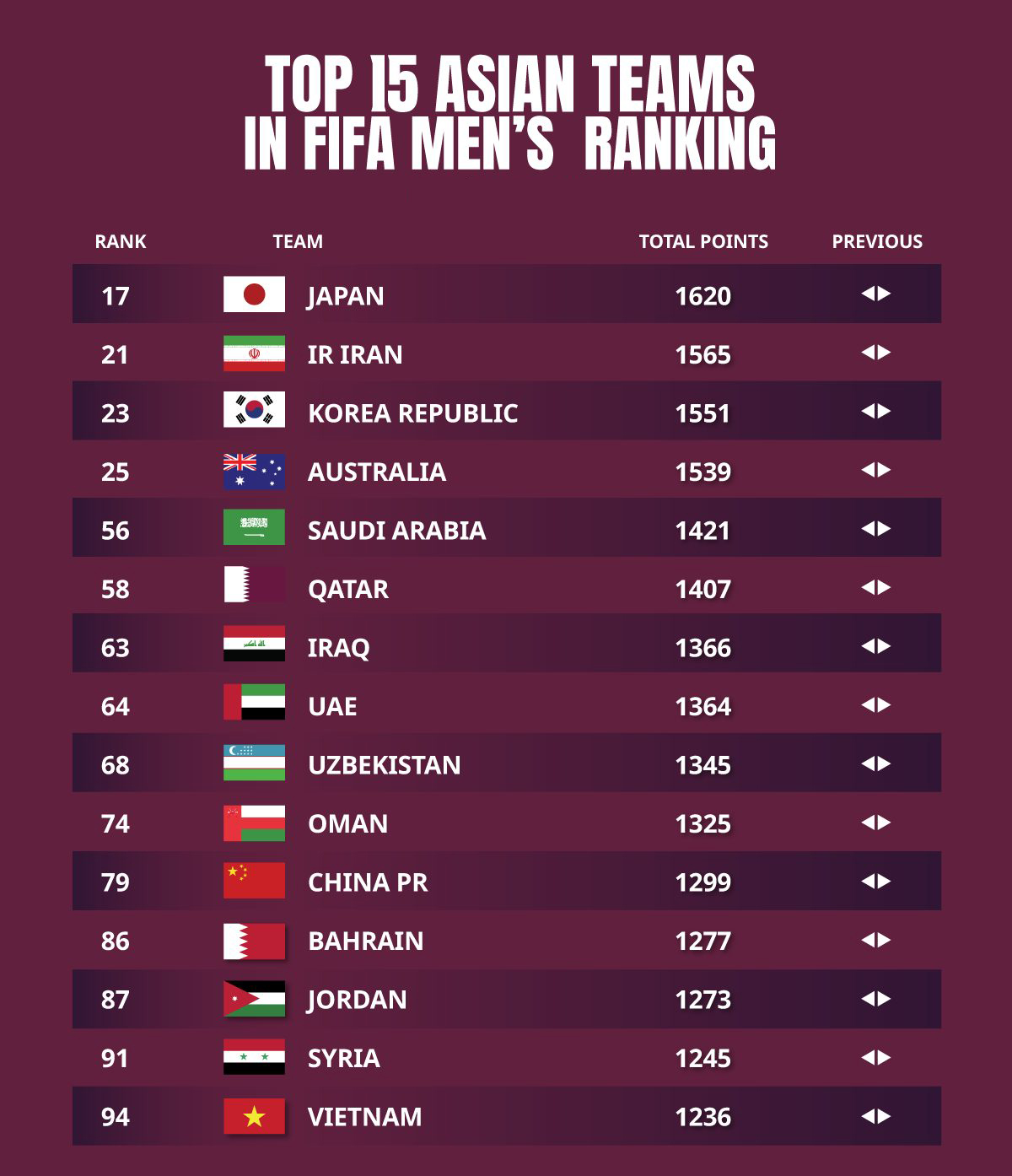
In the Southeast Asia region, behind the Vietnam National Team are the Thai National Team (ranked 113 in the world) and the Malaysian National Team (ranked 130 in the world). Meanwhile, Indonesia National Team – Vietnam National Team’s opponent in the 2023 Asian Cup group stage ranked 5th (ranked 146 in the world), behind the Philippines National Team (ranked 140 in the world).
In Asia, the top 5 are still Japan (ranked 17 in the world), Iran (ranked 21 in the world), Korea (ranked 23 in the world), Australia (ranked 25 in the world) and Australia. Saudi Arabia (ranked 56th in the world).
Vietnam National Team. Photo: VFF.
In the world’s top 10, 2022 World Cup champion Argentina still has no opponent at the top of the FIFA rankings with 1855.2 points. Following are France, England, Belgium, Brazil, Netherlands, Portugal, Spain, Italy and Croatia.
According to FIFA statistics, there will only be 11 international matches taking place in December 2023, of which 9 matches belong to Oceania teams participating in the Pacific Games. The remaining two matches are two friendly matches between Colombia and Venezuela and Mexico. That is also the reason why there was no significant disturbance in the rankings for the last month of this year.
Top 15 Asian teams with the highest rankings on the current FIFA rankings

Top 15 Asian teams with the highest rankings on the current FIFA rankings.
The most notable football event in January 2024 is the 2023 Asian Cup finals with the participation of 24 excellent teams from Asia. Vietnam National Team is in Group D with Japan National Team, Iraq National Team and Indonesian National Team. The results of the teams in this arena are forecast to create big changes in the world rankings, especially in the group of Asian teams.
To prepare for the 2023 Asian Cup finals, the Vietnamese team is expected to reunite on December 31. Coach Philippe Troussier and his team spent a few days practicing in the country before moving to Qatar for training and having a friendly match with Kyrgyzstan before the tournament.