
Intel Corporation is expanding its presence in the AI and quantum computing sectors following the January 2026 launch of its Core Ultra Series 3. While rumors of massive VRAM capacities circulate, the company’s current strategy emphasizes integrated AI capabilities and consumer-facing hardware.
Divergent Strategies at CES 2026
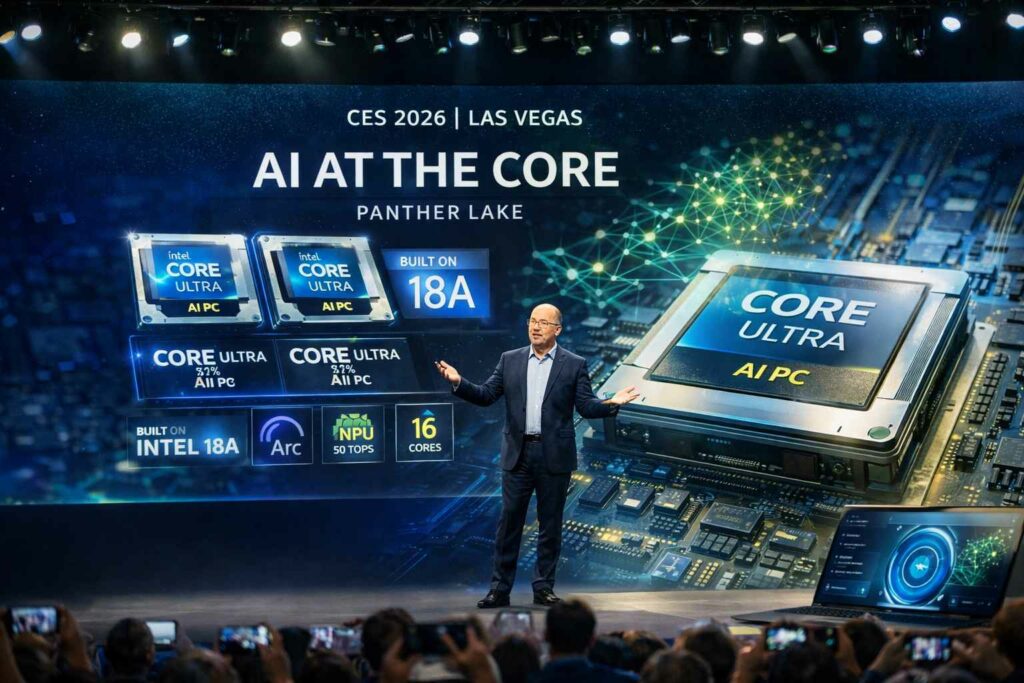
At the Consumer Electronics Show (CES) in January 2026, Intel adopted a distinct hardware strategy compared to its primary competitors. While NVIDIA focused its keynote on data center technologies and AMD highlighted its Ryzen AI 400 and Ryzen AI Max series, Intel prioritized the launch of consumer-ready products. This decision marked a clear separation in how the major chipmakers approached the 2026 hardware market.

Industry coverage noted that Intel was the only major player to launch a consumer product during its presentation at the event. While AMD showcased its new Ryzen AI lineup, and NVIDIA’s presence centered on data center solutions, Intel’s focus remained on the consumer and builder markets. This approach aligns with the company’s stated mission to provide technology that enables builders to move from prototype to global scale
, according to Intel’s official branding.
Core Ultra Series 3 and AI Integration
The introduction of the Intel Core Ultra Series 3 at CES 2026 represents the company’s push toward more integrated AI processing. This product line is a central component of Intel’s broader movement into the artificial intelligence sector, which includes significant investments in quantum computing and specialized AI hardware.
Intel’s current development cycle is designed to support a wide variety of computing needs through its three primary operating segments: Client Computing Group (CCG), Data Center and AI (DCAI), and Intel Foundry. By integrating AI capabilities directly into its silicon, the company aims to maintain its relevance in an era where local AI processing is becoming a standard requirement for both consumer and professional hardware.
Market Performance and Segment Operations
Intel’s market position has seen substantial growth during the first half of 2026. On May 20, 2026, Intel Corporation (INTC) shares closed at $118.96, representing a 7.36% increase. This performance is part of a significant upward trend for the company; its year-to-date growth stands at 222.38%, while its one-year growth has reached 459.29%.
The company’s market capitalization reached $597.893 billion during intraday trading. Despite recent gains, Intel’s financial profile shows a trailing twelve-month earnings per share (EPS) of -0.59. Trading volume for the stock has remained high, with a recent volume of 161,635,367 shares, significantly exceeding its average volume of 117,849,004. The stock has seen a 52-week range between $18.97 and $132.75, reflecting the volatility and rapid recovery seen in its recent fiscal cycles.
Verifying High-Capacity VRAM Claims
Speculation regarding massive video memory (VRAM) capacities, such as 480GB, has appeared in enthusiast discussions and online hardware communities. However, these specific figures have not been substantiated by official company disclosures or major industry reports following CES 2026.
While Intel is making significant moves in the AI sector, which often requires high-capacity memory, the confirmed product roadmaps focus on the Core Ultra architecture and its integration of AI-specific processing units. Current official documentation does not contain any mention of a consumer or professional graphics card featuring 480GB of VRAM. For now, the 480GB figure remains an unverified claim within the enthusiast community rather than a confirmed hardware specification.

