
Proceedings continued Tuesday at the Ronald V. Dellums Federal Building in Oakland. Inside the courtroom, Elon Musk, the world’s richest person, heard stern words from Judge Yvonne Gonzalez Rogers. The Tesla and SpaceX CEO appeared before the court as the legal process moved forward in the federal trial.
Judge Rogers, an appointee of former President Barack Obama, addressed the court regarding the intersection of Musk’s courtroom presence and his external activities. How can we get things done without you making things worse outside the courtroom?
she asked Musk during the hearing.
The $38 million charity dispute
The legal conflict centers on the origins of OpenAI. Musk helped start the organization in 2015 as a nonprofit, intending for it to serve as a counterweight
to Google. According to testimony provided during the first week of the trial, Musk viewed Google as having insufficient concerns regarding AI safety. This conviction stemmed from a disagreement with Google co-founder Larry Page, a former friend, who reportedly called Musk a speciesist for being pro-human
.
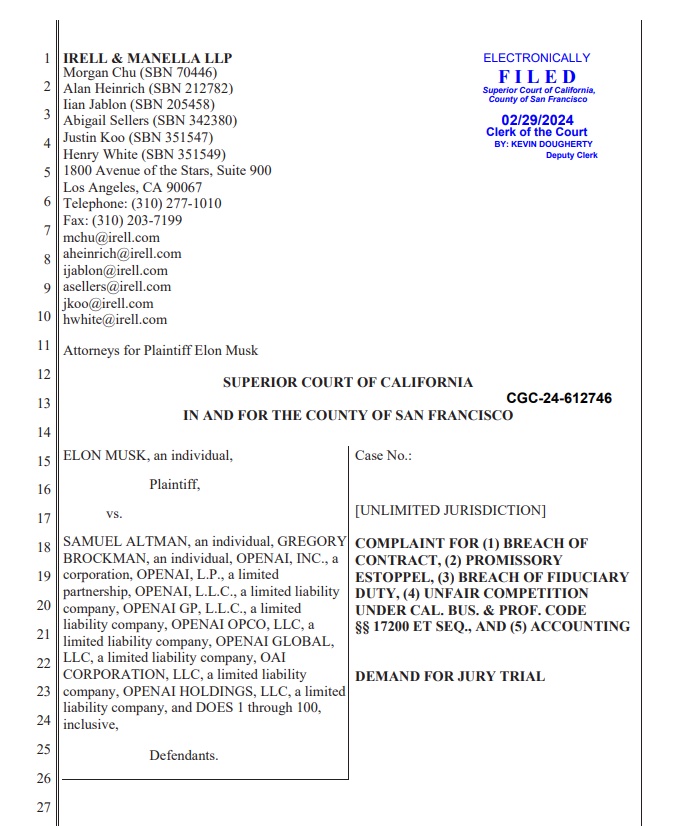
Musk’s claim is rooted in the belief that OpenAI’s transition toward commercialization went back on its founding promises. He alleges that the roughly $38 million he donated to the project was eventually used for unauthorized commercial purposes. Throughout three days of testimony, Musk repeatedly told the nine-person jury, You can’t just steal a charity
.
OpenAI has dismissed these allegations as baseless
. The company’s trajectory shifted significantly after Musk left the board in 2018, with the organization creating a for-profit subsidiary that same year. The transition accelerated following the late 2022 launch of ChatGPT and the subsequent raising of $10 billion in equity from Microsoft.
“What you can’t do is have your cake and eat it too,”Musk stated during his testimony
Musk testified that while he is not entirely opposed to the existence of a for-profit unit, the commercial side of the business eventually became the tail wagging the dog
. He accused OpenAI CEO Sam Altman and President Greg Brockman of enriching themselves from a charity while maintaining the prestige associated with running a nonprofit.
Commercial success versus nonprofit mandates
The scale of the dispute is underscored by the massive gap between the initial donations and the current market reality. While Musk is litigating over $38 million, private investors now value OpenAI at over $850 billion. This valuation reflects the explosive growth of the AI sector and the commercial viability of Large Language Models, which stands in stark opposition to the original charitable framework Musk describes.
Musk’s narrative is one of foundational ownership. He testified that OpenAI wouldn’t exist without him
, claiming that he provided the initial funding, recruited the key personnel, conceived the name, and taught them everything I know
. This assertion of primacy sets the stage for his argument that the current leadership diverted a resource he helped build for private gain.
The tension in the courtroom was most evident during cross-examination, where Musk repeatedly clashed with OpenAI’s lead counsel, William Savitt of Wachtell Lipton. These exchanges highlight the broader conflict between Musk’s view of the company as a betrayed trust and the legal defense’s portrayal of a natural corporate evolution.
Competitive friction and AI governance
The lawsuit does not exist in a vacuum; it is inextricably linked to the current competitive landscape of artificial intelligence. After leaving OpenAI in 2018, Musk waited five years before launching xAI as a direct competitor. In February 2026, he merged that business with SpaceX.
This sequence of events suggests a complex relationship between Musk’s desire for a non-commercial AI safety net and his own pursuit of commercial AI dominance. The trial serves as a proxy for a larger debate on AI governance: whether the development of potentially world-altering technology should be governed by nonprofit charters or the incentives of venture capital and equity markets.
As reported by CNBC, the first week of the trial was dominated by Musk’s testimony. The proceedings paused on Friday, leaving the courtroom dark before resuming next week. The outcome remains uncertain, as the court must weigh the specific contractual and charitable obligations of 2015 against the commercial realities of 2026.
The case, as noted by The Washington Post, has so far centered largely on Musk’s personal history with the organization and his perceived betrayal. Whether the jury views the shift to a for-profit subsidiary as a necessary evolution or a theft of charitable intent will determine the legal fate of the $38 million in question and potentially the governing precedent for future AI labs.