
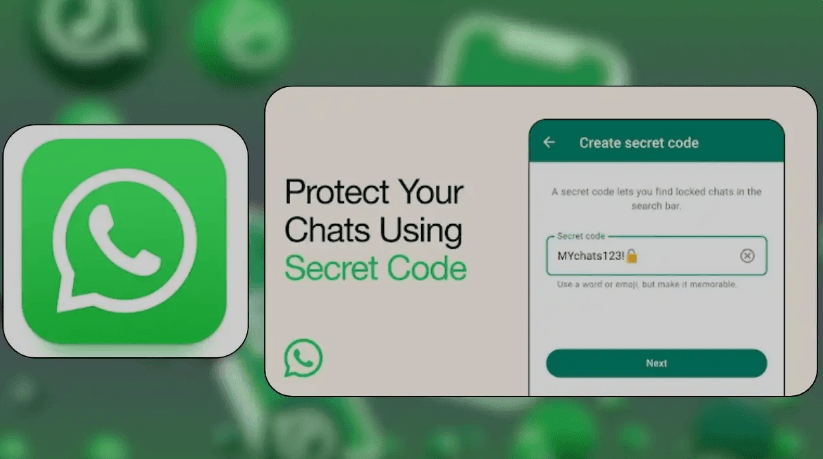
WhatsApp has implemented a secret code feature for its locked chats, enabling users to remove sensitive conversations from the primary chat list. This update enhances on-device privacy by requiring a unique password to reveal the hidden folder, distinguishing the feature from the app’s standard end-to-end encryption.
The rollout of the secret code functionality marks a shift in how Meta Platforms, Inc. addresses user privacy at the interface level. While WhatsApp has long relied on end-to-end encryption to secure data in transit, the secret code feature addresses a different vulnerability: physical access to an unlocked device. By allowing users to hide the Locked Chats
folder entirely, the application prevents bystanders or unauthorized users from even knowing that private conversations exist.
Mechanics of the Secret Code System
The feature operates as an additional layer on top of the existing Chat Lock system. Previously, locked chats were moved to a dedicated folder at the top of the chat list, which required biometric authentication—such as a fingerprint or FaceID—to open. While this secured the content of the messages, the presence of the Locked Chats
folder remained visible to anyone viewing the screen.
With the introduction of secret codes, users can now create a unique alphanumeric or emoji-based password. Once activated, the Locked Chats folder disappears from the main chat interface. To access these conversations, the user must type their secret code into the search bar. Only after the correct code is entered does the hidden folder reappear, granting access to the sequestered messages.
This implementation focuses on local device security. It does not alter the encryption protocols that protect messages as they move between servers. Instead, it creates a digital vault that remains invisible unless a specific key is provided, mitigating the risk of shoulder surfing
or coerced access to a device.
Strategic Divergence from Telegram Secret Chats
Market analysts have frequently compared this update to the Secret Chat
mode offered by Telegram. However, the two features serve fundamentally different technical purposes. Telegram’s Secret Chats are designed for maximum data volatility; they are device-specific, meaning they are not stored in the cloud, and they include a self-destruct timer that deletes messages from both devices after a set period.
WhatsApp’s secret code feature is a visibility tool rather than a volatility tool. The messages within a locked folder are still backed up to the cloud if the user has enabled backups, and they do not automatically vanish unless the user manually enables disappearing messages. The primary objective for Meta is the concealment of the conversation’s existence on the handset, whereas Telegram’s objective is the elimination of the conversation’s footprint across all servers.
The distinction is critical for users weighing the trade-offs between convenience and absolute anonymity. WhatsApp maintains its cloud-sync capabilities for ease of migration between devices, while Telegram’s secret mode sacrifices that convenience for a higher tier of ephemeral security.
Meta’s Competitive Positioning and User Retention
The introduction of high-visibility privacy tools is a tactical response to the growth of privacy-centric competitors like Signal and Telegram. As users become more aware of data harvesting and surveillance, the demand for granular control over message visibility has increased. For Meta, providing these tools is a means of reducing churn among high-value users who might otherwise migrate to platforms with more aggressive privacy defaults.
By integrating these features into an app already used by billions, Meta leverages its massive install base to normalize privacy settings that were previously the domain of niche, encrypted apps. This move allows WhatsApp to maintain its position as the primary communication utility while checking the boxes for privacy-first
user experiences.
The shift toward on-device concealment reflects a broader trend where privacy is no longer just about who can read the message, but who knows the message exists.
Marcus Thorne, Senior Analyst at Digital Privacy Watch
Regulatory Pressures and the Encryption Debate
The timing of these privacy enhancements coincides with ongoing regulatory scrutiny in the European Union and the United Kingdom. Governments have repeatedly pressed Meta to provide backdoor access
to encrypted messages to combat illegal activity. By doubling down on user-facing privacy tools, Meta reinforces its public commitment to encryption, making it politically and technically more difficult to implement government-mandated surveillance hooks.
If Meta were to compromise end-to-end encryption to satisfy regulators, the loss of user trust would be immediate. Features like secret codes serve as a signal to the user base that the company is prioritizing the individual’s control over their data. This creates a buffer of user loyalty that Meta can use as leverage when negotiating with regulatory bodies over the Online Safety Act and similar legislation.
However, the reliance on secret codes also highlights a limitation. Because the feature is a UI layer, it does not protect against sophisticated forensic tools used by state actors, which can often bypass device-level locks. The secret code is a deterrent against casual intrusion, not a shield against state-level espionage.
Future Trajectory of Private Messaging
The evolution of WhatsApp suggests a future where messaging apps function as fragmented environments. Users will likely move away from a single, monolithic chat list toward a system of tiered access: public, professional, and hidden. The secret code is the first step toward a more compartmentalized communication experience.
The next phase of this evolution will likely involve deeper integration with hardware-level security, such as Secure Enclaves in mobile processors, to ensure that secret codes cannot be intercepted by malware. As the boundary between personal and professional digital identities blurs, the ability to hide entire segments of one’s social graph will become a standard requirement for any competitive messaging platform.
For now, the secret code feature addresses a specific, common pain point: the fear of a partner, parent, or colleague glancing at a phone and seeing a sensitive conversation. While it lacks the ephemeral nature of Telegram’s secret mode, it provides a practical solution for the average user seeking a higher degree of discretion in their daily digital interactions.
