
Russia launched an invasion of Ukraine during the night of February 23 to 24, 2022, following a decision by President Vladimir Putin, according to 20 Minutes. The invasion included the bombardment of several cities, including Kyiv, and marks a major escalation of the long-standing conflict in the region.
The scale of the military operation involved multi-pronged attacks from the north, east, and south, involving ground forces, air strikes, and missile attacks. This escalation prompted immediate responses from the international community, including significant diplomatic condemnation and the implementation of economic sanctions against Russia by various nations and international organizations.
The 2022 Russian invasion of Ukraine
Russia and Ukraine have been engaged in an open war since February 2022, according to La Croix. The invasion began during the night of February 23 to 24, 2022, following a decision by President Vladimir Putin, according to 20 Minutes. This military action included the bombardment of several cities, such as Kyiv.
The conflict has had profound implications for European security architecture. Following the invasion, many NATO member states increased their defense spending and shifted their strategic focus toward territorial defense and the reinforcement of the alliance’s eastern flank. The United Nations General Assembly has also held multiple sessions to address the invasion, resulting in resolutions regarding the violation of Ukraine’s sovereignty and territorial integrity.
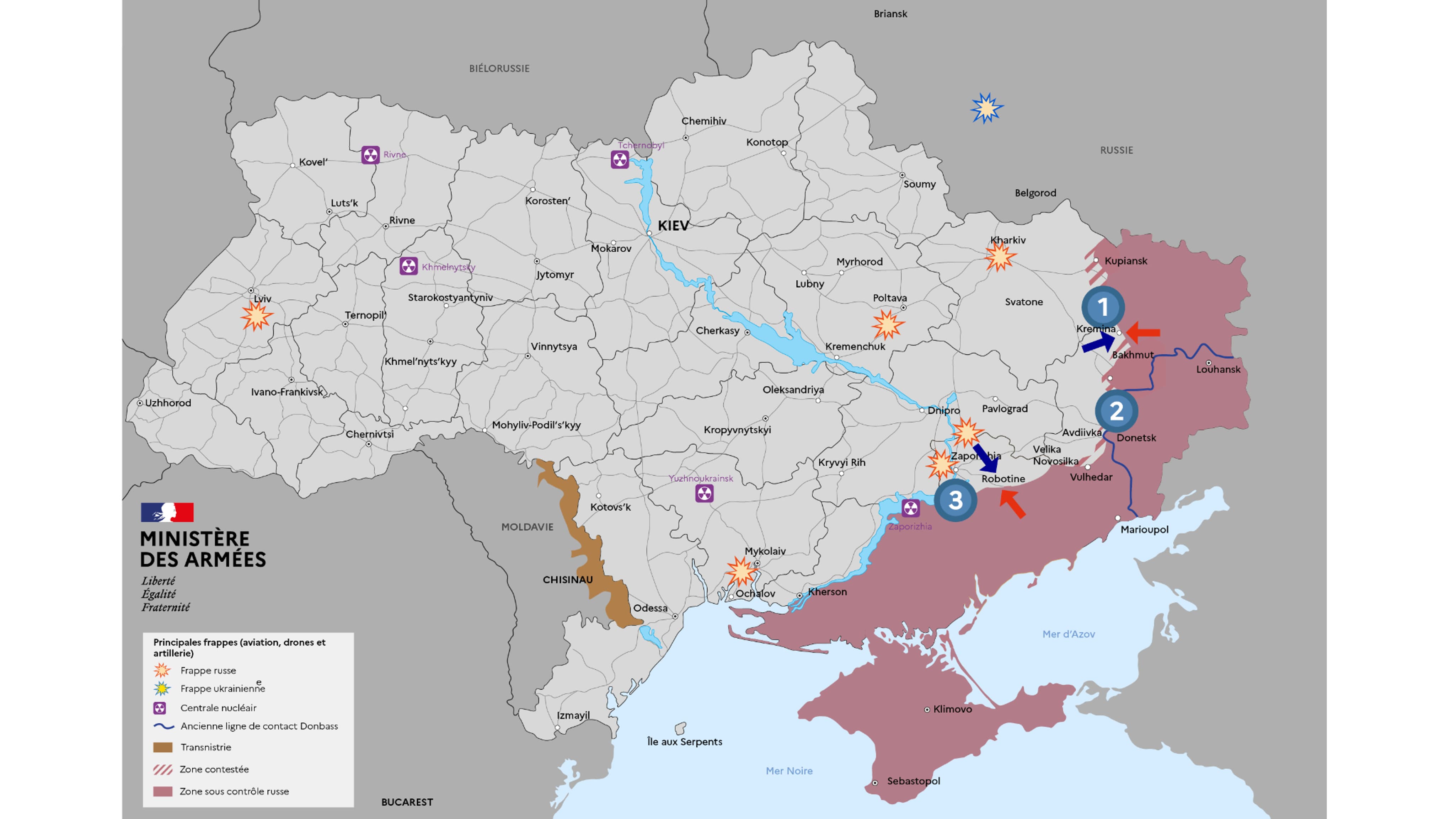
Ukraine, which gained independence in 1991, is the second-largest country in Europe by area and is not a member of the European Union, according to 20 Minutes.
The independence of Ukraine was a direct result of the dissolution of the Soviet Union in 1991. Geopolitically, Ukraine occupies a significant position due to its vast agricultural land, often referred to as the “breadbasket of Europe,” and its role as a transit corridor for energy resources. Its location bordering both the European Union and the Russian Federation places it at the center of regional security discussions.
Tensions in Crimea and the Donbass
The current conflict follows years of tension, including the 2014 annexation of Crimea by the Russian Federation, according to 20 Minutes. This followed the Maidan revolution, which resulted in the removal of the pro-Russian leader Viktor Ianoukovytch, according to 20 Minutes.
The events of the Maidan revolution, also known as the Revolution of Dignity, were driven by protests regarding Ukraine’s political direction and its relationship with the European Union. This period of political upheaval created a vacuum that preceded the subsequent shifts in territorial control in the Crimean Peninsula and the eastern regions of the country.
An armed conflict also emerged in the Donbass region in 2014. In that area, pro-Russian separatists demanded independence from Ukraine and annexation to Russia, according to 20 Minutes. A resolution attempt, the Minsk protocol, was signed on September 5, 2014, by Ukraine, Russia, and the separatists, but it failed to lead to a durable resolution of the crisis, according to 20 Minutes.
The Minsk agreements, which included the initial protocol in 2014 and a subsequent follow-up in February 2015, were intended to establish a ceasefire and provide a framework for political settlement in the Donbass. However, the implementation of these agreements remained inconsistent, with frequent reports of ceasefire violations. The failure to achieve a lasting peace through these diplomatic channels meant that the Donbass remained a site of active, low-intensity conflict for several years prior to the full-scale invasion in 2022.
A critical component of the diplomatic history in this region is the 1994 Budapest Memorandum. Under this agreement, Ukraine agreed to relinquish its nuclear arsenal in exchange for security assurances from the Russian Federation, the United States, and the United Kingdom, who committed to respecting Ukraine’s existing borders and sovereignty.
The evolution of modern warfare
War is defined as an armed conflict between organized political groups, such as states, according to Wikipedia. In the 21st century, the nature of warfare has expanded to include hybrid warfare and cyberwarfare, according to Wikipedia.
Hybrid warfare involves the integration of conventional military force with non-kinetic methods to achieve strategic objectives. These non-kinetic methods frequently include disinformation campaigns designed to influence public opinion, economic coercion, and the use of irregular or proxy forces. By blurring the lines between peace and war, hybrid tactics aim to destabilize an adversary from within while complicating the international community’s ability to define and respond to an act of aggression.
Cyberwarfare is a specific subset of these modern conflicts, focusing on attacks against an opponent’s digital infrastructure. This can include targeting government networks, electrical grids, financial systems, or communication channels. In contemporary conflicts, the ability to disrupt an adversary’s ability to command and control their forces through digital means is considered as significant as traditional kinetic strikes.
